
What is storytelling marketing?
Storytelling marketing (also known as narrative marketing) is an approach to communication in which a brand structures its message as a story – with a protagonist, context, a conflict or need, and a clear resolution. In event marketing and at trade shows, storytelling helps turn an offer into an experience: instead of a list of features, visitors get a narrative about the problem, the change, and the outcome your product or service enables.
In physical spaces – at a trade show booth (exhibition stand), in a showroom, or during a roadshow – storytelling marketing connects visuals, spatial layout, team messaging, and visitor interactions into one coherent journey. This makes brand touchpoints more memorable, easier to repeat in a sales conversation, and more effective for building brand image.
What are the main goals of storytelling marketing?
In offline activities, storytelling acts as the “script” for the entire brand experience – from the first glance at the booth structure to the conversation and the take-home materials. The most common goals include:
- simplifying a complex offer by placing it in a clear, real-world use context,
- building brand recognition and consistency through repeatable themes, language, and visual elements,
- strengthening trust by presenting proof, processes, and outcomes in a logical sequence,
- increasing visitor engagement through interactive elements and needs-based conversations,
- aligning booth design with sales, educational, or branding goals rather than displaying content at random.
What are the benefits of storytelling marketing?
In trade show practice, storytelling works because the human brain encodes information better in cause-and-effect structures than in a catalog of features. A narrative focuses attention, supports episodic memory, and makes it easier to recall your message after the event – crucial for lead nurturing and sales follow-up.
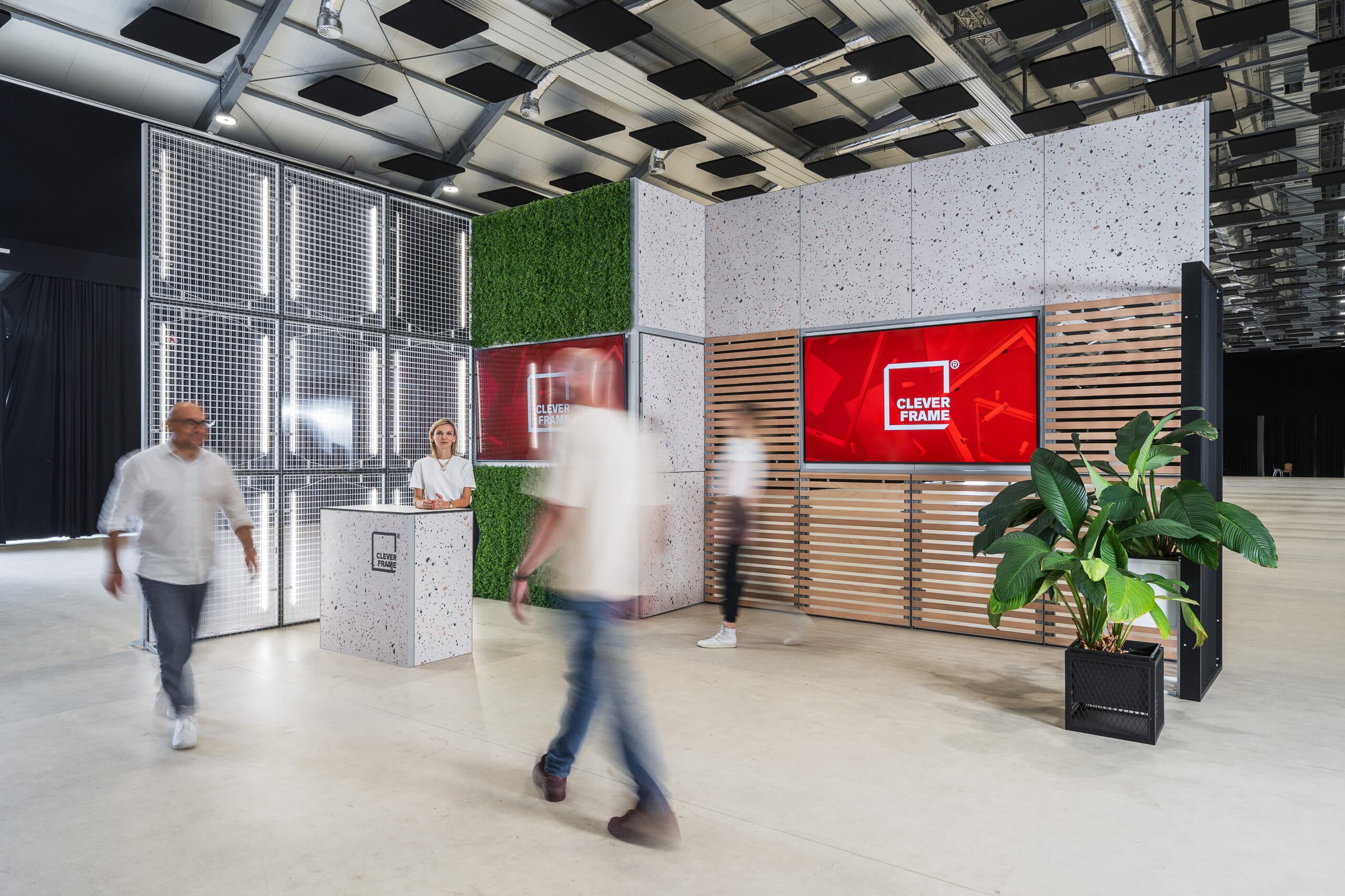
Benefits for the booth and event also include stronger consistency between creative, staff performance, and display elements. When the story is clearly defined, it’s easier to plan visitor flow (the direction and pace of movement), set the sequence of messages, and choose the right touchpoints: a demo, consultation, sample, presentation, or newsletter sign-up. With Clever Frame trade show booths, an additional advantage is the ability to quickly swap magnetic graphic panels mounted on frames – so you can keep the same booth architecture while adjusting the narrative layer for specific personas, industries, or seasonal campaigns.
What are the challenges and limitations of storytelling marketing?
The most common risk is “story for story’s sake”: a narrative that’s compelling but disconnected from the offer and what visitors actually expect. At trade shows, people have limited time, so your story needs a short version (a few seconds) and a deeper version (a conversation, demo, or case study). Another challenge is keeping the narrative consistent across channels: event announcements, on-booth messaging, post-meeting materials, and the sales team’s outreach.
Limitations also come from space and logistics. If the display layout doesn’t support the intended sequence, visitors “lose the thread.” Too many messages on graphic panels distract rather than clarify, and unclear calls to action reduce conversion. Finally, storytelling requires team preparation – the same terms, examples, and brand promises must sound consistent in conversations led by different people.
How is storytelling marketing used at trade shows and events?
At a trade show booth, the story should be visible on three levels: the spatial layout (what visitors see first), visual communication (which headlines and images dominate), and interactions (which questions lead to the next step). When designing the narrative, it helps to think of the visitor journey as a sequence of scenes: interest, needs clarification, credibility proof, and a next-step proposal.
This fits the Clever Frame modular booth system through its modular design based on frames connected with connectors, making it easier to adapt the layout to the venue and communication goal. Tool-free assembly and disassembly support repeatable event execution and fast configuration changes throughout the trade show season, while magnetic graphic panel mounting enables quick story updates without rebuilding the structure – for example, for a product launch, a different audience segment, or a shift in messaging priorities.
What are practical examples of storytelling marketing?
Event storytelling performs best when it’s operational – meaning it translates into specific design and conversation elements. Examples include:
- a “problem – risk – solution – outcome” narrative presented across consecutive display zones, from broad context to a demo,
- a customer story (case study) broken into short messages that guide visitors from a challenge to a measurable result,
- a product story based on a usage scenario, where booth elements direct visitors to the next information in a logical order,
- narrative versions tailored to audience segments via interchangeable graphic panels while maintaining consistent visual identity,
- a roadshow where the core brand story stays the same, while the modular booth layout adapts to different spaces and organizational constraints.
See also
- Event storytelling
- Storydoing
- Experiential marketing
- Emotional marketing