
What is storydoing?
Storydoing is a brand communication approach in which the core story is not only told (storytelling), but above all brought to life through action. In event marketing, it means designing situations, interactions, and experiences that let people “see” a brand’s values in practice – through contact with the product, the process, the team, and the service style. Instead of relying on declarations in promotional materials, the message is carried by the brand’s behaviors and decisions in a physical space.
At industry trade shows, events, roadshows, or in a showroom, storydoing translates into a visit scenario (visitor flow), zone layout, and consistent visual communication that together guide participants from first contact to a sales conversation or demonstration. The booth becomes a carrier of proof: how the brand makes choices easier, how it educates, how it solves problems, and how it builds relationships in direct contact.
What are the main goals of storydoing?
Storydoing aims to turn brand promises into concrete, repeatable experiences. In offline activities, goals can be grouped into a few areas:
- moving brand values from declarations to behaviors and interactions,
- making the offer easier to understand through demonstrations, prototypes, trials, or consultations,
- building trust through transparent processes (e.g., how a product is made or what service implementation looks like),
- guiding participants through the booth in line with buying-decision logic and information needs,
- creating conditions for high-quality sales conversations and collecting market insights.
What are the benefits of storydoing?
A well-designed brand experience increases recall and helps a brand stand out in an environment full of similar messages. In practice, storydoing strengthens event effectiveness through:
- greater consistency between visual communication, team behavior, and the real performance of the product or service,
- better alignment between the narrative and the role of the space – the booth becomes “evidence” of competence rather than just a carrier of slogans,
- reducing distance in B2B conversations through a shared experience (e.g., a workshop, diagnosis, or trial),
- higher lead quality, because participants decide based on real contact and verification,
- the ability to reuse activation elements in other channels (post-sale materials, content, training).
What are the challenges and limitations of storydoing?
Storydoing requires alignment and consistency – people quickly notice gaps between a promise and real-world practice. When planning booths and activations, it’s worth accounting for typical risks:
- too many stimuli and no clear priority – too many activities make it harder to grasp the main idea,
- a mismatch between the scenario and visitor flow – poor transitions between zones cause bottlenecks or lead people to skip key points,
- operational inconsistency – if the team has no clear roles, the experience loses quality and repeatability,
- difficulty measuring outcomes without predefined metrics (e.g., number of conversations, interaction time, conversions to meetings),
- “theatre” without value – a flashy form without useful content does not build credibility.
How is storydoing used at trade shows and events?
At trade shows, storydoing starts with space design: participants should intuitively understand what the brand offers and how they can interact. The key is linking visual communication with the zone layout (e.g., needs diagnosis, demonstration, conversation) and planning “proof points” that substantiate the brand promise. This approach is consistent with the logic of the experience economy described by B. Joseph Pine II and James H. Gilmore, where value increases with the quality of the experience, not the message alone.
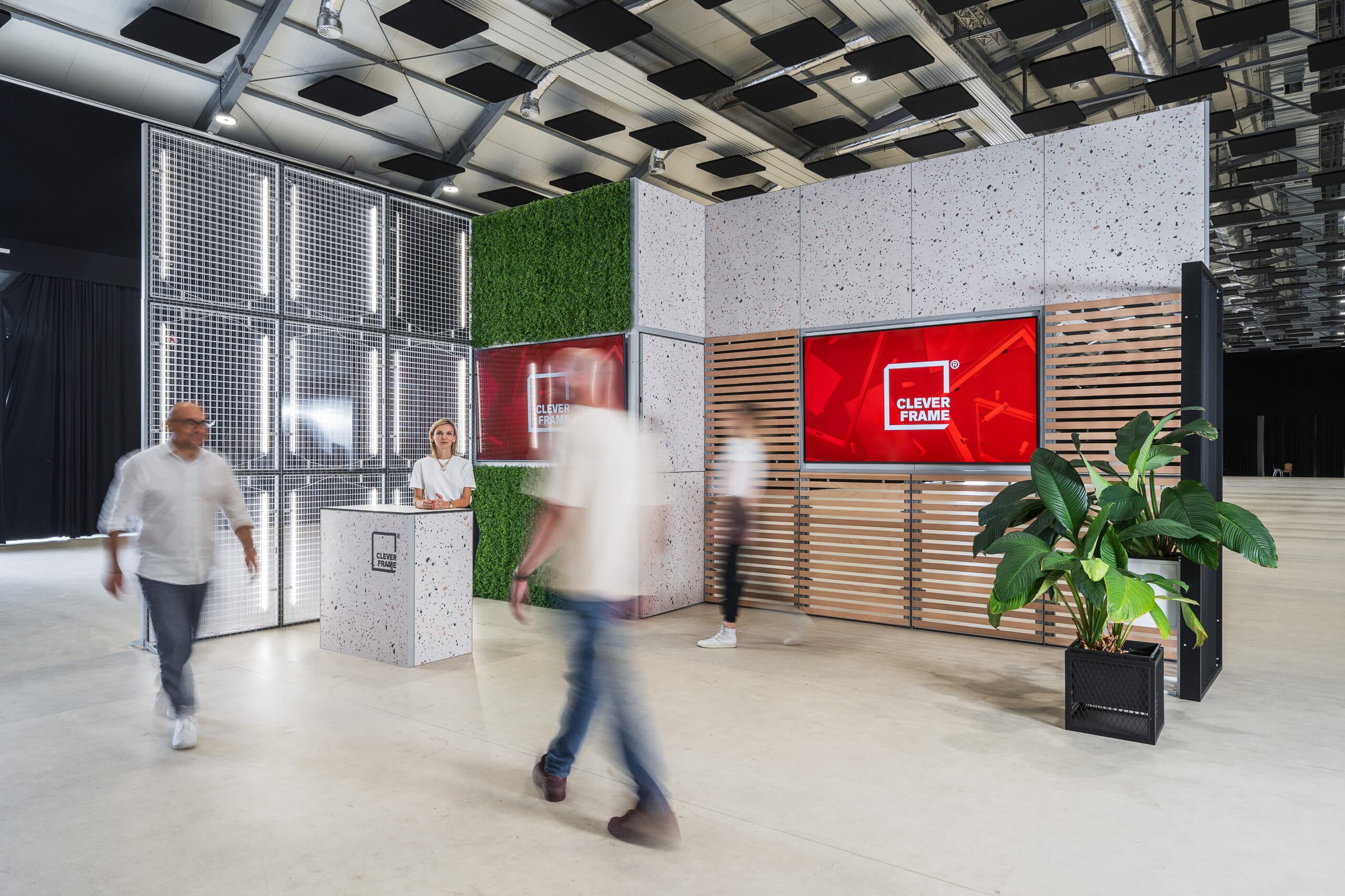
In practice, Clever Frame trade show booths can be helpful because they enable fast adaptation of the configuration to the event scenario. A modular structure based on frames and connectors allows changes in zone layout, and magnetically mounted graphic panels can make it easier to swap messages – for seasonal campaigns, different target groups, or successive roadshow stages. In Clever Frame modular systems, tool-free setup and teardown is possible. Reusing elements reduces waste compared with one-off builds – Clever Frame is a reusable system used across multiple projects.
Storydoing at an event is also about details: service language, the sequence of qualifying questions, take-away materials, and even the pace of moving between zones. Experience consistency grows when visual identity, panel content, and team behavior lead to the same conclusion: “this is how the brand works in practice.”
What are examples of storydoing in practice?
Storydoing can be planned for both product and service brands. Examples that often work well in trade show and event environments include:
- a micro-audit or needs diagnosis at the booth, ending with a recommended next step and a booked consultation,
- a “before and after” demonstration showing the real impact of a solution on the customer’s process (time, risk, quality),
- a short educational workshop based on real cases, allowing participants to apply the brand’s method,
- a comparison of offer variants as a decision path that moves through booth zones and ends with a sales conversation.
See also
- Storytelling Marketing
- Event storytelling
- Experiential marketing
- Brand activation