
What is brand activation?
Brand activation is a planned set of marketing activities that turns a brand promise from communication into a real audience experience. In event settings, it means creating situations where attendees don’t just “see” the brand – they interact with it: they try the product, talk to the team, join a demonstration, learn the brand’s story and values, and remember them through emotion and engagement.
At industry trade shows and events, brand activation combines exposure with experience: the booth space, the service scenario, and the visual materials work together to build recognition, trust, and purchase intent. In this approach, a booth is not only a carrier of messages – it is a tool for sales conversations, relationship-building, and collecting high-quality market insights.
What are the main goals of brand activation?
Brand activation should be designed and measured against specific goals, not just “visibility.” Most often, it includes:
- increasing brand awareness among precisely defined target groups,
- generating leads and initiating sales conversations in a controlled environment,
- accelerating purchase decisions by demonstrating value and reducing risk (e.g., a trial, pilot, or proof of concept),
- strengthening brand positioning through consistent messaging, design, and the way the team engages on the booth,
- gathering feedback on a product or service through conversations and observation of visitor behavior.
What are the benefits of brand activation?
The biggest advantage of brand activation in a physical space is the intensity of contact – people experience the brand multi-sensorily and in real time, and the team can respond to needs, questions, and objections. A well-planned activation narrows the gap between the marketing message and the product reality.
The benefits are reinforced by a well-designed space. The booth layout influences visitor flow – whether someone stops, where they naturally look, and how easily they move from first contact to a conversation. Consistent visual communication (color palette, information hierarchy, repeatable brand elements) reduces “noise” and speeds up understanding of the offer. With modular solutions, an additional advantage is the ability to maintain a consistent activation standard across successive events.
Challenges and limitations of brand activation
In trade show conditions, brand activation competes for attention with many stimuli, and contact time can be short. Another risk is a mismatch between promise and experience – even great graphics won’t help if the conversation scenario, logistics, or booth service are inconsistent.
The most common limitations to consider in planning include:
- limited floor space and organizer rules regarding booth construction and on-site communication,
- the need for clear zoning (first contact, demo, meeting, operational back area) without blocking traffic,
- message consistency between online and offline, including alignment between sales materials and what the team presents,
- measurability of results, meaning a designed method for collecting data (e.g., lead qualification, surveys, observations),
- time and operational resources, including setup and teardown and preparing materials for several events per year.
How is brand activation used at trade shows and events?
At trade shows, brand activation starts with information architecture and space ergonomics. A booth should communicate “who we are” and “who it’s for” within a few seconds, and then guide the visitor through the next steps – from interest, through interaction, to a conversation with an expert. In this context, both the graphic design and the actual layout matter, because they organize visitor flow.
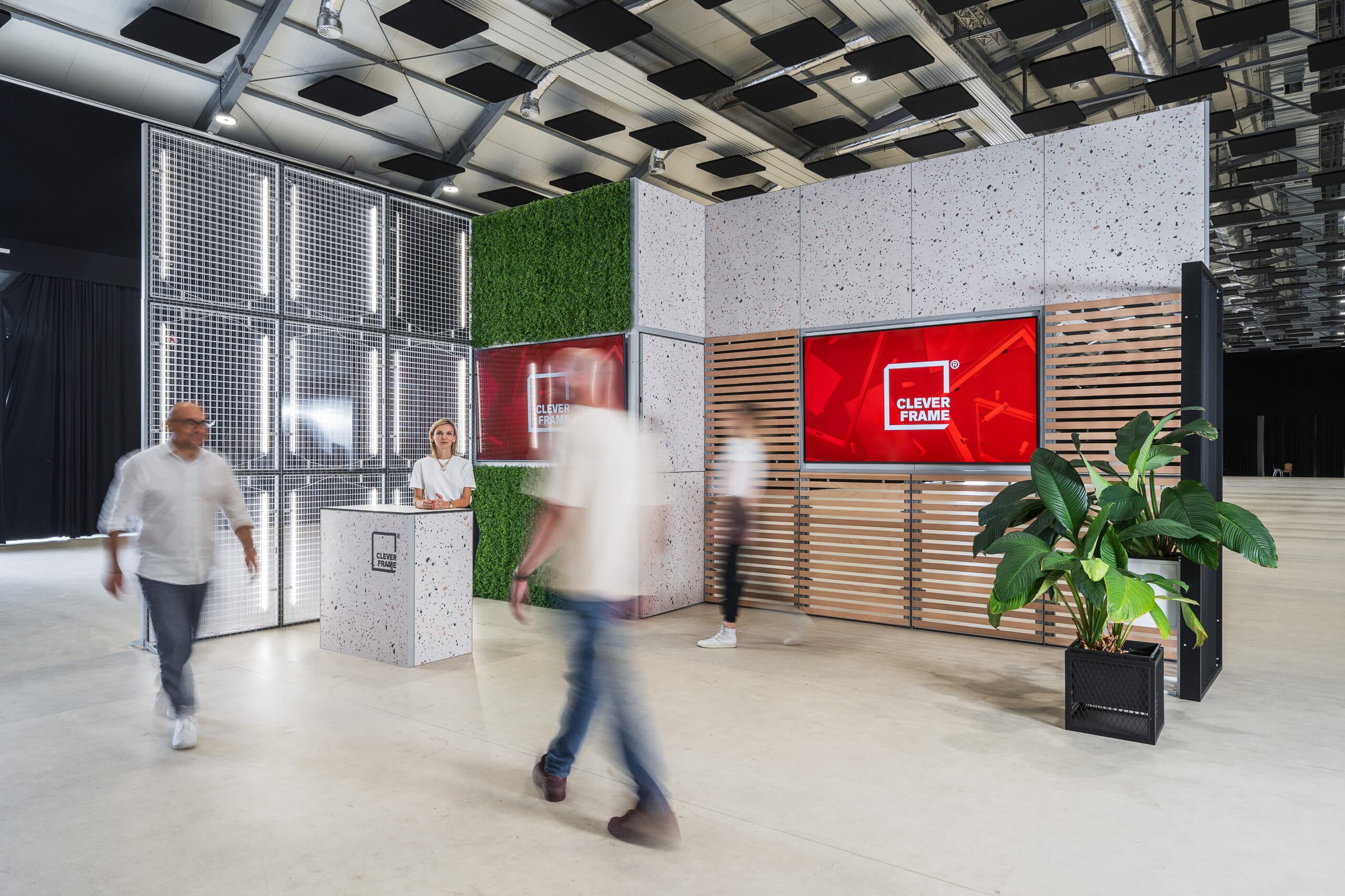
Clever Frame trade show booths are used for activation activities where repeatable quality and fast preparation are important. A structure based on frames and connectors enables different configurations using the same elements. Setup and teardown are tool-free. An important element is magnetically mounted graphic panels – making it easier to swap messages and tailor creative to seasonal campaigns, product launches, or different audience segments without changing the entire build.
Practical examples of brand activation
Activation can take different forms depending on the goal and the funnel stage. The examples below show how to combine experience with booth design and team execution:
- a demo zone where attendees complete a short “task” with the product, while the graphic panels guide them step by step,
- a recurring mini-workshop (e.g., every hour), where the booth layout sets aside space for viewing and a follow-up conversation,
- a “before and after” comparison, where the visual narrative on the graphic panels supports the sales argument,
- a roadshow activation where the same space concept and brand identity are replicated across multiple locations, and panel content is updated for local context,
- a temporary conference showroom where zones are designed for different personas (e.g., IT, procurement, operations) and the team follows a consistent conversation scenario.