
What is event gamification?
Event gamification is the design of attendee experiences using game mechanics such as goals, challenges, points, levels, badges, competition or collaboration, and feedback. In event marketing, gamification structures brand interactions into a clear action path – so attendees don’t just “watch,” but complete tasks, make decisions, and return for the next steps.
At trade shows and in face-to-face marketing, event gamification supports the brand experience, makes it easier to present products and services, and improves the quality of contact in a physical environment. A well-designed game mechanic connects a business goal (e.g., lead qualification) with an attendee goal (e.g., gaining knowledge, solving a problem, testing themselves). This strengthens message recall and helps guide people through the booth or an activation zone.
What are the main goals of event gamification?
Gamification at an event is not “an attraction for the sake of it.” It should follow the brand’s objectives, the spatial layout, and the planned visitor flow – how participants move between touchpoints.
- increasing engagement and time spent in the brand area through a series of micro-interactions,
- making sales conversations easier by creating a natural reason to connect and an organised path of questions,
- delivering product education through tasks, tests, and demonstrations that help verify understanding of key features,
- collecting qualitative and quantitative data about participant needs, for example through quiz choices and form declarations.
What are the benefits of event gamification?
The benefits come from the psychology of motivation and learning – game mechanics can support a sense of competence, autonomy, and relatedness (described, among others, in Deci and Ryan’s Self-Determination Theory). This encourages active participation and better retention of information.
- better lead quality, because tasks and stages make it easier to match participants to the right offer or the right team member faster,
- stronger recognition of key messages when the visual identity and game instructions are clear across the entire space,
- greater control of visitor flow, because challenges can “lead” participants through successive zones and reduce congestion at a single point,
- better event metrics such as dwell time, number of conversations, completed tasks, badge scans (where permitted), or post-meeting surveys.
Challenges and limitations of event gamification
Gamification must be designed at the intersection of brand strategy, spatial UX, and event logistics. Limitations usually appear when the mechanic is not matched to booth realities and visitor behaviour.
- overly complex rules that extend onboarding and discourage participation in trade show conditions,
- lack of consistency between the game promise and the actual experience, e.g., unclear messages or inconsistent visual execution,
- the risk of queues and blocked walkways if tasks don’t account for throughput and stopping points,
- legal and operational requirements, including personal data protection (GDPR), marketing consents, data minimisation, and clear contest rules.
How is event gamification used at trade shows and events?
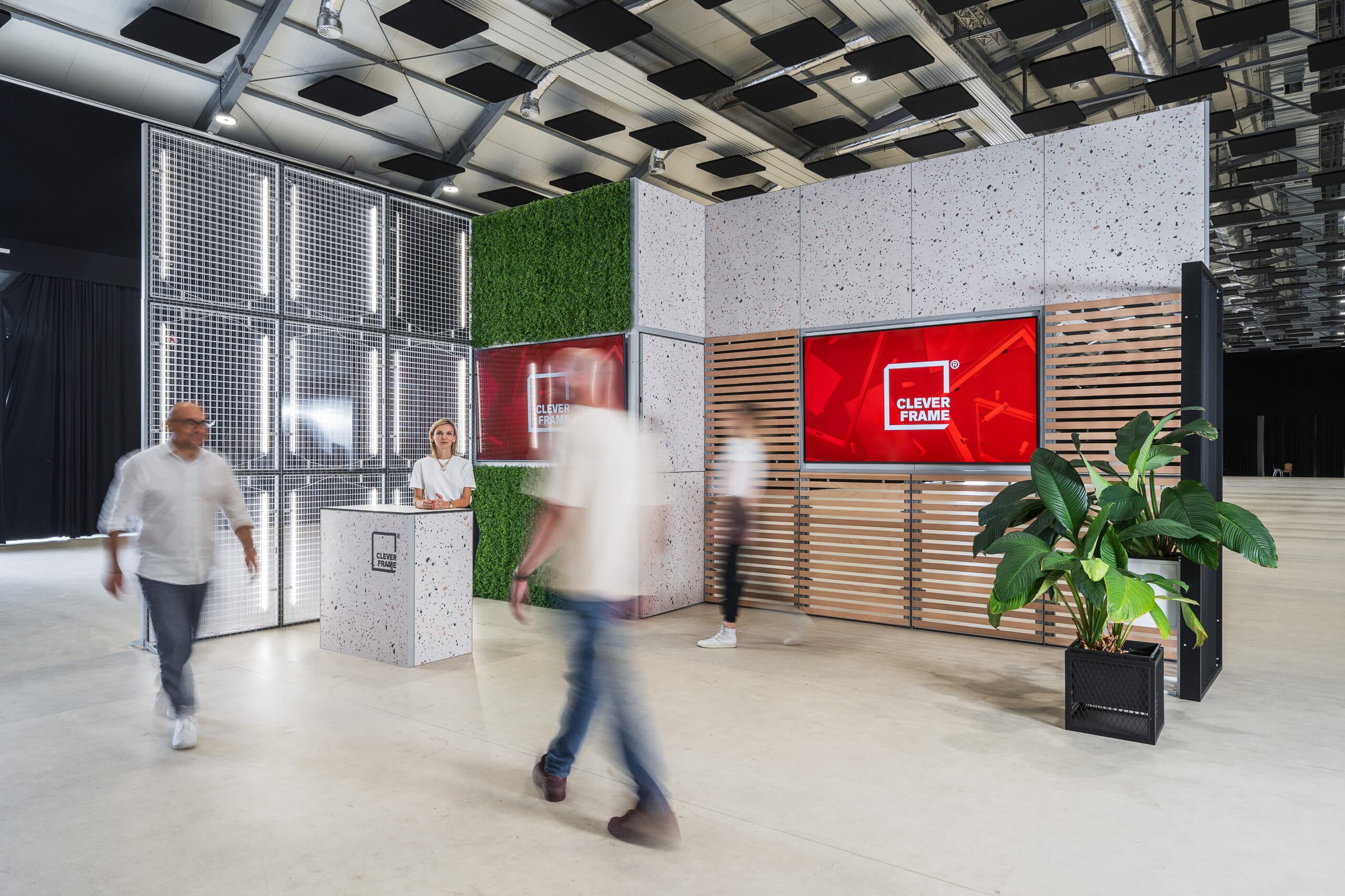
At a booth, space plays a key role: zones should support successive stages of the activity – from quick attention capture, through interaction, to conversation and sharing contact details. Clever Frame trade show booth layouts support this kind of planning: the system offers a modular structure that enables reconfigurations for different event formats, as well as efficient setup and teardown.
In practice, game mechanics can be embedded into the booth’s navigation and information elements so participants intuitively understand what to do next. It’s worth using easily replaceable graphic panels that enable quick changes to messaging and instructions, adapting them to seasonal campaigns or shifting priorities across events. This supports consistent branding while helping reduce single-use materials – important in the context of sustainability.
Gamification can also work well beyond trade shows – in showrooms, roadshows, and demo zones – because the “game” can be transported between locations. Modular structures help maintain a repeatable standard of brand experience despite differences in floor space or room layout.
Practical examples of event gamification
The examples below show how to connect game mechanics with marketing goals and the attendee journey without overloading the space.
- a “find the right solution” diagnostic quiz where participants answer a few questions and the result guides them to the right conversation or demonstration,
- a “get to know the product in 3 steps” task path, where each stage is linked to a specific benefit and a short presentation,
- an industry competence challenge, such as a mini case study solved with expert support, ending with a summary and a resource to download,
- a collaboration-based team game in which participants collect clues at different points in the zone and complete the final step through a consultative conversation.
In each variant, it’s worth planning success metrics in advance – for example, the number of tasks started and completed, the conversion rate to a sales conversation, and the quality of the data captured during the activity. That way, gamification stops being an add-on and becomes a measurable element of event marketing.