
What is a visitor engagement strategy?
Visitor engagement strategy is a plan designed to encourage trade show or event participants to interact with a brand in a physical setting – at a booth, in a showroom, during a roadshow, or in a demo zone. It covers both experience design (spatial layout, visual communication, conversation scenario) and the tools that support contact (product demos, consultations, activations, lead capture, and informational materials).
In practice, a visitor engagement strategy combines event marketing, sales, and branding: it helps attract attention, maintain interest, make the offer easier to understand, and move people to the next step in the funnel (a meeting, an offer, a trial, or follow-up). A key element is matching the approach to the event context and audience profile, while keeping the message consistent at every brand touchpoint.
What are the main goals of a visitor engagement strategy?
The goals of a visitor engagement strategy should follow from the role of attending the event (brand-building, sales, or education) and the success criteria defined before the event. Most often, they include:
- increasing the number of high-value contacts through conversation qualification and lead capture,
- improving conversation quality through clear messaging and easy-to-follow presentation scenarios,
- extending interaction time (dwell time) through engaging yet substantive touchpoints with the offer,
- building a memorable brand experience through consistent visual cues and a benefits-led language,
- enabling smoother follow-up by collecting conversation context and ensuring GDPR-compliant data processing (including the appropriate legal basis and information obligations).
What are the benefits of a visitor engagement strategy?
A well-designed strategy increases the effectiveness of trade show participation by aligning team actions and enabling comparable measurement across events. The key benefits include:
- better use of booth traffic by planning visitor flow and “pause points” (e.g., a demo, a consultation, quick qualification),
- more consistent visual communication when key visuals and headlines guide visitors from interest to offer understanding,
- higher sales effectiveness by matching content to the visitor’s awareness level (from inspiration to specific requirements),
- easier scaling across locations when booth elements and service scenarios can be replicated and optimized,
- fewer “empty interactions” thanks to defined qualification criteria and clear next steps after each conversation.
Challenges and limitations of a visitor engagement strategy
A visitor engagement strategy requires balancing creativity with functionality. Constraints often come from venue conditions, participant behavior, and available team resources. In practice, common challenges include:
- crowding and noise, which make conversations harder and reduce presentation quality,
- short attention spans that require a simple message and a fast “first step,”
- inconsistent communication when graphics, presentations, and sales narrative are not aligned,
- difficulty measuring outcomes without predefined KPIs (e.g., qualified conversations, demos per hour, conversion to meetings),
- the risk of collecting or using data without clear rules, meeting information obligations, and having the appropriate legal basis (under GDPR), which requires procedures and an organized lead-capture process.
How is a visitor engagement strategy used at trade shows and events?
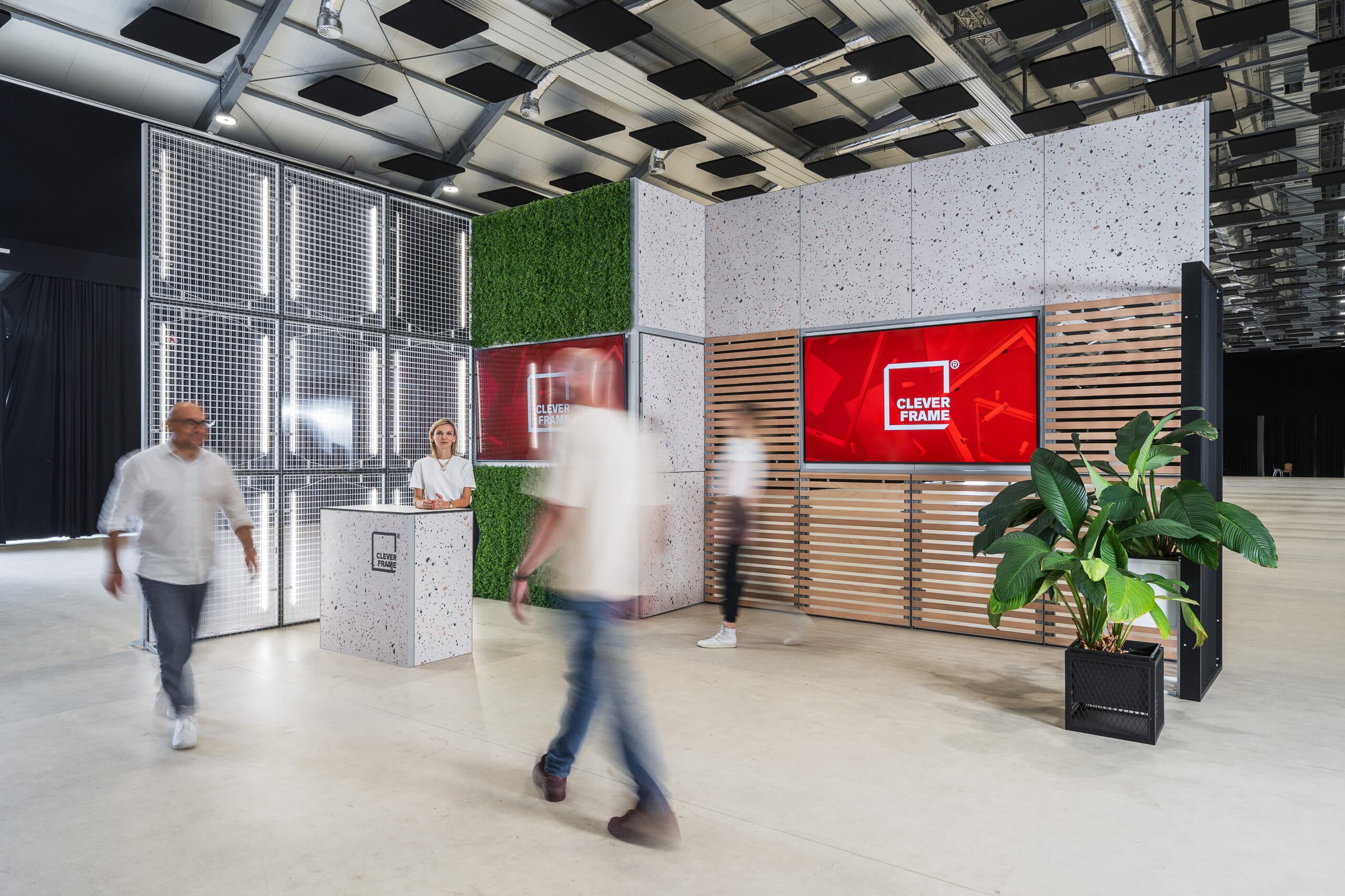
At offline events, what matters most is how the space supports visitor behavior. The booth layout should create a natural path: noticing the brand, understanding the value proposition, interacting with a product or expert, and deciding on the next step. In this context, Clever Frame trade show booths can work well – modular construction makes it easier to adapt the configuration to the floor area, goals, and traffic intensity, and a fully tool-free system enables fast setup and teardown.
The visual layer is equally important. Consistent messaging on graphic panels helps “anchor” the topic of the conversation quickly. A system that uses magnetic tape or hook-and-loop fasteners (Velcro) enables quick and easy graphic swaps and efficient adaptation of messaging to seasonal campaigns or changing offer priorities. This supports an agile approach to event marketing: testing messages, iterating, and updating materials without rebuilding the entire booth concept.
In many industries, engagement strategy also includes sustainability-related elements: reusing build components across projects, reducing single-use waste, and improving logistics planning. Modularity supports a longer display lifecycle, which can translate into a lower need to produce new elements for every event.
Practical examples of a visitor engagement strategy
Tactics should be selected based on whether the event is sales-driven, brand-focused, educational, or recruitment-oriented. Examples of actions that can be planned as part of an engagement strategy include:
- a quick needs-diagnosis zone where the team asks a few standardized questions and directs visitors to the right section of the display,
- a product demo scenario in two time variants (e.g., 2 minutes and 8 minutes), adapted to traffic intensity,
- a “proof point” area with concrete evidence (case studies, samples, results, certifications) mapped to key customer objections,
- micro educational activations, e.g., short expert consultations with a clear CTA to schedule a post-show meeting,
- versioning visual communication across graphic panels to tailor messaging to different audience segments within one event cycle.
It’s worth adding a simple measurement plan: number of conversations, number of qualified leads, number of meetings booked, average interaction time, and the quality of follow-up data. This turns a visitor engagement strategy into an optimization tool, not just a set of one-off activations.
See also
- Visitor flow
- Customer engagement
- Audience activation
- Event gamification