
What is brand consistency?
Brand consistency is the consistent application of the same brand identity and communication rules across every audience touchpoint – from sales materials and digital channels to trade shows, events, showrooms, and roadshows. In offline settings, it means the brand looks, sounds, and “behaves” in a similar way regardless of the venue, the scale of the event, or the team delivering the booth.
At a trade show booth, brand consistency includes consistent visual communication (colors, typography, key visual, information layout), consistent content (brand promise, benefit-led language, CTAs), and a consistent experience (space organization, visitor flow, and the quality of conversations and demos). This helps people recognize the brand faster, understand the offer more easily, and connect what they experience at the event with what they see in other channels.
What are the main goals of brand consistency?
At events, brand consistency serves both brand and operational goals. In practice, it helps maintain a predictable standard of brand presentation under different conditions – from a small conference to a large industry trade show.
- increasing brand recognition through repeatable visual and communication elements,
- building trust through consistency of message and the quality of the visitor experience,
- reducing the time needed to understand the offer through a clear information hierarchy and consistent messaging,
- making sales and marketing teams’ work easier through clear display rules and conversation scenarios,
- maintaining campaign continuity (e.g., product or seasonal campaigns) in the offline channel as well,
- protecting the brand from message dilution when the booth is reused multiple times and in different configurations.
What are the benefits of brand consistency?
The most important benefit is a cohesive brand experience that strengthens recall and associations. At trade shows, people compare many companies in a short time, so consistent communication and presentation make it easier to quickly classify the brand and remember its differentiators.
In practice, brand consistency can improve lead and conversation quality: when messages are clear and repeatable, the team more often speaks with visitors whose needs are a good fit and spends less time explaining the basics. Consistency is also measurable operationally: it standardizes assets, shortens event preparation, and reduces the risk of print or content errors.
Challenges and limitations of brand consistency
Brand consistency can be difficult when a company operates across multiple markets and event formats vary (trade show hall, conference, showroom, roadshow). Constraints also come from logistics, timelines, available floor space, and different levels of experience among people implementing the identity on-site.
- brand guidelines that are too generic and don’t translate rules into booth realities (e.g., distance readability, message hierarchy),
- a conflict between the need for consistency and the need to localize the message (language, offer, industry context),
- inconsistent product and collateral display when there are no rules for what should be “front and center” and how to guide the narrative,
- campaign changes during the event season that require fast updates to messages and graphics,
- the risk of overloading the booth with content, which disrupts visitor flow and reduces message clarity.
How is brand consistency used at trade shows and events?
At events, brand consistency starts with spatial design: the booth layout, clear zones (e.g., conversations, demos, consultations), visibility of key messages, and a logical visitor flow. These elements influence whether visitors intuitively understand where to go, what to see, and what to ask about.
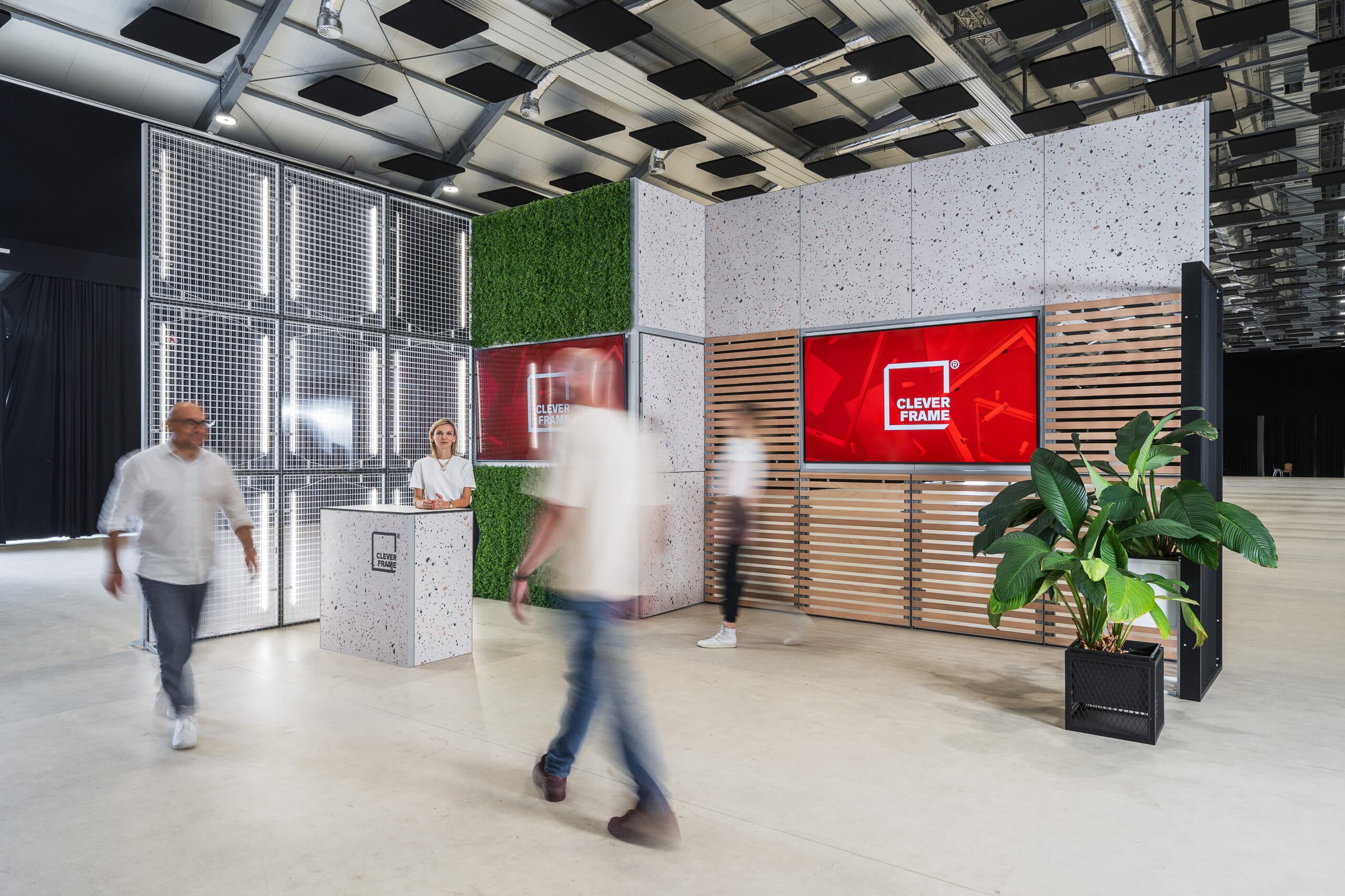
With Clever Frame trade show booths, it is easier to maintain consistency thanks to a modular approach to the structure and tool-free setup and dismantling. Repeatable frames and connectors allow teams to recreate a proven layout at subsequent events, while interchangeable graphic panels enable fast messaging updates (e.g., for seasonal campaigns) without rebuilding the entire display. This helps the brand keep stable identity elements while flexibly adjusting the message without changing the whole build.
Practical examples of brand consistency
Brand consistency is not about copying one identical design into every hall, but about maintaining stable rules for recognition and experience. In practice, it helps to describe consistency as a set of decisions that can be recreated across different footprints and event formats.
- using the same message hierarchy on the main display surfaces: brand promise, product category, 1-2 key advantages,
- maintaining a repeatable “spatial language,” meaning a similar zone layout and a clear visitor flow,
- consistently applying the key visual and color palette in areas visible from a distance,
- standardizing the product presentation style (e.g., the order of topics in a demo, the way features and use cases are described),
- planning a set of swappable graphic panels to quickly adapt the booth to a specific campaign or market,
- preparing short team rules: how to greet visitors, how to guide traffic, how to close a conversation, and how to invite the next step in the sales process.