
What is communication design?
Communication design is the planning and design of how a brand communicates with its audience through content, form, and experience – including visual communication, message language, information structure, and the way people are guided through a physical space. In offline settings such as industry trade shows, conferences, corporate events, showrooms, or roadshows, communication design links marketing goals with the realities of in-person contact: limited time, visitor traffic, information “noise,” and the need to understand an offer quickly.
In the context of trade show booths, communication design includes both the graphic layer (e.g., key visual, message hierarchy, consistency with brand identity) and the spatial layer: booth layout, zone clarity, the logic of visitor paths (visitor flow), and interaction points with the team. Well-designed communication reduces the distance between the brand and the audience, increases message recall, and supports specific tasks – from lead generation to product demonstrations.
What are the main goals of communication design?
Communication design structures the message so people quickly understand who they are dealing with, what the brand offers, and what the next step is. At a booth, the key is combining consistency with selection – not everything needs to be said at once, but what matters most should be visible and easy to understand.
- improving offer clarity through information hierarchy and reducing communication noise,
- building a consistent brand image through a coherent visual style and message language,
- guiding visitors through the space so they can easily find the right zone and conversation topic,
- triggering interaction – encouraging conversations, demonstrations, QR-code scans, or booking a meeting,
- supporting sales and event goals, e.g., lead acquisition and qualification, product launches, and market education.
What are the benefits of communication design?
The benefits are measurable both qualitatively (brand perception, consistency) and operationally (smoother booth traffic handling). Well-thought-out communication can reduce the load on the sales team, because some basic questions are “filtered” by clear on-site messaging.
- faster understanding of the offer and a higher share of valuable conversations,
- greater recognition thanks to consistent use of visual identity elements,
- a better visitor experience through logical zoning and clear wayfinding,
- easier scaling of communication across different event formats, from trade shows to roadshows,
- the ability to update messaging quickly – especially when a brand runs seasonal campaigns.
What are the challenges and limitations of communication design?
Communication design at events is constrained by limited attention time, movement patterns in the space, and environmental conditions. A common mistake is designing communication “as if it were for the internet” – too much content, too little hierarchy, and no priority for what must work in the first seconds of contact.
- too many messages that blur the brand’s core promise and make it harder to decide to approach,
- inconsistency between what is visible at the booth and what the team says or what the campaign promises,
- poor fit with visitor flow – graphics and information placed in the “wrong places” relative to traffic directions,
- a conflict between aesthetics and function, e.g., attractive creative without a clear CTA and without supporting the conversation,
- production and logistics constraints that require planning communication in advance.
How is communication design used at trade shows and events?
At trade shows and events, communication design should integrate content, graphics, and space. In practice, this means defining the main message (what the brand wants visitors to remember) and then breaking it down into levels of detail – from a headline visible from a distance, through short promises near the entrance, to content that supports conversations in meeting and demo zones.
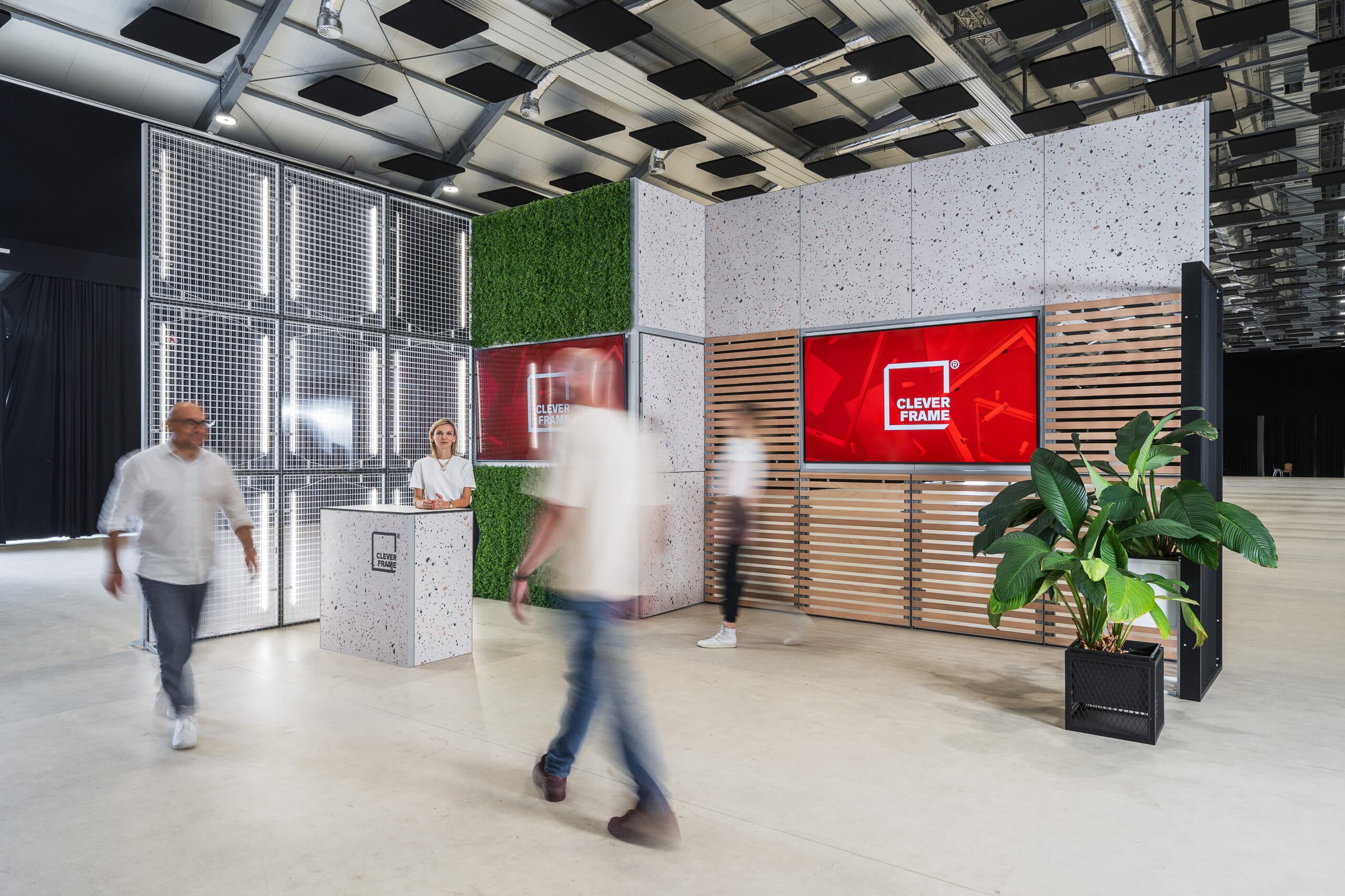
In Clever Frame trade show booths, communication design is supported by a modular, fully tool-free structure and solutions that enable fast swapping of graphic panels. The entire system is designed so setup, teardown, and modifications happen without tools. This makes it easier to manage communication across an event cycle: the same frames and connectors can be used across multiple builds, and graphic panels can be swapped efficiently to adapt the message to new products, segments, or campaigns. This approach helps maintain brand consistency while keeping communication highly flexible.
Examples of communication design in practice
Communication design is most effective when it follows the event goals and the visitor journey. The examples below show how to connect messages with booth layout and key touchpoints.
- content zoning: a headline and brand promise visible from main aisles, with offer details placed in conversation zones,
- a space-supported conversation scenario: demo areas with messages like “what you’ll see” and “who it’s for,”
- a consistent event kit: the same themes and naming across team materials, booth messaging, and post-event communication,
- campaign changes without rebuilding: keeping the booth structure and swapping graphic panels to refresh the message quickly,
- design for multiple formats: configuring booth elements for trade shows, showrooms, or roadshows while keeping the same communication logic.
See also
- Customer Experience Design
- Key visual
- Brand identity
- Brand consistency