
What is Brand Identity?
Brand Identity is a set of deliberately designed elements that define who a brand is, how it wants to be perceived, and how it communicates with its audience. It includes the visual layer (e.g., logo, colour palette, typography, overall design style) and the meaning layer (e.g., values, brand personality, tone of voice, brand promise). In offline environments, brand identity is “read” through the space itself, build quality and finishing details, team behaviour, and the overall quality of the in-person experience.
In the context of trade shows and event marketing, brand identity takes shape in how a trade show booth (exhibition stand) is designed, how it guides visitors (visitor flow), and how it supports conversations about the offer. Consistency across elements – from graphics on panels to the layout of meeting zones – drives recognition, trust, and recall after the event, and influences whether interactions with the sales team feel professional and aligned.
What are the main goals of brand identity?
Brand identity brings structure to communication and makes it easier to build a consistent image across multiple touchpoints, including physical spaces. Its most common goals include:
- increasing brand recognition through consistent use of visual and verbal cues,
- helping the brand stand out from competitors on a busy show floor where attendees compare many offers in a short time,
- building credibility through alignment between what the brand declares (e.g., its values) and what people experience at the event,
- making life easier for marketing and sales teams thanks to clear rules for communication and presenting the offer.
What are the benefits of brand identity?
A well-defined brand identity improves the effectiveness of event and sales activities by reducing randomness in design and communication decisions. In practice, it provides:
- a consistent attendee experience – from the event invitation, through the booth conversation, to post-show follow-up,
- clearer messaging – people understand faster who the brand is for and what it promises,
- higher-quality face-to-face engagement, because the space and materials support the sales narrative,
- easier scaling across multiple events thanks to repeatable rules for booth presence, display, and layout.
What are the challenges and limitations of brand identity?
Brand identity works only when it is implemented consistently and updated as strategy evolves. The most common challenges include:
- inconsistency between online and offline materials – for example, different promises in marketing content and a different way of speaking at the booth,
- too many messages in a limited space, which reduces clarity and disrupts visitor flow,
- difficulty maintaining build quality when displays change frequently or when there is time pressure before an event,
- a clash between aesthetics and functionality – when the design looks great but doesn’t support conversations, demos, and the team’s workflow.
How is brand identity used at trade shows and events?
At events, brand identity is not just “graphics” – it is a spatial experience blueprint. What matters most is the booth layout, the logic of how visitors move through the space, message visibility in the first few seconds, and the points where people interact with the team and the product.
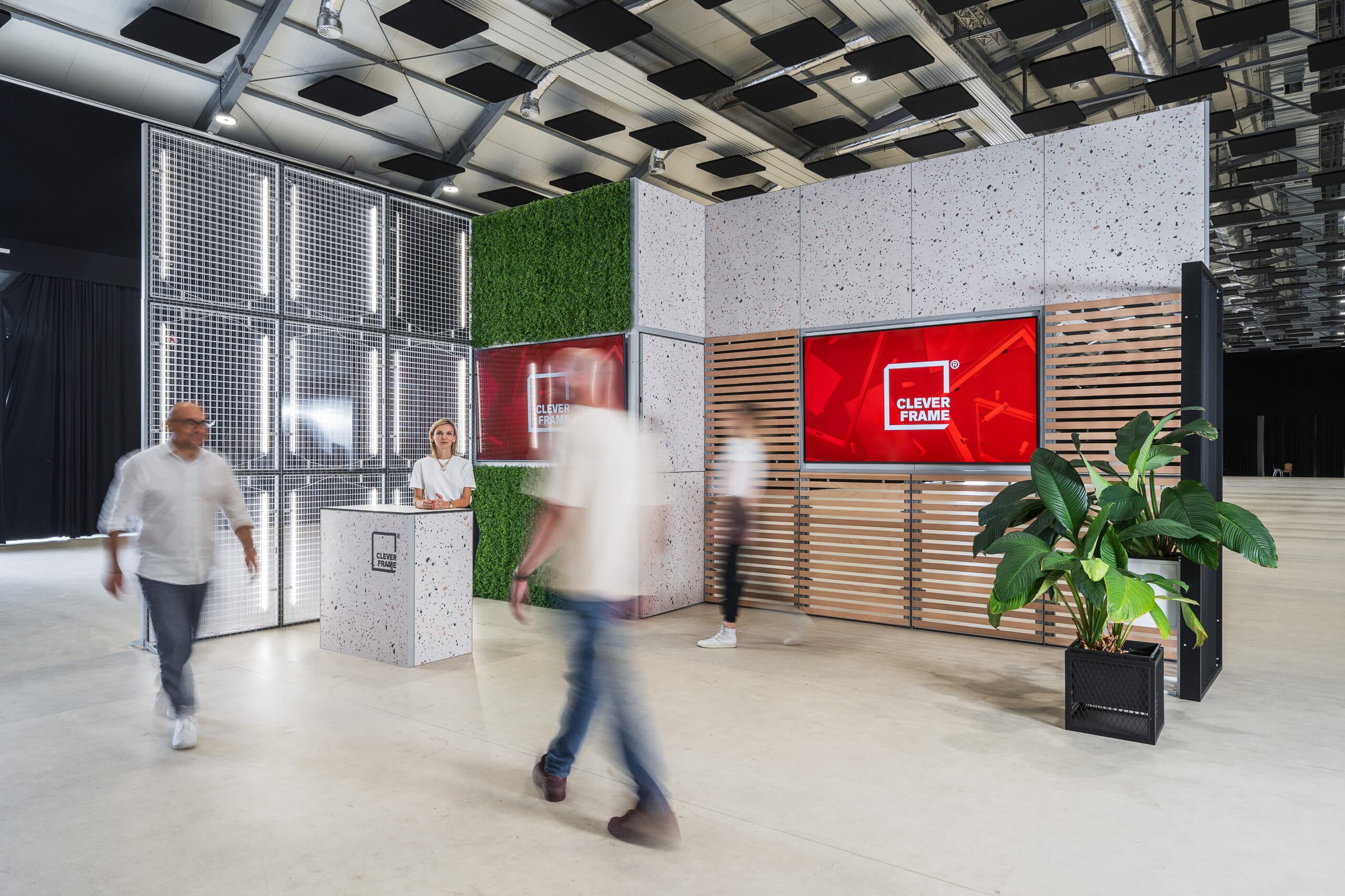
Clever Frame trade show booths support brand consistency through a modular build and the ability to plan repeatable zones (e.g., for conversations, presentations, consultations). Magnetic graphic panel mounting makes it easy to refresh messages quickly and align the exhibition stand design with a campaign, season, or specific event – without rebuilding the entire display. Tool-free assembly and dismantling helps maintain operational repeatability, especially across multiple trade shows, roadshows, or showroom presentations.
What are practical examples of brand identity in action?
Brand identity can be implemented through design decisions, content, and team behaviour. Examples of actions that genuinely shape brand perception during an event include:
- designing the welcome zone and first message so visitors understand the category and key advantage in 3-5 seconds,
- setting up the visitor path (visitor flow) to move from problem, to solution, to a conversation with an advisor,
- planning a consistent content hierarchy on panels: headline, benefit, proof, call to action,
- preparing graphic variations for different segments or languages to keep the same brand identity across audiences.
See also
- Modular trade show booth
- Event marketing
- Visitor flow
- Sustainability