
What is experience-led marketing?
Experience-led marketing is an approach in which the starting point for communication and promotional activity is the audience experience – intentionally designed across space, time, and interactions with the brand. In practice, it means building a contact scenario (from the first impression through the conversation and follow-up) so it reinforces offer understanding, trust, and associations with the brand’s values.
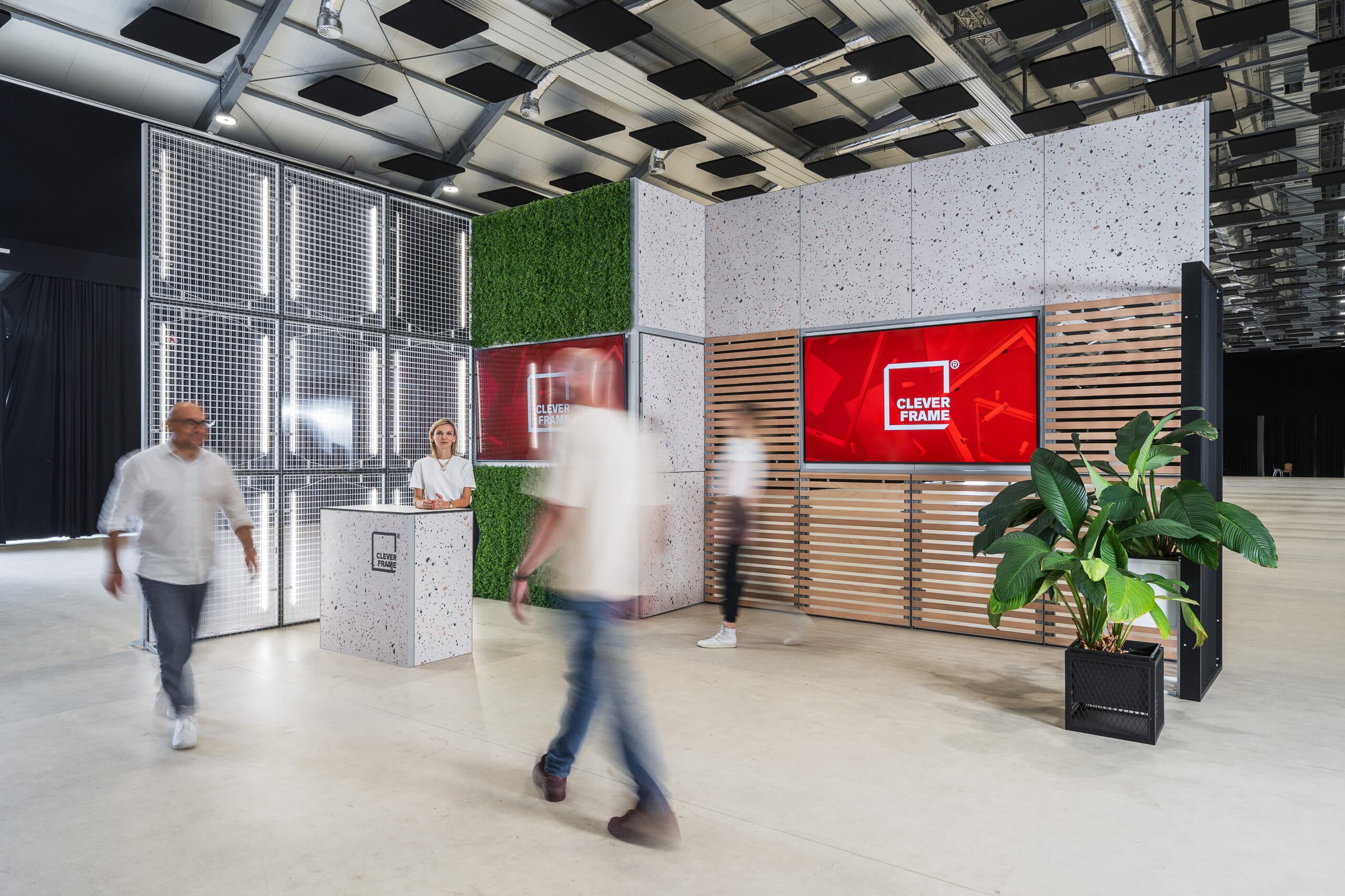
In event marketing and at industry trade shows, experience-led marketing connects booth design, staff execution, content, and engagement activities into one cohesive whole. The booth is not merely an information display, but an environment for conversations, demonstrations, product trials, micro-trainings, and solution comparisons – planned with visitor flow, message readability, and real-world interaction quality in mind.
What are the main goals of experience-led marketing?
The goals of experience-led marketing focus on what the visitor should understand, feel, and remember after direct contact with the brand. In offline activities, these goals typically include:
- shortening the path from interest to a sales conversation through clear entry points and readable messages,
- improving lead quality by matching content and activities to visitor intent,
- reinforcing brand differentiators through an experience aligned with the brand promise – not just declarations,
- making complex offers (e.g., technology or B2B services) easier to understand through demonstrations and use-case scenarios,
- building trust through knowledgeable staff, proof points (e.g., case studies), and transparent answers to questions.
What are the benefits of experience-led marketing?
The benefits come from the fact that experience can be a real differentiator in a market where many companies communicate similar promises. In the context of trade shows and events, an experience-led approach most often translates into:
- stronger brand recall thanks to multi-sensory cues and interactions embedded in a consistent narrative,
- higher visitor engagement because people become participants rather than passive viewers,
- more effective sales conversations when the space supports comfortable discussion, demos, and comparing options,
- greater messaging flexibility when graphics and key messages can be updated for different segments or event objectives,
- better efficiency of the exhibition investment when the booth can be reconfigured for different event formats and locations.
What are the challenges and limitations of experience-led marketing?
Experience-led marketing requires designing experiences like a product – with assumptions, testing, and iteration. Typical challenges include:
- the risk of inconsistency when booth design, content, staff execution, and follow-up do not form a single scenario,
- sensory overload when too many messages, screens, and activities are placed in a small footprint,
- maintaining interaction quality during high traffic, which requires a visitor flow plan and clear team roles,
- space constraints and venue rules that affect layout, accessibility, and logistics,
- measurement challenges if KPIs and data collection methods are not defined before the event.
How is experience-led marketing used at trade shows and events?
At trade shows, the experience is built primarily through space. The booth layout should guide visitors from the core message (what the company does and for whom), through clarification zones (products, benefits, proof points), to a conversation area. The pace of contact matters as well: one scenario works for someone walking by, and another for a visitor arriving with a specific buying problem.
Clever Frame trade show booths can make this approach easier to implement: their modular design allows you to adapt the layout to event goals and expected traffic. In Clever Frame modular systems, structural elements can connect without tools, which simplifies setup and teardown within trade show schedules. Graphic panels are mounted magnetically to the frames, so swapping them is fast and supports message updates – for example, for seasonal campaigns, a product launch, or different audience groups across consecutive events.
What are practical examples of experience-led marketing?
Experiences do not have to mean complicated attractions. The most effective ones solve a real visitor problem and lead to a clear next step. Examples used at trade shows, in showrooms, and during roadshows include:
- a “problem – solution – proof” path where visitors choose a challenge area and then move through a demo and a case study,
- a consultation zone with a quick needs diagnosis, after which the visitor receives a tailored recommendation and books the next conversation,
- 10-15 minute micro-trainings delivered in a recurring format, based on a repeatable script and consistent visual messages,
- comparing offer variants through a “conversation configurator,” where a sales rep walks the client through selection parameters,
- a roadshow version where the same set of modules and graphic panels supports a consistent brand experience across cities and venues.
In each case, it’s essential that graphic design, booth content, and team behavior come from one experience brief: what should happen in the first 30 seconds, what should support decision-making, and what should make post-event contact easier.