
What is customer-centric marketing?
Customer-centric marketing is an approach in which communication, offers, and brand experiences are planned around real customer needs, not around what a company wants to say or sell. In practice, it means designing touchpoints so they help customers make decisions, deliver value during the interaction, and build trust in the brand.
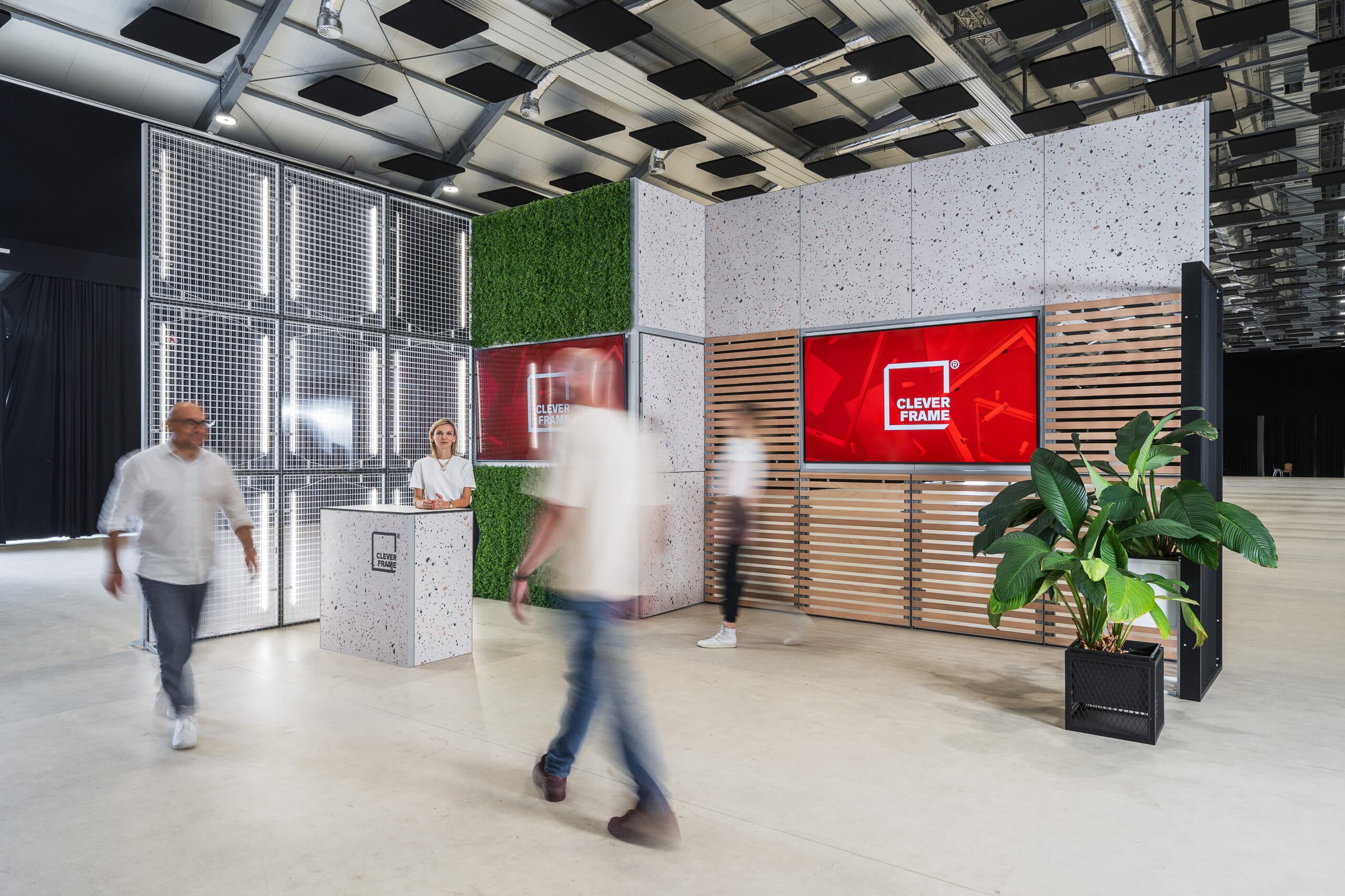
In event marketing and at industry trade shows, customer-centric marketing translates into intentionally shaping the booth space, interactions, and messaging. This includes clear wayfinding, a logical visitor flow, consistent visual communication, and conversation scenarios tailored to different visitor types (e.g., people comparing vendors, end users, partners). The booth becomes a tool that structures the brand experience in a physical environment, not just a place to display information.
What are the main goals of customer-centric marketing?
In offline activations, the goals of customer-centric marketing relate to both communication effectiveness and the quality of contact with visitors. Most often, they include:
- understanding the buying-decision context and the role of the event (e.g., lead generation, education, demos, relationship-building),
- making the brand’s messaging easier to navigate through a simple information architecture,
- improving the quality of sales conversations through better visitor segmentation and tailored messages,
- building a consistent brand experience at the intersection of space, people, product, and communication,
- collecting qualitative and quantitative data (e.g., question themes, barriers, intent) to optimize future activations.
What are the benefits of customer-centric marketing?
When the booth, content, and the team’s actions are designed from the visitor’s perspective, it becomes more likely that an event interaction ends with a concrete next step: signing up for a demo, downloading materials, scheduling a meeting, or submitting an inquiry. The benefits are visible both in performance and in how the brand is perceived:
- clearer offer understanding: visitors faster grasp who the solution is for and why it matters,
- a better conversation experience: fewer random interactions and more discussions based on real needs,
- stronger brand consistency: visual identity and messages remain aligned across all booth elements,
- higher operational efficiency: it is easier to plan team roles, materials, and engagement scenarios,
- more actionable post-event insights: data and observations can be linked to audience segments and funnel stages.
In practice, many teams combine this approach with customer experience metrics such as NPS, CSAT, or CES (Customer Effort Score), as well as lead quality measures, to validate whether the booth experience genuinely supports business goals.
Challenges and limitations of customer-centric marketing
Customer-centric marketing requires planning discipline and consistent execution. At trade shows and events, the most common constraints come from the dynamics of the venue, time pressure, and stakeholder complexity:
- difficulty balancing the needs of different audience groups within one booth footprint,
- the risk of message overload when a brand tries to communicate too much at once,
- inconsistent execution: even a strong concept loses impact if the team works without a shared conversation framework,
- logistical and time constraints that limit testing layout variants and collateral,
- the need to collect and interpret data so decisions are not based on intuition alone.
How is customer-centric marketing used at trade shows and events?
In offline activations, a customer-centric approach starts with planning the visitor journey: from the first visual contact, through entering the space, to the conversation and the next step after the event. A key role is played by the booth layout and visitor flow, meaning whether guests intuitively understand where to go, what to see, and who to talk to.
Consistent visual communication is also essential. Clever Frame trade show booths can support this through modular construction and solutions that make it easier to update the graphic layer. Panel replacement is fast and completely tool-free, which helps adapt the display to seasonal campaigns, portfolio changes, or the goals of a specific event. Tool-free setup and dismantling also supports teams delivering recurring activations across multiple locations.
From a customer-centric perspective, interaction management matters as well: zones for quick and in-depth conversations, space for product demonstrations, and clear touchpoints with the team. Instead of maximizing the number of elements, the goal becomes minimizing friction so visitors can move faster from interest to a meaningful conversation.
Practical examples of customer-centric marketing
Customer-centric marketing can be implemented at large trade shows, in a showroom, or during a roadshow. Examples of actions that support customer focus include:
- problem-to-solution messaging design, where key headlines answer the most common visitor questions,
- dividing the space into clear functions (welcome, demo, conversation) to reduce the time needed to understand the offer,
- variant graphic panels tailored to personas or industries, swapped depending on the event profile,
- conversation scenarios built around visitor intent (vendor comparison, implementation, integrations, budget),
- capturing post-contact insights (e.g., recurring objections) and updating messaging for future events.