
What is contextual marketing?
Contextual marketing is an approach in which a brand adapts its message, communication format, and audience experience to the specific situation the participant is in – their needs, decision-making role, stage in the buying journey, and the conditions of time and place. In offline activities, this means designing communication so it “fits” the environment – such as a trade show booth, an industry event, a showroom, or a roadshow – rather than repeating one universal message in every space.
In event marketing, contextual marketing links content planning with booth information architecture, zone layout, and the on-site journey (visitor flow). Context is shaped by the first seconds of contact with the brand, foot traffic intensity, the type of conversations (quick qualification, presentation, negotiation), and environmental factors such as neighboring booths or the event agenda. The goal is a cohesive brand experience where visual communication, team actions, and informational materials respond to the visitor’s real intent.
What are the main goals of contextual marketing?
Contextual marketing structures communication around the visitor’s situation rather than a list of product features. In practice, it helps you design the booth and interaction scenarios so that, under different event conditions, the conversation naturally moves toward what matters most to the participant.
- improving message relevance by matching the visitor profile and needs,
- getting to the core of the conversation faster through quicker lead qualification,
- strengthening brand recall through a consistent in-person experience,
- making it easier to present products and services through use-case scenarios, not only specifications,
- improving booth-team effectiveness thanks to clear touchpoints and conversation paths.
What are the benefits of contextual marketing?
The benefits come mainly from giving participants information that matches their situation, rather than a generic message. At trade shows, where attention is scarce, context works like a filter – helping the brand say less, but with more precision.
- better lead quality, because communication and booth layout support conversations with the right people,
- higher engagement, because visitors quickly recognize the offer relates to their problem,
- stronger brand consistency when visual identity, benefits language, and team behavior fit the event format,
- more flexibility across an event series, because content can be adapted to an industry, country, or audience segment,
- savings in materials and production time when communication is planned modularly and updated as needs change.
Challenges and limitations of contextual marketing
Effective contextual marketing requires preparation: audience diagnosis, a map of questions and objections, and consistent execution on the booth. In practice, the most common limitations relate to workflow and delivery consistency, not the idea itself.
- the risk of inconsistency when different materials or team members communicate different priorities,
- difficulty measuring how specific contextual elements affect outcomes without an analytics plan,
- overcomplicating communication when a brand tries to serve too many segments at once,
- space and conversation-time limits that force selection of the most important content,
- the need to refresh messaging seasonally and in response to competitor actions.
How is contextual marketing used at trade shows and events?
At a trade show booth, context is built on three layers: (1) space and zone layout, (2) visual communication, and (3) team interactions with visitors. A well-designed visitor flow leads from first contact to a substantive conversation and then to the next step (e.g., booking a meeting or scheduling a demo after the event).
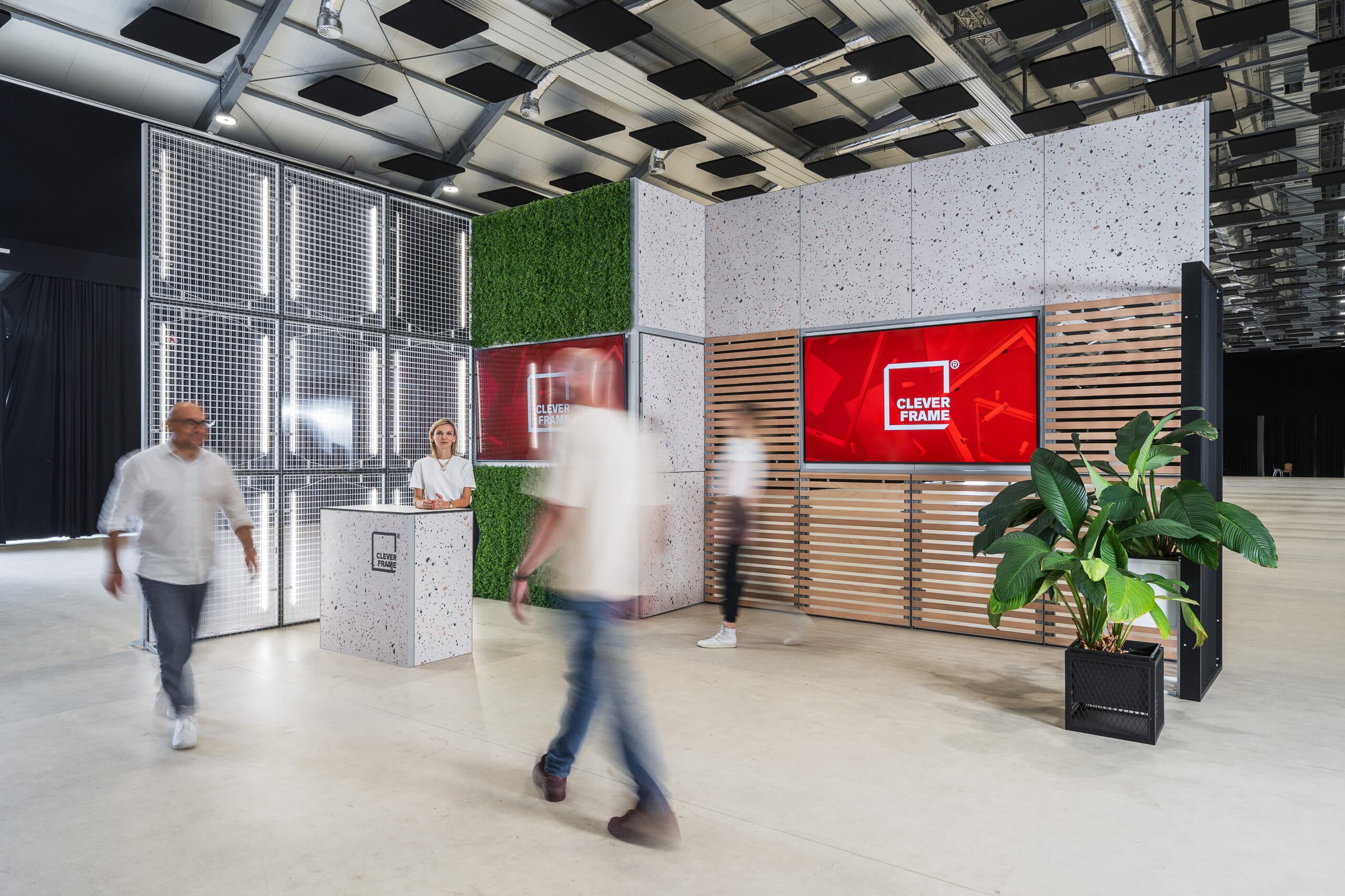
With modular solutions, the ability to adapt quickly to different events is crucial. Clever Frame trade show booths make it easier to work with context thanks to repeatable frames and connectors, plus interchangeable graphic panels that can be updated quickly for a specific segment, campaign, or local market.
Practical examples of contextual marketing
Contextual marketing at events works best when it is described in simple scenarios: who arrives, what they see first, where they go next, and what content they receive in each zone.
- splitting messaging by zones: a short problem-led headline at the entrance, role-based arguments in the conversation zone (procurement, technology, leadership), and concrete use cases in the demo zone,
- versioning graphic panels for different industries on the same frames – for example, one content set for industrial trade shows and another for an IT event,
- adapting the narrative to the relationship stage: for new contacts, emphasize category and differentiator; for existing customers, focus on expansion and offer updates,
- time-based context: different messaging on opening day, during peak hours, and during calmer expert conversations,
- channel context: connecting booth messaging with post-event follow-up (e.g., materials matched to the conversation topic) to maintain continuity of the brand experience.
See also
- Marketing personalization
- Customer-centric marketing
- Customer journey
- Engagement marketing