
What is an activation funnel?
An activation funnel is a model that describes the stages an audience member goes through before taking a desired action after encountering a brand. In event marketing and at trade shows, it represents a planned experience path: from first noticing the booth, through engaging with the message and the team, to micro-conversions (e.g., signing up for a demo, sharing contact details, booking a meeting) and post-event actions.
Unlike funnels typical of digital channels, an activation funnel depends heavily on physical space and real-world behavior: booth layout, message visibility, conversation quality, smooth visitor flow, and how products are presented. This model helps connect marketing and sales goals with brand experience design in face-to-face interactions.
What are the main goals of an activation funnel?
An activation funnel structures what should happen at the booth and after the event. Instead of tracking only visitor volume, it defines measurable intermediate steps. Most often, it includes goals such as:
- increasing brand visibility and offer clarity in the first seconds of contact,
- encouraging people to enter the conversation or demo zone through a clear spatial layout,
- guiding visitors toward a specific interaction (e.g., product trial, consultation, attending a presentation),
- capturing contact details and, where applicable, marketing consents in a way that complies with GDPR and brand standards (including clear information duties and the correct legal basis for processing),
- handing off the lead to sales with context (needs, interests, buying stage),
- maintaining the relationship after the event so it doesn’t end with the booth conversation.
What are the benefits of an activation funnel?
An activation funnel improves the predictability of offline performance because it forces you to design the experience around audience intent and brand goals. In practice, it delivers several important benefits:
- stronger communication consistency, from the booth key visual to the team’s conversation language,
- higher-quality leads thanks to defined micro-conversions and qualifying questions,
- more efficient use of space through intentional visitor flow management,
- the ability to compare events based on funnel stages, not only attendance,
- easier optimization, because you can see where participants drop off and what to improve (e.g., message visibility, demo ergonomics),
- more repeatable results across the trade show calendar when the brand returns to future events.
Challenges and limitations of an activation funnel
The model is useful, but it requires discipline in planning and measurement. The most common challenges include:
- harder attribution, because the impact of a trade show conversation may become visible only weeks later,
- differences in visitor behavior depending on time of day, booth location, and traffic intensity,
- inconsistent team execution when there is no conversation playbook and no clear qualification criteria,
- too many visual messages, which reduces clarity at the first stage of the funnel,
- technical and formal constraints related to data capture and consent management.
How is an activation funnel used at trade shows and events?
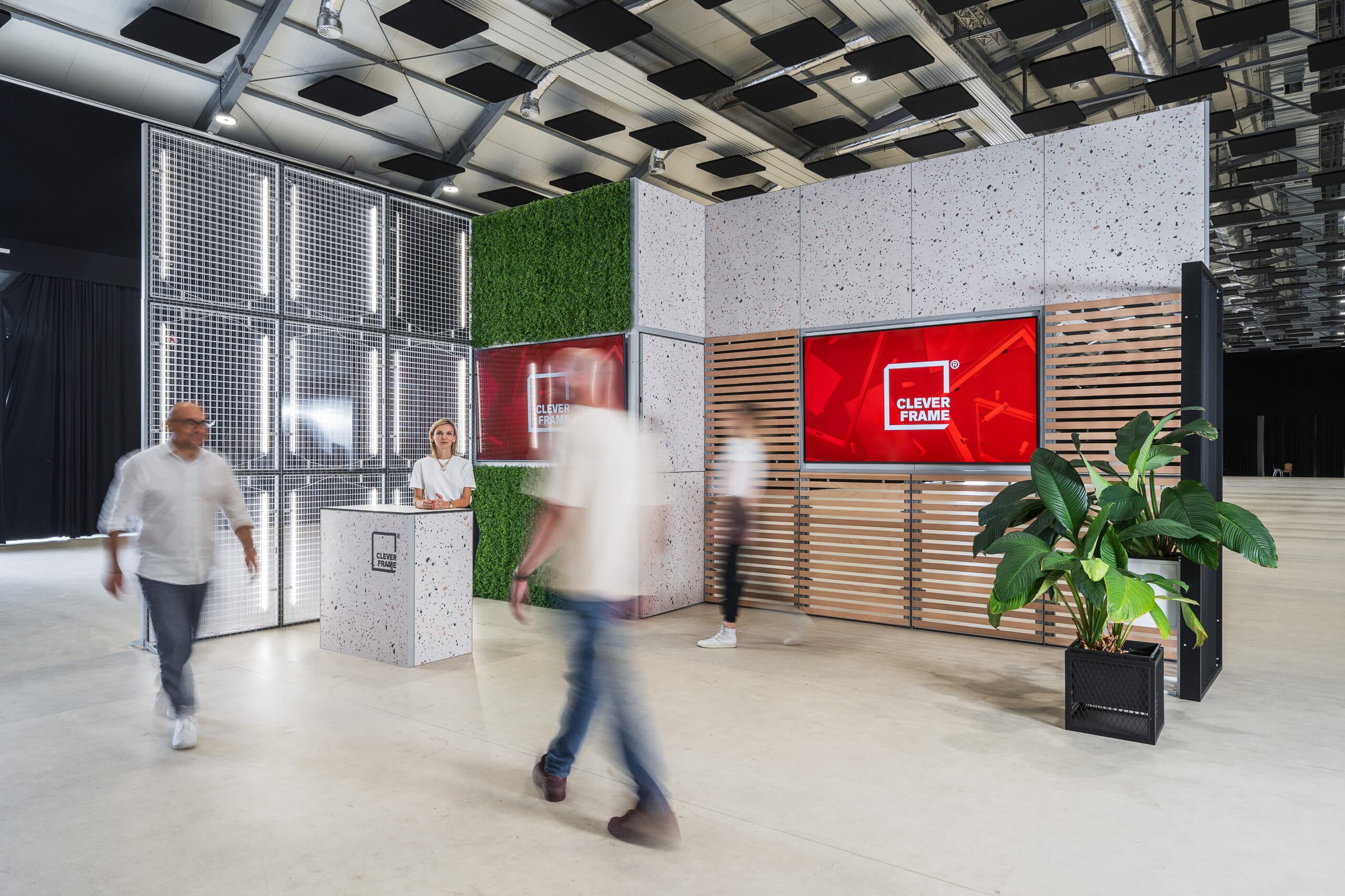
At offline events, the activation funnel starts before someone even enters the booth: whether the message is understandable from a distance and whether the layout encourages people to approach. Next, touchpoints matter: the welcome point, the demo zone, informational materials, and the transition from conversation to a clear next step (e.g., booking a meeting, requesting an offer, registering for a post-show webinar).
Booth design can support the activation funnel when it enables fast message alignment with the event objective. Clever Frame trade show booths use a modular structure and an assembly system that makes it easier to replace graphic panels, so messaging can be tailored to different audience groups, seasonal campaigns, and changing sales priorities. Tool-free setup and teardown can also simplify logistics across event cycles, roadshows, and showroom activations.
In practice, it’s worth designing the space so it naturally guides people through the funnel stages: quick value identification, interaction, and then a micro-conversion close. Operationally, this includes clear team roles (who welcomes, who runs the demo, who qualifies leads) and prepared paths for different visitor types.
Practical activation funnel examples
An activation funnel can be written as a simple sequence of actions and metrics matched to the event format. Examples include:
- Product launch at a trade show: notice the message → enter the booth → demo → badge scan or form → book a conversation with an advisor,
- Educational event: attract people to a short presentation → Q&A → sign up for materials or a consultation → follow-up with content matched to needs,
- Showroom: enter the tour path → hands-on product contact → conversation about use cases → offer or sample → define the next sales step,
- Roadshow: fast space configuration → consistent branding across locations → a repeatable activation script → comparable KPIs across cities.
In each scenario, consistent visual communication, spatial ergonomics, and intentional visitor flow management are key. An activation funnel also helps assess whether your booth investment keeps working over time: the same elements can be reused repeatedly, while graphic panels are updated for new objectives and events, supporting cost efficiency and a more sustainable approach.