
Not every industry event works the same way. At some trade shows, a conversation lasts two minutes and ends with a quick handover of materials; at others, the first meeting takes twenty minutes and feels more like a working consultation than a standard sales interaction. That is exactly why trade show booth design should not start with questions about square footage or the look of the structure alone. What matters much more is how attendees behave, how quickly they make decisions, and what kind of interaction the brand wants to have with them.
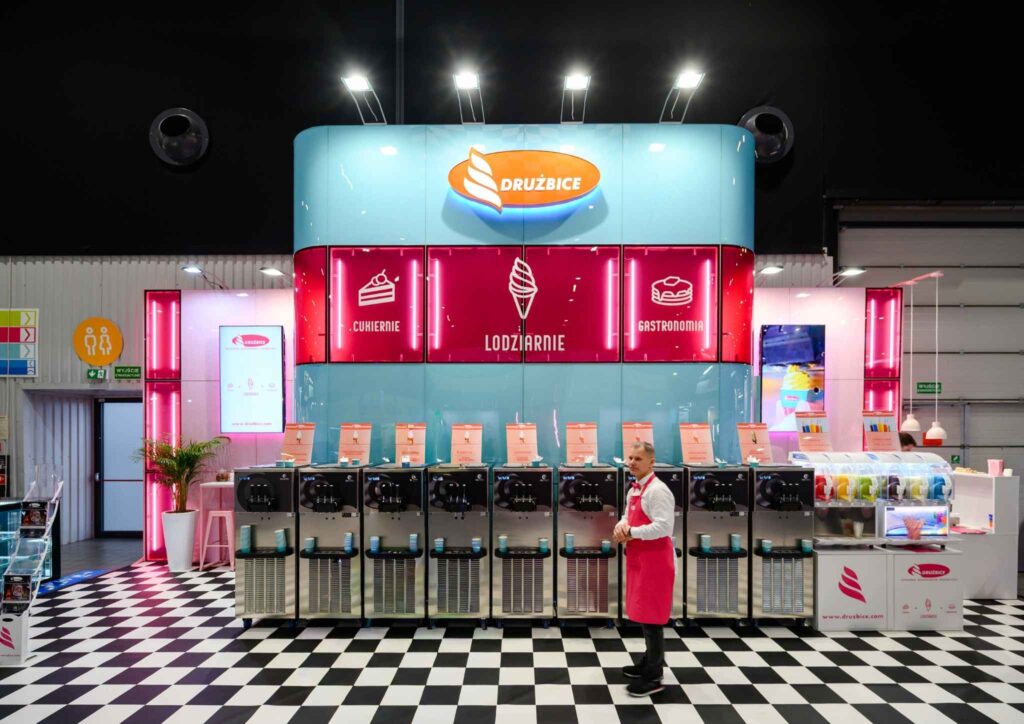
This is one of the most frequently overlooked elements of event planning. Companies often choose their booth setup out of habit: “last time we had this layout, so let’s do something similar,” or based purely on aesthetics: “this booth looks modern, so it will be a good fit.” In reality, a well-designed trade show booth should first and foremost reflect the rhythm of a specific event. A booth for an industrial trade fair, where longer technical conversations matter, is planned differently from a beauty event, where traffic is intense and more impulse-driven, and differently again from an HR conference or tech event, where you need to combine networking, short demos, and qualification conversations.
In this context, Clever Frame trade show booths show their biggest advantage not only as modular exhibition structures, but as a tool for designing different brand-presence scenarios. The flexibility of the system makes it possible to adapt the layout of zones, messaging, and visitor flow to a specific type of event and the nature of a given industry. In practice, that means less guesswork and better use of your event budget.
The pace of conversation at a booth is simply the rhythm at which an attendee engages with a brand, decides to stop, absorbs the message, and moves to the next step. In some industries, this process is extremely fast: the attendee looks, evaluates, asks one question, and decides whether to move on. In others, they need time to understand the context, see how the solution is applied, speak with an expert, and only then schedule the next stage of contact.
If the booth does not match that pace, it starts getting in the way instead of helping. At high-traffic events, an overly closed layout can limit entry and reduce the number of interactions. At events where conversations are longer and more consultative, a space that is too open and purely pass-through will make it harder to focus, stay comfortable, and hold quality meetings.
That is why booth design should take into account not only what the brand wants to showcase, but also how attendees move through the event, how much time they realistically devote to contact, and what their decision-making journey looks like. From this perspective, it becomes clear that different industries really do require different solutions.
This group usually includes B2B events in sectors such as manufacturing, business technology, automation, logistics, healthcare, pharmaceuticals, finance, and specialist business services. In these industries, a conversation rarely ends with a single question. The attendee needs to understand the process, technical parameters, use case, solution advantages, and sometimes even the implementation model.
In practice, this means the booth should support:
At these events, layouts work best when they do not “push” the visitor out of the conversation after a few dozen seconds. A meeting zone, a demo or consultation space, and back-of-house support that allows the team to work smoothly with materials, notes, or presentations become very important. A clear communication hierarchy also works well: from a distance, visitors can see the main category or value proposition, and up close they can move into more detailed content.
It is exactly in these scenarios that booth ergonomics becomes especially important. If you need to organize storage, material flow, and the division into work zones, it is also worth reading Booth ergonomics – the back-of-house area everyone forgets about, which clearly shows how space organization affects team performance.
Things look different at events where attendees move quickly, compare many brands, and decide within seconds whether to stop. This often happens in beauty, lifestyle, FMCG, design, food service, retail, consumer electronics, promotional events, and more open expo formats.
Here, the booth needs to work instantly. What matters most is:
In these industries, an overly complex booth structure can slow traffic and reduce the number of interactions. More open layouts tend to perform better, with well-visible product displays and messaging designed for quick visual scanning. Instead of several parallel communication threads, it is better to focus on one core message, strong visual identity, and a simple path from first glance to stopping at the booth.
This is also the moment when the team’s ability to react quickly becomes critical. If the nature of the event requires efficient traffic capture and instant adaptation of the conversation to the visitor, the article Trade Shows Without Operational Chaos: How to Structure Your Team’s Workflow at the Booth may also be helpful.
Many events do not fit neatly into a simple “slow” versus “fast” split. Good examples include technology trade shows, HR, education, marketing events, and startup expos. Some visitors only want a quick overview of the offer, while others move straight into a more specific discussion. That requires a layered booth that can support different scenarios at the same time.
In such cases, the best solution is usually a layout built around several zones:
This model gives the brand greater flexibility. Someone who only needs a simple explanation does not block the space for those who are already ready for a longer conversation. At the same time, the team can qualify conversations more quickly and direct visitors to the right part of the booth.
If the quality of leads matters more than their sheer number, the article Lead Quality at Trade Shows Without Long Forms: How to Qualify Contacts on the Spot Without Slowing the Conversation is another useful read. It provides a strong context for thinking about the booth layout not only as a branding tool, but also as a support system for more effective traffic qualification.
Put simply: the faster the event, the more openness, simplicity, and instant message accessibility matter. The slower and more consultative the event, the more important comfort, logical zoning, and space for conversation become.
In practice, this can be translated into a few simple design principles.
If attendees decide within seconds whether to approach, the booth should have as few entry barriers as possible. A wide front, clear brand exposure, a limited number of messages, and easy access to the team work especially well.
When a brand sells a solution that requires discussion, the booth should structure that contact in stages. First an introduction, then clarification, and then the actual conversation. This helps not only visitors, but also the team, which can guide interactions in a more predictable way.
The most universal model is one where two logics function side by side: quick exposure and calmer conversation. This allows the booth to remain dynamic while still supporting high-quality meetings.
The spatial layout is one thing, but the communication layer is just as important. Graphics for an event where visitors only read what they can see from several meters away should be designed differently from those for an event where attendees can come closer and calmly analyze information.
At fast-paced events, what works best is:
At more consultative events, you can allow for more layered communication, but still without overloading it. The key is for the message to support the conversation, not try to replace it with a wall of text.
This is also one of the reasons why flexibility in the visual layer matters so much today. In Clever Frame trade show booths, graphic panels mounted with magnetic strips can be changed easily, allowing messaging to be adapted to seasonal campaigns or changing marketing needs. As a result, the brand keeps a consistent structural base while flexibly updating the message. This means the same booth system can work across events with completely different characteristics, without the need to build a new custom stand every time.
If you want to look more broadly at how to maintain one brand message across different event formats, it is also worth reading How to maintain brand consistency at events.
The pace of conversation does not result from the offer alone. It is also strongly influenced by how attendees move through the event. At some trade fairs, visitors stroll, stop spontaneously, and explore the space. At others, they move with a clear task in mind, often with a list of specific exhibitors or pre-scheduled meetings.
This should affect the booth design. Events with freer movement tend to work better with more open, inviting layouts. Task-oriented events more often require clear orientation points, a strong division of zones, and well-organized pre-arranged conversations.
In practice, this means that even two events in the same industry may require different configurations. And that is exactly why modularity matters so much today. It allows you to treat the booth not as a rigid structure, but as a solution that can be adapted to a specific traffic scenario without losing visual consistency.
The biggest problem for many brands is that their event calendar is not uniform. Over the course of a year, a company may appear at a strictly industry-focused trade show, a partner conference, a product event, a roadshow, and an additional recruitment or educational event. If each of these required a completely new booth logic, the entire operation would quickly become expensive and inconsistent.
Clever Frame modular trade show booths are well suited to this challenge because they make it possible to create different layouts from the same base set of components. In practice, this means:
There are also practical operational benefits. Assembly and disassembly take place without tools, which makes move-in easier and shortens setup time. Space savings during transport support logistics when the event schedule is intense. And the ability to reuse the same booth at different events reduces the pressure to build everything from scratch every time.
If you are interested in the broader perspective of treating a booth as a resource for multiple applications, another useful read is Can a trade show booth be treated as a service? The Booth-as-a-Service model in practice.
Before you choose a booth layout, it is worth organizing a few key points. This short review helps avoid designing from memory and makes it easier to match the structure to the real nature of the event.
Different industries really do have different conversation tempos, but the most important conclusion is even broader: a booth should not be designed according to a general event category alone, but according to how attendees behave and what the brand wants to achieve. It is the intersection of these two perspectives that shows whether you need a more open exhibition space, a calmer area for conversations, or a hybrid layout.
A well-designed trade show booth is not universal in the sense of being “the same everywhere.” It is universal because it can be adapted to different scenarios without losing brand consistency. That is where the real strength of modular solutions lies: they allow brands to design their event presence in a more strategic, flexible way that is aligned with the actual nature of the event.
If you want to match your booth layout to a specific industry, conversation rhythm, and event goal, it is worth choosing a solution that allows the structure to be configured flexibly while maintaining brand consistency. Clever Frame trade show booths provide a modular base that can be adapted to different event scenarios, so the booth works for the brand not only aesthetically, but also operationally and commercially.