
At trade shows, conferences, and industry events, the number of business cards collected is no longer a measure of success. For marketing managers, event managers, and brand managers, something else matters: lead quality, meaning whether a contact has real sales potential and whether the team can follow up quickly after the event. The problem is that long tablet forms slow the conversation, discourage visitors, and reduce the pace of work at the booth.
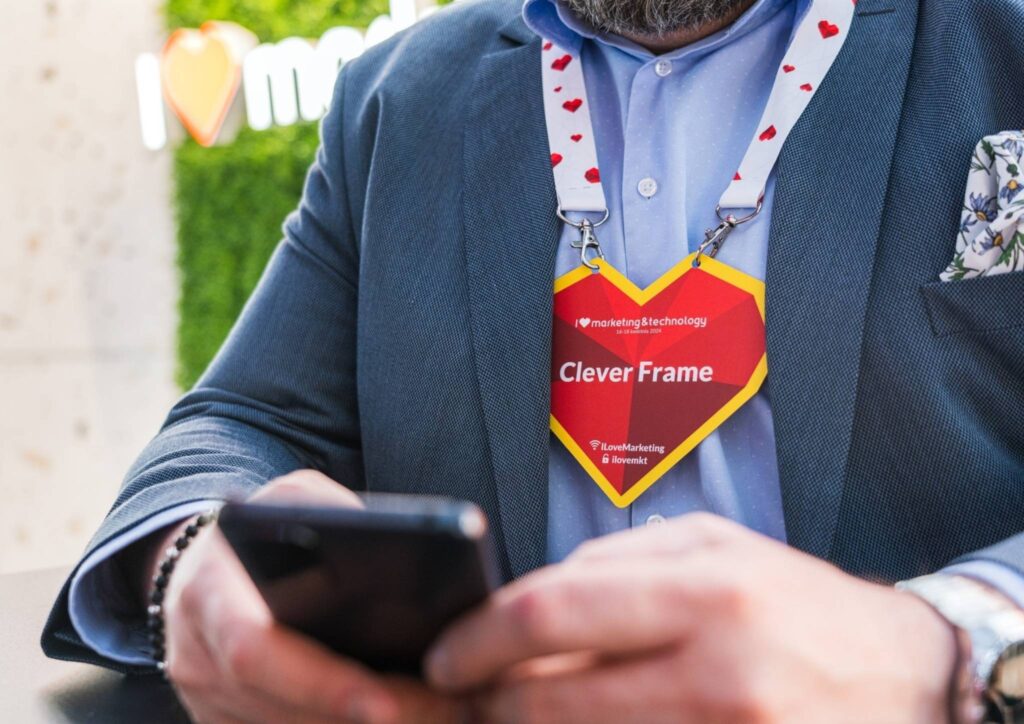
In practice, lead quality can be improved without interrogating people and without long fields to complete. What helps is not only the conversation scenario, but also the space itself: whether the layout guides visitors, whether the graphics filter out random passers-by, and whether the team has a place to move the conversation to the next level. Clever Frame trade show booths, thanks to modular booth design, tool-free assembly and disassembly, and the ability to quickly update messaging on graphic panels, support zone-based layouts so qualification happens on the move, not in a survey.
Lead quality is an assessment of how well a contact matches the customer profile and how likely it is to move to the next stage: a meeting, presentation, offer, or pilot. At an event, the speed of that assessment matters because conversation time is limited, and visitors often compare several suppliers at once.
The best on-the-spot qualification is simple: it collects minimal data but still allows the next step to be agreed. The rest of the information can be уточized after the event – when you have more time and calmer conditions.
The form itself is not the problem, but the way it is used. At the booth, the conversation should build a relationship, and the data collection tool should remain in the background.
Lead qualification starts with how visitors move through the booth. A modular booth design makes it possible to prepare a layout aligned with the goal of the event: one for generating meetings, another for product presentations, and yet another for partner recruitment. Clever Frame trade show booths allow configuration changes and expansion without building everything from scratch, which makes it easier to create zones with specific tasks.
The biggest difference in lead quality does not come from how much information you collect on site, but from whether the space makes it easier to move to the next step. When a booth has clear zones, sales reps do not have to improvise – they guide the conversation in line with the process – Artur Balcerzak, Branch Director.
The simplest way to qualify leads without forms is to let the space suggest the next step. Visitors enter a zone aligned with their intent, and the team automatically applies the right conversation scenario.
Modularity helps build these zones across different floor spaces. The same base can work as a compact setup for a one-day event and as an expanded trade show booth – what changes is the layout of elements and the communication hierarchy, not the whole project from scratch.
A high-quality lead often starts with the right first sentence, before any conversation takes place. In practice, that means a clear value promise and a precise indication of who the offer is for. Clever Frame trade show booths allow messaging to be updated without replacing the entire booth build, because a system of interchangeable graphic panels can make message changes easier.
It is worth designing messaging so that some visitors self-exclude and do not take up the team’s time. That is not lost reach, but saved resources.
Effective qualification can rely on minimal data, short notes, and clear tagging. The goal is to move from conversation to the next step, not to build a CRM profile while standing at the booth.
Three questions structure the conversation and make it possible to assess fit without going into implementation details. What matters is that the questions are short and the answers can be noted in a few words.
This can be implemented without a form: the information can be saved as a short note in a CRM, contacts app, or badge-scanning tool if the organizer provides one.
If the team uses a shared tagging language, even short notes become very useful. Tagging speeds up post-event work and makes it easier to assign follow-up to the right person.
In practice, it takes only 10-20 seconds to tag a contact – much less intrusively than a full form.
A high-quality lead is not only about fit, but also about readiness to act. That is why it is better to offer small, concrete steps at the booth that are easy to accept.
This approach reduces the number of empty leads because it filters out random visitors without discouraging the right ones.
Lead quality depends not only on the conversation scenario, but also on working ergonomics and the clarity of the display. If the booth is crowded or chaotic, conversations become shorter and more superficial. If the layout supports natural flow, the team has space for qualifying questions.
Clever Frame trade show booths are designed so the configuration can be adapted to different goals and floor spaces. From a lead quality perspective, this means the booth can be prepared for a specific type of conversation without the compromises typical of one-off booth builds.
The less energy goes into logistics, the more resources remain for preparing the team for conversations and follow-up – and that directly improves lead quality.
Lead quality increases when booth messaging is aligned with the campaign and the goal of the event. If a company takes part in several events a year, it often needs different communication versions: one product-focused, another employer-branding focused, another partner-focused. In this context, interchangeable graphic panels can make it easier to update messages without rebuilding the structure.
As a result, at each event it is possible to set the filter for the right contacts without compromising the quality of the display.
More and more trade show conversations touch on environmental responsibility, especially in companies reporting ESG performance or working with international partners. An approach based on reusing the booth build is clear and credible because it reduces the need to produce one-off elements for every event.
Modular booths that can be modified and reused across locations support the practice of reducing one-time use. In addition, replacing only the graphic panels makes it possible to refresh messaging without creating an entirely new structure, which helps rationalise the production of event materials.
High lead quality is one of the strongest ROI factors because it reduces the post-event workload of sales teams and shortens the time to the first valuable meeting. In practice, effectiveness grows when the booth helps the team do two things: route traffic into the right conversations and consistently secure the next step.
A modular booth build also supports operational efficiency because the same investment can work across many events. Instead of treating the booth as a one-time cost, it can be planned on an annual cycle, adjusting the layout and communication to each event.
The process should be easy to learn, consistent across the whole team, and resistant to crowd pressure. The framework below can be adapted to different booth configurations.
This approach does not require long forms, while ensuring the team does not return from the event with a list of contacts that have no context.
The biggest improvement in contact quality comes from actions that structure traffic, shorten data collection, and strengthen the next step.
If you want to improve lead quality at your next events, start with a simple audit: what zones are on the booth today, where does the conversation bottleneck, and do the graphics filter the right traffic? The Clever Frame team can help choose a modular configuration and communication variants that improve on-site qualification without long forms and without slowing the pace of work.