
What is phygital marketing?
Phygital marketing is an approach that combines physical, in-person experiences with digital solutions, allowing event attendees to move seamlessly between “live” interactions and online touchpoints. In practice, it means designing brand touchpoints at trade shows, conferences, product launches, showrooms, and roadshows so that the space, messaging, and technology all support one coherent experience journey.
In the context of trade show booths (exhibition stands), phygital marketing is not about “adding a screen.” It’s about intentionally designing the interaction: from capturing attention and guiding visitor flow, through conversation and product demos, to lead capture and post-event communication. The key is that technology should strengthen face-to-face contact – not replace it.
What are the main goals of phygital marketing?
Phygital marketing structures event activities around business objectives and measurable audience behaviors. Most commonly, it focuses on:
- increasing attendee engagement through interactions that encourage people to step into the booth and stay longer,
- making sales conversations easier with fast access to product content, configurators, or downloadable materials,
- capturing data and leads in a GDPR-compliant way, including marketing consent and a clear purpose for processing,
- ensuring consistent visual identity and messaging between the physical space and online channels,
- extending the impact of the event via automated follow-ups, meeting scheduling, or personalising future touchpoints.
What are the benefits of phygital marketing?
Well-designed phygital marketing strengthens both brand experience and sales effectiveness. The biggest benefits include higher-quality conversations, stronger message recall, and the ability to measure results at the interaction level – not just by counting visitors.
At the booth, the space itself plays a major role: clear visibility of key messages, well-defined zones (e.g., demo, sales talks, consultations), and a logical visitor flow. If the booth layout supports a quick “first-touch” interaction and then naturally guides visitors toward deeper engagement, technology can capture intent signals (e.g., choosing a use case in a short survey) and help the team steer the conversation more effectively.
Challenges and limitations of phygital marketing
Connecting physical and digital experiences requires quality control and operational readiness. The most common constraints include:
- infrastructure reliability – stable internet, power supply, and a contingency plan for digital solutions,
- data protection and privacy – collecting only what’s necessary, using proper consent, and integrating securely with your CRM,
- user experience friction – forms that are too long, unclear instructions, or too many steps,
- team capability – using tools (e.g., badge scanning, lead qualification) requires training,
- accessibility and inclusivity – considering people with different needs (legibility, language, and alternatives to mobile-only experiences).
How is phygital marketing used at trade shows and events?
At events, phygital marketing works best when it’s built into the booth story and aligned with the brand’s aesthetic. Consistent visual communication (colours, key visual, slogans, information hierarchy) helps attendees quickly understand the offer, while digital interactions should always serve a specific purpose: education, qualification, booking a conversation, or triggering a product demo.
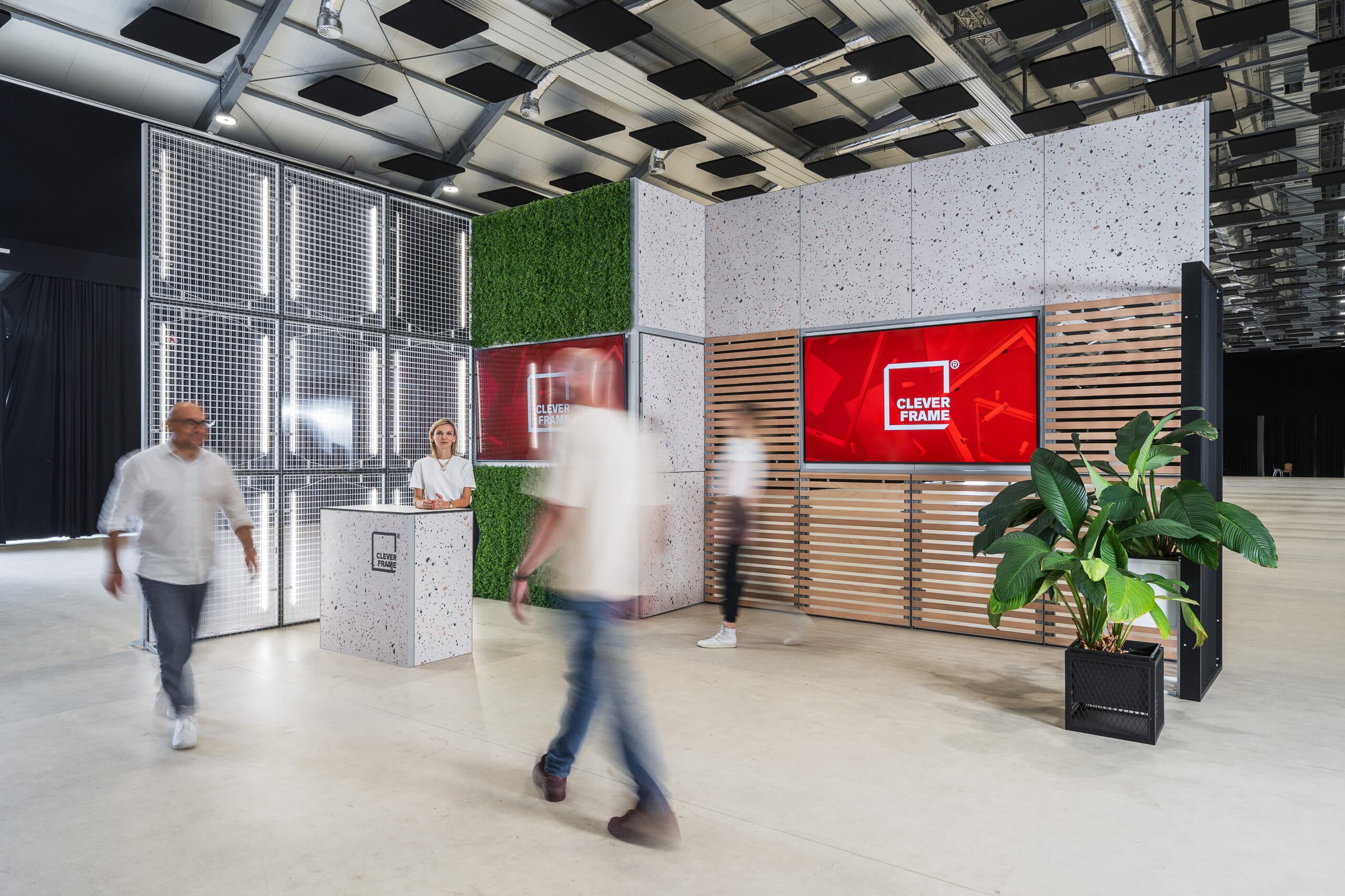
Clever Frame trade show booths can support this approach through a modular structure that makes it easy to build layouts aligned with your planned visitor flow and different event formats. Tool-free assembly and disassembly simplify operations for frequent travel, and the magnetic system makes it easy to swap graphic panels to match seasonal campaigns or changing marketing trends. This flexibility supports message testing and fast creative iteration – without rebuilding the entire stand.
Practical phygital marketing examples
Phygital marketing can be implemented at different levels of maturity – from simple touchpoints to advanced data journeys and automation. Examples include:
- QR codes linking to a catalogue, specifications, case studies, or a segment-specific landing page,
- qualification surveys on mobile or tablet that route visitors to the right conversation (sales, technical, partners),
- demo registration and meeting-queue management to streamline booth operations during peak hours,
- augmented reality (AR) to showcase product variants, use cases, or configurations when a physical demo unit isn’t available,
- NFC or badge scanning to deliver materials and trigger follow-up sequences, with clear information about data processing.
It’s worth planning these mechanisms together with the spatial layout: the “first contact” point should be prominent and quick, the meeting area calmer and clearly marked, and the messaging on graphic panels aligned with each stage of the attendee journey. This way, technology supports the experience rather than competing with the conversation.