
Trade show booth design is often treated as a backdrop for sales conversations. In practice, it can be one of the sales team’s key working tools – or its biggest limitation. The difference usually is not about how eye-catching the booth looks, but whether it organises the team’s on-site work: attracts the right visitors, makes lead qualification easier, enables conversations in the right conditions, and supports consistent brand communication.
Below you’ll find a practical guide to spotting the point where the booth starts limiting sales goals – and how Clever Frame modular trade show booths can solve the problem through scalable configurations, mobility, and fast communication updates.
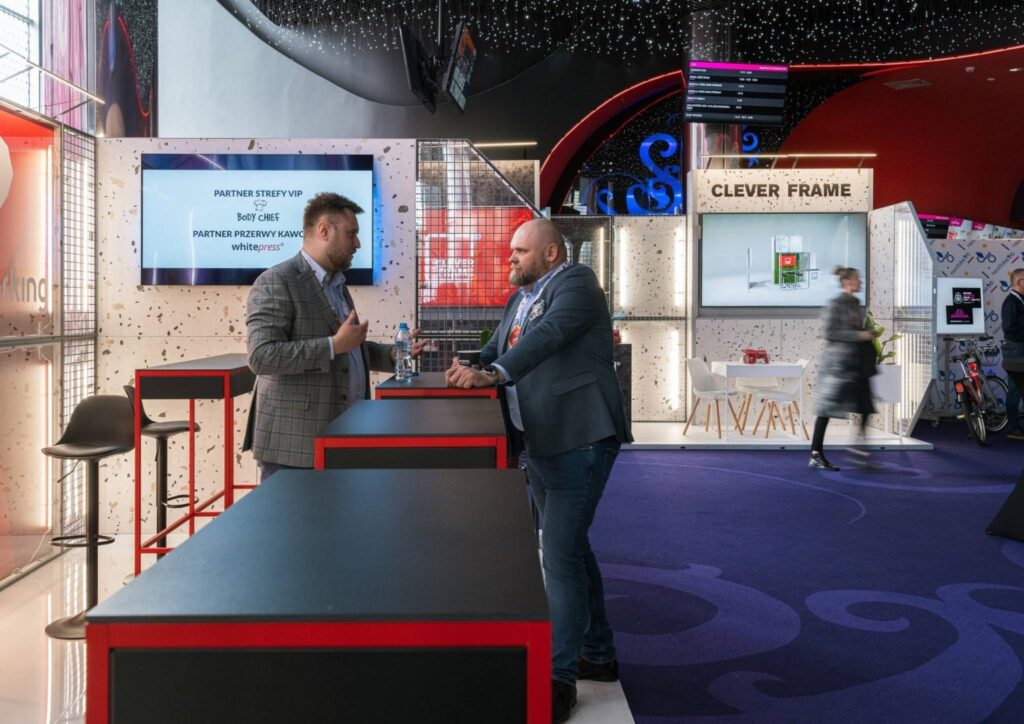
At business events, sales do not happen at the booth in a single moment – they happen in a process: attracting attention, the first conversation, qualification, presentation, and booking a follow-up. Booth design supports that process when it creates a clear layout and removes operational friction. It holds you back when it forces bad habits: congestion in one area, no space for a presentation, difficulty updating messages, or a difficult and time-consuming setup.
If the same issues keep coming up after several events, it is worth treating them as data, not just the nature of trade shows. Most often, the source is the booth’s layout and functionality, not the team’s motivation.
Your sales team needs space both for quick first contact and for deeper conversations when there is real business value. Booth design starts limiting the team’s work when:
Even the best salespeople lose effectiveness when part of the day is consumed by organisation. Typical symptoms include:
If the booth looks different every time and the team has to explain what is not visible in the visual communication, the brand pays the price in weaker recognition and lower lead quality. This happens especially when:
A booth supports sales when it is a working tool, not a one-off set piece. The key is aligning it with event goals and the way the team runs conversations.
A modular approach makes it possible to build different configurations from the same elements, so the layout can be matched to the floor space and conversation scenario without a major change in budget or logistics. In practice, this means:
The biggest difference shows up when the booth stops being scenery and starts working like a process tool. The team does not waste time improvising, because the layout cues where the conversation starts and where it moves into specifics – notes Artur Balcerzak, Branch Director.
At events, repeatability and predictability matter. If the structure allows tool-free assembly and disassembly, the team gains simpler logistics and less risk of problems on-site. That impacts sales because:
In many companies, marketing is responsible for consistency while sales delivers results at the booth. These two functions meet in the graphics: they must be clear, up to date, and aligned with the event. The solutions used in the Clever Frame system make it possible to replace graphic panels quickly and easily, adapting them to seasonal campaigns or changing priorities. For the sales team, this means:
When a booth needs to work at several events each year, logistics becomes part of the event strategy. From the sales team’s perspective, mobility means less friction and greater readiness to act. It is worth planning the booth build so that:
A booth should not sell instead of the salesperson, but it can make sure the conversation starts at a higher level. Good booth design supports the brand in three areas: recognition, offer clarity, and credibility. In practice, this means a design that is consistent and repeatable, yet flexible.
It is best to plan the booth around conversation scenarios first, and only then around aesthetics. A layered approach helps:
Modular layouts make it easier to preserve this logic across different floor spaces without losing consistency. Fast graphic panel replacement, in turn, helps tailor messages to a specific event instead of using one universal narrative for every trade show.
In the context of events, sustainable increasingly means simply sensible: less one-off use, more reuse, and better planning. A modular booth build supports this approach because the same structure can work across many events in different configurations.
In practice, the eco-friendly dimension results from how the work is organised:
Evaluating booth costs should not come down to the price of a single appearance. A more relevant question is lifecycle cost: how many times the structure can be used, how easily it can be adapted to different events, and how much work it removes from the team.
A modular booth build usually improves efficiency in the areas that create hidden costs inside companies: time, transport, repeated production, and on-site improvisation. Pay attention to:
If the structure is meant to support sales all year round, it is worth planning its use more broadly than just within the trade show calendar. Modular solutions also work well wherever a consistent, mobile, and easy-to-reconfigure brand space is needed.
The same elements can be used in different scenarios by adapting the layout to the space and the goal. Most often these include:
The list below helps quickly assess whether the booth works as a sales tool or simply fills space. If several points perform poorly, you probably have a compromise instead of an advantage:
If the checklist points to recurring friction, it is worth starting with a map of the team’s workflow at the event: where the first contact happens, where qualification takes place, and where the conversation moves into specifics. Then the layout and graphics can be adjusted to guide visitors from the big picture to the details, while giving the team the right conditions for different types of conversations.
Examples of how to scale layouts, plan zones, and update communication quickly can be found at https://cleverframe.com/. It is a practical reference point for brands that want their booth to work as a sales tool, not a source of extra complications.