
A trade show budget often starts with one question: how much does the booth cost? That’s a natural starting point, but also one of the most common reasons for underestimating the real budget. In practice, the total cost of exhibiting at a B2B event never ends with the booth build itself. You also need to account for organizer fees, transport, logistics, material preparation, team time, pre-event promotion, and post-event follow-up. If these elements are not calculated together, a brand can enter an event with a budget that looks reasonable on paper but starts to balloon at every next stage.
That is why it makes sense to view trade show participation not as a single expense, but as the full cost of a sales and marketing project. Only then can you reliably assess the return on a trade show, compare different event formats, and make decisions that support not just one event, but your entire B2B event calendar.
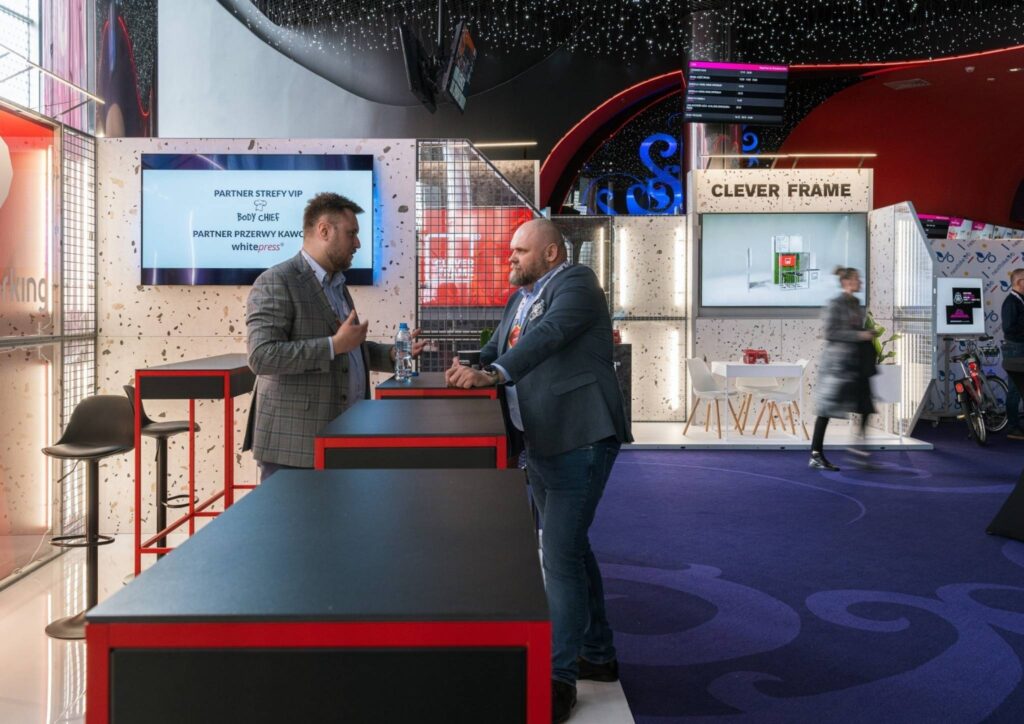
In this context, Clever Frame trade show booths fit well with an approach based on the total cost of exhibiting, not just the price of the booth itself. A modular structure, the ability to reuse the same base multiple times, quick graphic panel replacement, and simpler logistics all help reduce costs that often slip outside the core exhibition budget.
The most common mistake is building the budget with a purchasing mindset rather than a project mindset. A company compares the price of floor space, the cost of a booth, or the price of a specific exhibitor package, but does not map out the full journey of the brand’s presence at the event. Meanwhile, a B2B event is a process that starts long before booth installation day and ends long after the exhibition hall closes.
If the team looks only at the cost of “getting in,” it is easy to overlook items such as:
As a result, the brand thinks the “booth costs X,” while the real cost of exhibiting is significantly higher. That is exactly why it makes more sense to talk not about the booth price, but about the total cost of your brand’s presence at the event.
The safest approach is to break the budget down into five main areas: venue cost, display cost, operating cost, team cost, and the cost of activities before and after the event. Only the combined total of these elements shows what trade show participation actually costs.
This is usually the first and most visible cost. It includes the exhibition space itself, but very often also a range of additional charges that appear after the contract is signed. Depending on the event, these may include electricity connection fees, technical fees, badges, a trade show catalog listing, cleaning, charges for additional equipment, or non-standard booth construction requirements.
At this stage, it is worth asking not only about the price per square meter, but also about the full package of mandatory and optional costs. This is where the first underestimations very often appear.
The second category is the booth itself: the structure, spatial layout, functional zones, and visual presentation. This is the element that is easiest to compare by price, but not always the easiest to assess over the long term. If a brand looks only at the cost of a single event, it may conclude that the cheapest booth is the best choice. The problem begins when the next event requires everything to be produced from scratch again.
That is why it is worth looking at booth costs from two perspectives:
This is exactly where a modular approach starts to offer a major advantage. If the same structure can be used across several events, in different configurations – from compact displays to larger, more elaborate setups – and with updated messaging, the total cost becomes more predictable over time.
This topic is explored in more detail in the article Trade Show Costs: How to Strategically Plan Your Budget.
This is one of the most frequently overlooked budget items. Yet in trade show projects, logistics can have a real impact not only on cost, but also on stress levels and organizational risk. You need to calculate the transport of the booth structure, materials, packaging, samples, additional items, and everything that returns to storage after the event or goes directly to the next one.
It is worth including:
If the booth takes up less space in transit and is easier to transport, the team benefits not only financially, but operationally as well. That is why, when planning a trade show budget, it makes little sense to separate the booth from logistics, because one directly affects the other.
Participating in a B2B trade show usually involves not only the salespeople present at the booth, but also marketing, the people responsible for preparing materials, coordinating travel, handling logistics, and managing follow-up. This cost does not always appear in the event budget because it is often “hidden” in team salaries. From a business perspective, however, it is still a real cost of exhibiting.
So it is worth including:
This is especially important for companies that want to discuss the real profitability of an event with management. The cost of floor space and the booth alone does not show the full level of organizational commitment.
The result of participating in a trade show depends not only on what happens on-site. Promotional activities before the event and what the brand does after it ends are also critical. If these stages are not included in the budget, the company may come to the wrong conclusion that the event “didn’t deliver,” when the actual issue was a lack of investment in activation and follow-up.
In this part of the budget, it is worth planning for:
Underestimation usually does not result from one major mistake, but from many small items that seem insignificant until they start adding up. These may include extra print runs, rush transport, graphic edits just before the event, non-standard equipment, the cost of booth modifications, or extra labor hours caused by unforeseen changes.
That is why it is worth including an operational contingency in your trade show budget from the very beginning. This is not about artificially inflating costs, but about making the realistic assumption that B2B events almost never go exactly as planned in the first spreadsheet.
A simple model works well:
The biggest mistake in trade show cost planning is evaluating booth construction only through the lens of upfront price. From the perspective of the total cost of exhibiting, what matters far more is whether the booth can be used more than once, whether it can be easily adapted to different footprints, and whether updating the messaging requires rebuilding everything from scratch.
That is exactly why Clever Frame modular trade show booths fit so well into a TCO logic – total cost of ownership. A brand does not have to start from zero every time. It can work from one base, change the layout, scale its presence, and update the visual layer without replacing the entire structure. The modular system allows for easy replacement of graphic panels, making it possible to quickly adapt booth messaging to seasonal campaigns or changing marketing needs while keeping a consistent booth base.
In practice, this means several important benefits:
If you want to explore this logic in more detail, it is also worth reading Trade Show Booth as Part of a Cohesive Marketing Ecosystem, Not a One-Off Project.
The simplest way is to treat trade show participation as a project with a full cost cycle, not as a one-off purchase. A phased approach works well.
At this stage, add up the costs without which participation in the event simply would not happen. This usually includes exhibition space, organizer fees, the basic booth, transport, and team staffing.
This includes all the elements that improve effectiveness: materials, presentations, samples, pre-event promotion, a lead capture system, and post-event follow-up.
This is where you account for graphic updates, layout modifications, unusual organizer requirements, extra equipment, or other elements that depend on the specific event scenario.
Without a contingency buffer, even a well-structured budget can drift off course. In practice, it is safer to assume a margin for items that only emerge during the preparation phase.
A well-calculated budget is not only there to help you “stay within plan.” It also helps determine whether a specific event actually makes business sense. If a brand knows the full cost of exhibiting, it becomes easier to compare that cost with lead potential, meeting quality, the opportunity to build new business relationships, or support for brand objectives.
This is especially important in B2B, where the effect of a trade show is not always visible in sales immediately after the event. Often, the real value lies in the processes started at the booth: first conversations, new contacts, open projects, and sales opportunities that mature later. All the more reason why the budget should be calculated broadly and realistically.
You can also find a practical extension of this approach in the article How to Prepare a Trade Show Booth: Practical Tips for Exhibitors.
The biggest trap is focusing only on the cost of floor space or the booth itself. In reality, the cost of exhibiting at a B2B event is shaped by many overlapping areas: from organizer fees and logistics to team time, communication, and post-show activities.
The most important rules to remember are:
If you want to calculate your trade show budget without underestimating costs and see what the full cost of your brand’s presence at a B2B event really looks like, it is worth relying on a solution that supports long-term budget predictability. Clever Frame trade show booths provide a modular base that can be adapted to different event formats, expanded, and updated in line with campaign needs – so your budget stays predictable not just for one event, but across your entire event calendar.