
Entering a new market rarely begins with full brand recognition. Much more often, it starts with uncertainty on both sides: the company is only beginning to establish its presence, while the audience is still learning who this new player is, what it offers, and whether it is worth trusting. That is exactly why your first trade show in a new market matters so much. It is not just another event. It is the moment when your brand takes physical shape in the eyes of potential customers, partners, and distributors.
In this context, a trade show booth should not be treated as decoration or a one-off build simply used to “tick the box” of attendance. It should function as a structured market entry tool: explaining who you are, organizing your messaging, supporting sales conversations, and creating a strong first impression of professionalism. This is especially important when your brand does not yet have the advantage of recognition and must win through consistency, clarity, and the quality of the visitor experience.
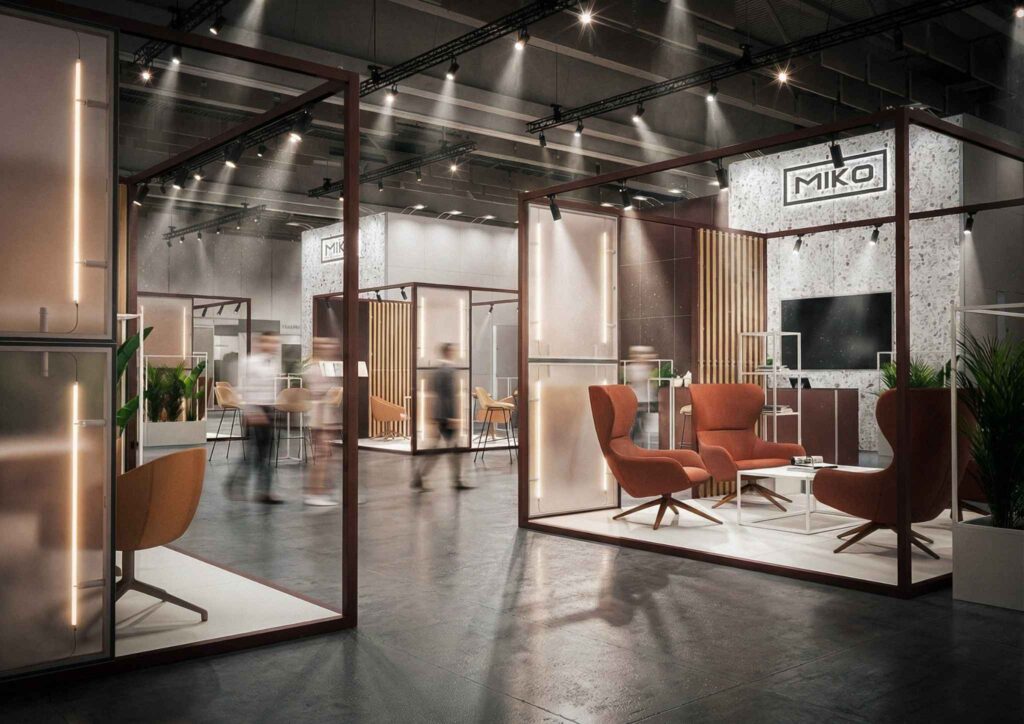
Seen from this perspective, Clever Frame trade show booths are well suited to the needs of companies beginning their presence in a new market. Their modular construction makes it possible to start with a format that matches the real scale of your market entry, then expand the layout as you attend more events, from compact displays to larger, more advanced booth designs. This allows a brand to look professional from day one, without having to invest in a rigid, one-time exhibition stand.
In a market where a brand is already known, the booth usually reinforces what the audience already understands. In a new market, it works differently. Here, the exhibition booth often serves as the brand’s first real “proof of existence” in the offline world. It shapes the first judgment: does the company look credible, does it communicate clearly, does it know who it is speaking to, and is it ready for a long-term presence?
In practice, this means that a trade show booth for a company entering a new market should accomplish several goals at the same time:
That is why the first trade show requires not so much the most spectacular booth possible, but a well-thought-out one. For a new brand, scale matters far less than whether a visitor can understand within a few seconds who they are dealing with and why it is worth starting a conversation.
One of the most common mistakes when entering a new market is trying to say everything at once. A company wants to present its entire offer, every advantage, every product application, and every possible target audience. The result is usually the opposite of what was intended. Instead of a clear message, you create communication overload that makes the brand harder to understand.
In new markets, a principle of selection works much better. The booth should be built around one core message and a few supporting arguments, not a full catalog of everything the company can do. A well-designed exhibition stand does not dump the entire offer onto the walls. Instead, it guides the visitor through the most important points: who we are, what problem we solve, who we work for, and what makes us different in practice.
If you want to look more broadly at how booth layout should follow your communication goals, it is also worth reading Exhibition Stand Layout and Marketing Goals – How to Design a Space that Drives Brand Success?
Companies entering a new market often face a dilemma: should they invest immediately in a large trade show booth to look “serious,” or start with a smaller format and risk being perceived as less important? In practice, this is the wrong way to frame the choice. Professionalism does not automatically come from booth size. It comes from consistency, functionality, and the quality of communication.
Even a small or medium-sized exhibition booth can build a very strong brand image if it:
This is one of the biggest advantages of a modular approach. A brand can start with a sensible format tailored to its real stage of market entry, while thinking of the booth from the beginning as a foundation for further growth, including larger and more advanced exhibition stands as the brand’s presence in the new market begins to scale. This logic is also explored in the article Trade Show Booth Design Across the Brand Lifecycle – How to Plan an Exhibit for More Than One Event.
At your first trade show in a new market, it is especially important that the booth layout helps with two things at the same time: attracting attention and enabling conversations. This means the booth should be designed not only visually, but operationally as well.
In practice, the following zones work particularly well:
This kind of layout is especially important when the brand is not yet recognized. The visitor does not arrive with prior knowledge. The trade show booth must help them understand the brand step by step. Clever Frame modular trade show booths make this easier because they allow you to create functional layouts from repeatable elements and adapt the configuration to the available space and the nature of the event.
In a new market, trust is built in the first few seconds. Even before a sales representative starts talking, the visitor judges the brand by the way it presents itself at the trade show. Is the communication organized? Does the display feel well thought out? Does the booth look like part of a professional organization, or like a rushed improvisation?
That is why the booth design should support an aspirational brand image, but without overdoing it. The best solutions are the ones that:
In this area, the ability to adapt communication later to the local market is also highly important. When entering a new territory, the language of communication, product priorities, sales arguments, or even the structure of the offer often changes. That is why it is important that the booth structure does not block those changes. If you want to see how this approach works in practice, take a look at New Branding, the Same Structure – Changing Communication Without Building a New Booth.
Entering a new market rarely follows a straight line. The first event is used for exploration, the next for refining the message, and the one after that for going deeper into sales relationships or partnerships. Very often, after the first trade show, the brand already knows that something needs to change: priorities must shift, different products should be highlighted, the conversation flow should be redesigned, or the visual layer should be improved.
That is why the most practical exhibition booth at this stage is not one that looks good only once, but one that can evolve alongside your knowledge of the market. In Clever Frame trade show booths, the modular structure allows the layout to be modified, while graphic panels mounted with magnetic tape make it quick and easy to update messaging for seasonal campaigns and changing marketing needs. As a result, the brand retains a consistent booth foundation while flexibly updating the message wherever the market requires it.
For a brand entering a new market, this creates a very specific advantage: there is no need to redesign everything from scratch each time. You can learn the market while maintaining continuity and a professional presence.
When discussing new markets, it is easy to focus on communication and sales while overlooking logistics. Yet when entering new territories, logistics often determine whether a brand can maintain a high-quality presence at future events. New locations mean different exhibition halls, different transport conditions, tighter timelines, greater organizational uncertainty, and a stronger need for predictability.
That is why booth construction should support not only branding, but operational peace of mind as well. In practice, the features that matter most include:
With Clever Frame trade show booths, an additional advantage is tool-free assembly and disassembly, which helps streamline booth preparation and reduce operational stress, especially when a company is only beginning to build its event procedures in a new market.
The most common mistakes are not caused by a lack of ambition, but by expecting too much from a single event. A brand wants to build awareness, generate sales, present its full offering, educate the market, and look like a category leader all at once. That usually leads to an overloaded project.
It is worth avoiding the following pitfalls in particular:
A much safer approach is to work in stages: start with a consistent, professional foundation, then develop it as your knowledge of the market and the event calendar grows. In this sense, the perspective described in the article Trade Show Booth as Part of a Cohesive Marketing Ecosystem – Not a One-Off Project is also very useful.
For companies entering new markets, it is especially important that the investment in a trade show booth does not end with a single event. The same foundation can support not only traditional industry trade shows, but also many other formats that often appear during the expansion stage.
A modular booth system can also work as:
Thanks to this, the brand can build awareness from the start in a repeatable and structured way, instead of creating a separate and inconsistent presence every time.
The checklist below helps organize the most important decisions before the first event:
Entering a new market does not require the biggest booth or the most spectacular execution right away. Above all, it requires consistency, clarity, and a professional start. These are the qualities that determine whether the audience sees the brand as a mature partner or merely as a temporary participant in the event.
The key takeaways are simple:
If you are planning your first trade show in a new market, it is worth thinking of your booth not as a one-time cost, but as a structured foundation for further expansion. Clever Frame trade show booths are a modular booth solution that lets you start professionally from the very first event and then grow your brand presence, both upward and outward, without losing consistency and without rebuilding everything from scratch.