
A trade show booth is not just a backdrop for sales conversations. It’s an environment that directs attention, structures communication, and helps visitors take the next step: stop, ask a question, leave their contact details, or book a meeting. In practice, buying decisions are often the result of a well-designed journey through the space – not just the strength of the arguments in the conversation.
At trade shows, attention is a limited resource. Many stimuli compete at once, and decisions are made quickly and often intuitively. Trade show booth design can support this process if it reduces uncertainty, simplifies choice, and clearly communicates what the brand offers.
Visitors scan their surroundings for signals: is this offer for them, is it worth stepping in, and how do they start a conversation? A clear composition, a logical zone layout, and graphics that are consistent with the intended messaging help shorten interpretation time and increase the likelihood of interaction.
Trade show sales rarely start with a full product presentation. More often, they begin with micro-decisions: moving closer, pausing without feeling pressured, and then engaging in conversation. A booth layout should support these steps with a clear entry point, a space for a quick exchange, and a dedicated area for focused discussions.
“At trade shows, space works like a silent moderator of the conversation: it helps visitors understand what matters, where to start, and when to get specific. When the layout is logical, the team has more time for real conversations and less time explaining the basics” – Artur Balcerzak, Branch Director.
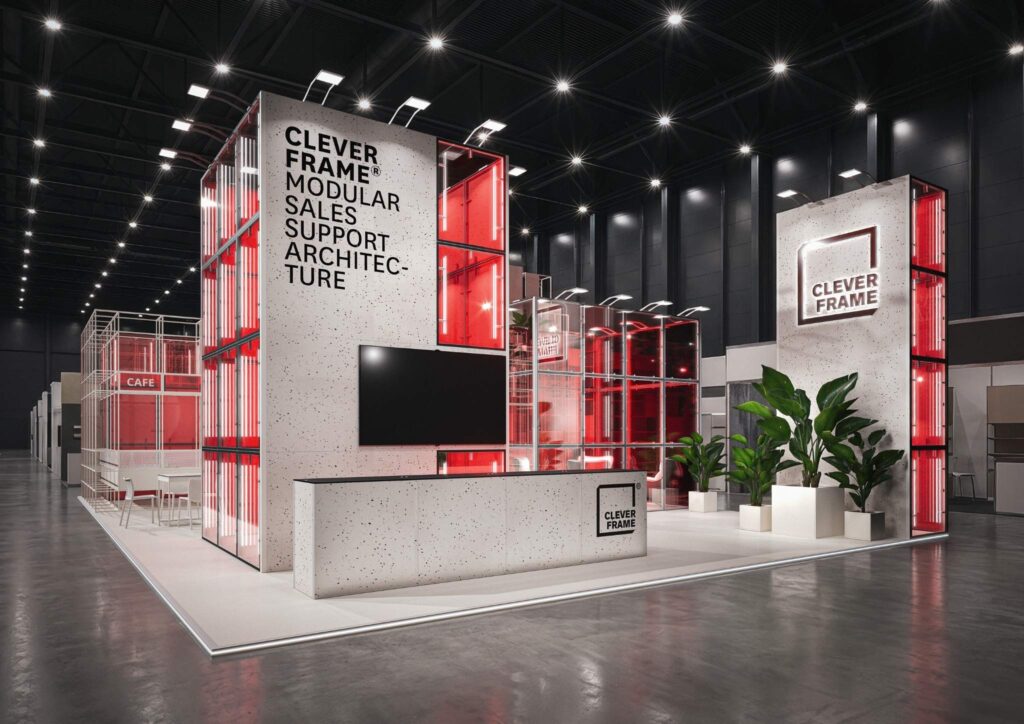
In a sales context, it’s not only about aesthetics, but also function. Well-designed Clever Frame trade show booths can support marketing and sales because they allow you to plan the space as a tool that guides the visitor through the offer.
Visitors should understand in a few seconds who the offer is for and what problem it solves. Avoid message overload. Instead, plan a content hierarchy: a primary headline, a short value promise, and details only after that.
Sales requires different types of conversations. An initial contact looks different from a consultation, and different again from a decision-maker meeting. Space helps when it’s divided into zones with varying interaction intensity, for example:
When graphics, layout, and messaging are consistent, visitors understand the offer faster and are more likely to associate the brand with professionalism. Consistency works like a mental shortcut – it builds credibility without extra words.
A booth designed for lead generation works differently than a space built to launch a new product, and differently again than an exhibit at an industry event with a high volume of B2B meetings. Clever Frame trade show booths are modular, which makes it easier to match the configuration to the event’s goal and floor space, while also enabling later modifications and expansion.
For marketing managers and sales teams, the key question is whether the booth helps them operate faster, more consistently, and with less organisational risk. A modular approach supports event-cycle planning because one concept can be developed and adapted over time.
The Clever Frame system is based on a set of lightweight aluminium frames and dedicated connectors that can be combined, expanded, and reconfigured in a simple, tool-free way according to the brand’s current needs. These building blocks make it possible to create exactly the booth required and then easily change its layout, size, or function – for example, turning an island booth into a row booth or adapting it to a different event space. This approach gives brands real flexibility when planning their presence at different events and allows the same system to be used repeatedly without redesigning the entire booth from scratch.
At trade shows, time and predictability matter. Tool-free setup and teardown simplify logistics, reduce the number of potential on-site issues, and help the team get the space ready for work more efficiently.
The booth’s communication layer should keep up with your offer and campaigns. In Clever Frame, graphic panels can be replaced in seconds thanks to magnetic mounting, and assembly and disassembly do not require tools. This significantly reduces logistics time and on-site workload. One system can support multiple brands or adapt easily to a rebrand or seasonal messaging update. As a result, Clever Frame trade show booths remain highly flexible and practical in everyday use, while the display can change almost instantly.
Scaling event activity depends on logistics. When a booth is designed for transport and repeat use, it’s easier to maintain a steady event rhythm and deliver the same display quality across locations. With Clever Frame trade show booths, efficient packing and space-saving transport are important advantages, making trip planning and storage easier.
To ensure space supports buying decisions, design it like a process. Every element should have a function: attract, explain, guide to contact, or facilitate conversation. Below are actions that help connect booth design with sales goals.
Your booth layout should answer the question: what should happen in the first minute, and what should happen in the next five? The following assumptions help:
Booth graphics should work like a silent salesperson: explain, organise, and reinforce the message. A strong direction is a design where one part of communication drives recognition and another provides arguments, depending on which booth zone the visitor is in.
Clever Frame trade show booths make it easier to prepare multiple variants of the same build – such as a more open layout for lead-generation events and a more office-like setup for B2B meetings. Instead of creating separate concepts, you can develop one visual line and adjust the layout and graphic panels as needed.
More and more, brand evaluation isn’t only about the product, but also about how a company operates. In the events industry, that includes reusing booth structures and reducing one-off builds. From a brand image perspective, modular solutions can support a more responsible event presence model.
In the context of Clever Frame trade show booths, what matters most includes:
Booth efficiency is not just the cost of a single trade show appearance – it’s the entire life cycle of the booth structure. A modular approach supports budget planning because part of the investment can work across many events, while changes mainly involve configuration and visual communication.
In practice, modularity helps reduce recurring costs by:
When a booth is designed modularly, it’s easier to use it across other brand touchpoints. The same booth can support branding and sales even when an event doesn’t follow the classic trade show format.
The most common use cases include:
If trade show booth design is meant to drive sales, it should be planned as a tool that guides visitors through a decision, not as a neutral display. The biggest benefits come from combining function, communication, and logistics into one consistent operating model.
If you have more events planned this season and need to align your booth layout with sales goals and logistics, a good next step is a conversation about how modular Clever Frame trade show booths can be adapted to different floor spaces and team workflows – from quick touchpoints to in-depth meetings.