
Team performance at a trade show depends not only on product knowledge and preparation, but also on how the space works. The right trade show booth design can speed up visitor handling, streamline lead qualification, reduce unnecessary steps, and organise brand communication. In practice, that means less chaos during peak hours, better control of foot traffic, and a stronger visitor experience.
Clever Frame trade show booths are built around a modular approach, making it easier to adapt the layout to the event goal, floor space, and team size. This flexibility translates directly into work pace: from how quickly sales reps take over conversations to how smoothly meetings and presentations rotate throughout the day.
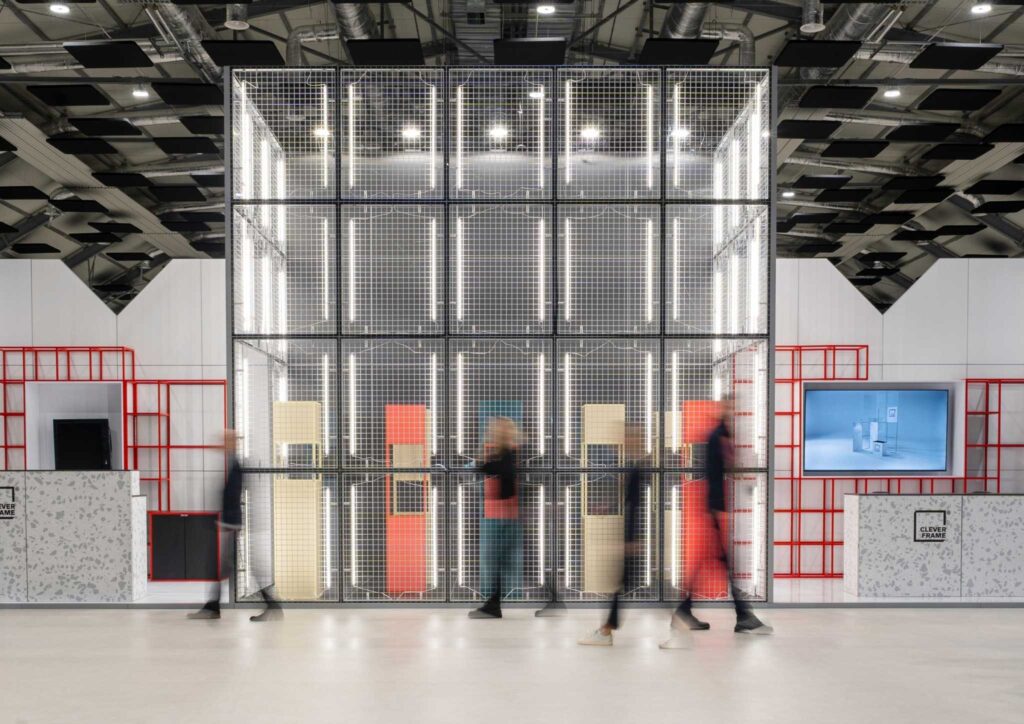
At a trade show booth, several processes happen in parallel: capturing attention, the first conversation, qualification, presenting the offer, handing over the contact for follow-up, and handling materials and logistics. When the layout does not support these stages, the team loses time walking back to the same places, duplicating conversations, or searching for a quieter space to exchange key information.
In a well-designed booth build, the space guides visitors and structures the team’s workflow. What matters most are clear entry points, a predictable traffic flow, zones with different levels of privacy, and points that naturally stop visitors without blocking walkways.
The simplest way to design a layout is to map team responsibilities to zones. A modular approach makes it easier to build layouts that can be modified depending on the event scenario and traffic intensity, without having to replace the entire booth build.
This is the area where quick sorting happens: who needs a short answer and who requires a longer conversation. The layout should support short, dynamic interactions and avoid creating congestion at the entrance.
This area needs more comfort, including acoustic comfort. A layout that is too open lowers conversation quality and lengthens the time needed to clarify customer needs. A layout that is too closed, on the other hand, restricts flow and reduces the number of interactions.
If the product needs to be shown, the booth layout should include a safe viewing distance and a separate path for people who just want a quick look. This helps the team work more efficiently, because some visitors carry out an initial self-assessment and conversations begin with more specific questions.
This does not need to be a large room. What matters is that the team has a place to quickly organise operational items and tools. This kind of zone reduces chaos and shortens response time during peak hours.
Work pace on a stand increases when the space does not force the team to navigate around obstacles. The best layouts are the ones where roles and zones are obvious from the first minute, for both visitors and sales reps – says Artur Balcerzak, Branch Director.
Productivity rises when traffic is smooth and predictable. In practice, visitors should not stop in bottlenecks, and the team should be able to quickly engage the right people and direct them to the next zone. The modular nature of Clever Frame trade show booths makes it easier to adapt the layout to the floor space and hall conditions.
Booth graphics are more than branding. In practice, they are an information shortcut that speeds up conversations and reduces the number of introductory questions. When layout and graphics work together, part of the qualification happens self-serve: visitors understand faster what the brand does and what kind of problem is worth bringing to the team.
In Clever Frame trade show booths, graphic panels can be easily removed and replaced, so changing communication does not require any change to the booth structure. This makes it possible to adapt the display efficiently to seasonal campaigns or changing marketing needs. As a result, message variants can be prepared for different events, or even for different days of the same trade show if the agenda and sales focus shift over time.
It helps to treat visual communication as part of the on-stand conversation script. Well-positioned graphic panels support sales reps in guiding the discussion and make it easier for another team member to take over seamlessly.
The same floor space can work perfectly for two people or completely block six. That is why layout planning should start with operational questions: how many conversations need to happen in parallel, who handles qualification, and who runs presentations. Clever Frame trade show booths let you modify the configuration, expand the booth build, and match changing needs instead of rebuilding from scratch each time.
Work pace does not start when the trade show opens. It starts during preparation, setup, and reorganisation. If the booth build requires long work and many stages, the team loses time, energy, and focus that could otherwise be spent getting ready for conversations.
Clever Frame trade show booths stand out for tool-free assembly and disassembly, which makes organisation easier and reduces the risk of delays. Mobility and space-saving transport also matter, which means logistics can be simpler and booth elements can be reused more effectively at future events.
A sustainable approach to events is not only about minimising waste, but also about designing layouts that can be adapted. A modular booth build makes it possible to reuse the same elements in different configurations, helping reduce the production of one-off solutions for individual events.
The concepts below help you think of booth layout as an operational tool. Each of them can be adjusted through the modular configuration of Clever Frame trade show booths, depending on floor space and event goals.
Works well when the priority is fast qualification and routing valuable contacts into a quieter area.
Helps when the product or service has a longer decision cycle and requires the benefits to be presented in a structured way.
Supports situations where the goal is a high number of contacts and quick handoff to follow-up.
Booth layout is part of an event marketing strategy because it affects conversation quality and the number of valuable contacts. The more the layout reflects the team’s workflow, the easier it is to maintain pace during the busiest hours. A modular approach also supports growth over time, from one event to the next, without having to redesign everything from the beginning.
If your priority is more predictable team performance on the booth in the coming seasons, it is worth starting with a review of your zones and visitor flow, and then aligning the booth configuration accordingly. Examples of layouts and expansion options are presented at https://cleverframe.com/, making it easier to translate operational assumptions into a coherent exhibition solution.