
A one-off booth build can meet its goal at a specific trade show, but it rarely supports the brand in the long term. In practice, events form a calendar: product launches, industry trade shows, conferences, partner meetings, roadshows, or temporary displays at your headquarters. That’s why the key question is increasingly not “how do we build a booth for this event,” but “how do we plan a booth build so it works across the brand lifecycle and can be reused again and again?”
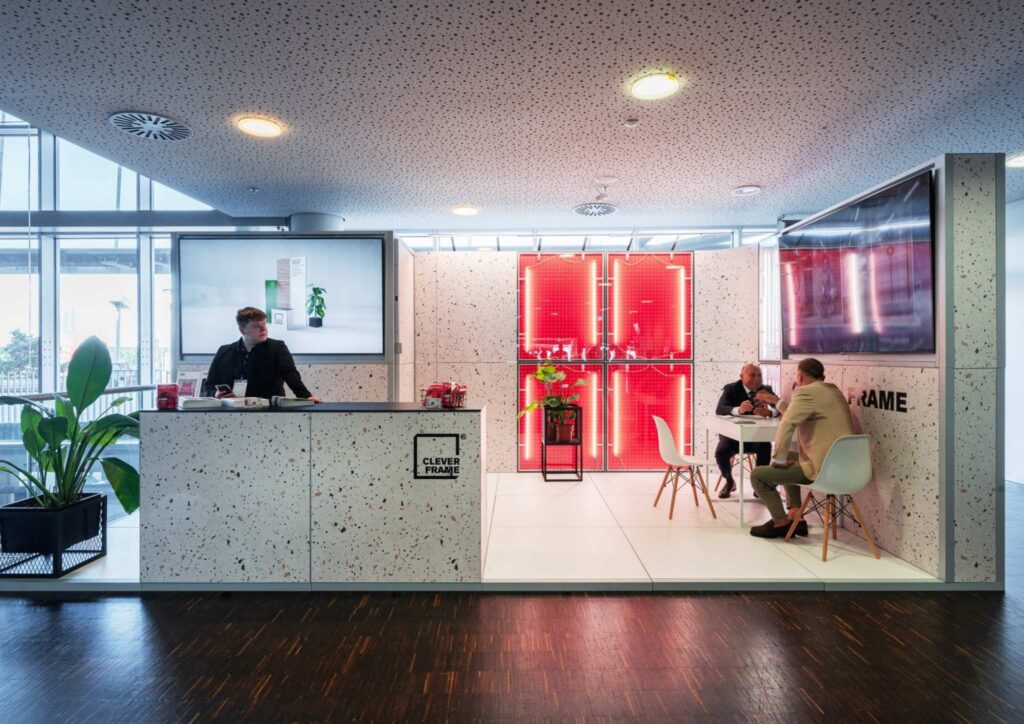
Clever Frame trade show booths meet this need with a modular system, easy tool-free assembly and disassembly, and the ability to update communication quickly. The guide below shows how to plan an exhibit so it stays consistent with your brand, remains flexible across different event formats, and is cost-effective over multiple seasons.
Brands evolve in stages: they build awareness, launch new product lines, expand partner networks, and shift communication priorities. When booth design is treated as part of the brand lifecycle, it becomes a repeatable event marketing tool rather than a short-term cost.
In a multi-event approach, the booth should deliver repeatable outcomes under different conditions: attract attention, structure the visitor journey, support sales conversations, build trust, and reinforce visual consistency. That requires a structure you can reconfigure and scale instead of starting from scratch every time.
In a multi-event cycle, it pays most to think of the booth as a repeatable brand standard. When the base stays consistent and the variables are the layout and messaging, the team gains predictability and can focus on the quality of conversations instead of putting out organizational fires – says Artur Balcerzak, Branch Director.
It’s a strategy in which the booth build is designed to grow and change along with future campaigns and events, without the need to redesign the entire booth from scratch. The foundation is a modular, repeatable structure that ensures a consistent booth character and brand recognition, while the messaging layer and layout remain flexible.
The basic booth structure creates a stable foundation that helps maintain a consistent brand image across different events. A repeatable architecture makes it easier to plan layouts and modify the exhibit when needed.
What usually changes fastest are campaigns and messages. The Clever Frame system allows quick graphic panel replacement and booth reconfiguration, so the exhibit can be adjusted to seasonal campaigns, a rebrand, or changing marketing needs. This way, the brand stays consistent while the booth remains flexible and ready for new challenges.
Planning for more than one event starts with structuring your calendar. Different events come with different goals, space constraints, and conversation dynamics, and that affects the booth configuration.
A useful breakdown includes:
The common denominator is the need for flexible configuration and the ability to expand or modify layouts depending on the available space and the event objective.
In Clever Frame, modularity means that frames and connectors can be combined freely, making it easy to create different booth layouts. A large trade show booth can be quickly reconfigured into a smaller stand for a conference or another event, without the need to redesign everything from scratch. One set of elements can create hundreds of configurations tailored to the event type and floor space. This approach provides full flexibility, saves time, and allows the same base to be reused in different scenarios.
A good practice is to prepare three variants that match the most common on-site conditions. Each version should maintain a cohesive look while differing in scale and function.
It’s worth planning:
This approach simplifies logistics and decision-making: for the next event, you do not create a new project from scratch, but select the configuration that fits the footprint, objective, and schedule.
A multi-event plan assumes the structure can stay the same while the graphic layer and presentation scenario change. This approach supports brand consistency and makes work easier for marketing teams.
In Clever Frame trade show booths, graphic panels can be replaced quickly and easily thanks to magnetic tapes. Changing the graphics is fast and tool-free, making it possible to adapt them to seasonal campaigns or changing marketing needs. In practice, this means the brand can prepare several panel sets and rotate them depending on:
It is also a way to reduce the risk of an outdated display when the brand identity or offer evolves faster than the booth lifecycle.
The booth build should help structure visitor behaviour. In multi-event planning, it is worth thinking of the booth as a tool for guiding a conversation, not just as a graphic surface. The zone layout should be scalable so it can be transferred to a smaller or larger footprint.
An effective approach is to treat zones as functions that can be switched on or off depending on the configuration:
This type of zoning does not require defining a single “centre.” What matters is a clear path, smart placement of key messages, and the ability to adapt the layout to traffic intensity.
In a multi-event cycle, costs and organisational workload often grow more because of logistics than because of the design itself. That is why solutions that simplify transport, setup, and reuse matter.
In the context of Clever Frame trade show booths, the key advantages include:
The result is practical: the team can repeat a proven event presence standard instead of going through a full implementation cycle every time.
Many organisations now link marketing goals with ESG requirements and stakeholder expectations. In the context of booths, what matters most is reducing one-off use. The longer the same booth build is used across the brand lifecycle, the less need there is to produce new elements and the more waste can be reduced after each event.
Modular planning supports sustainability because it:
It is worth emphasising that the sustainability effect does not come from one feature alone, but from a consistent multi-season plan: a usage schedule, replacing only the graphic panels rather than the whole system, and maintaining a coherent display standard.
If the booth is meant to work across the brand lifecycle, it should also be usable beyond the exhibition hall. This is especially important when the number of annual events varies and brand communication needs consistent visibility across different customer touchpoints.
Clever Frame trade show booths can support activities such as:
That way, the investment in the booth is not idle between trade shows, but can work in many different scenarios, supporting brand recognition and consistency.
To make a multi-event approach truly workable, you need a simple set of decisions that structures the design and production process. This kind of checklist makes collaboration between marketing, sales, and the event team easier.
Planning booth design across the brand lifecycle is based on repeatability and flexibility, not one-off creativity. The greatest value comes from combining a stable base with easy communication updates.
If your event plan includes multiple formats and locations, it is worth comparing possible layout variants and the scope of communication changes before materials and operational schedules are created. For reference, you can browse configuration and project examples at https://cleverframe.com/ and use them as a benchmark for building your own seasonal event map.