
A trade show booth is often treated as a project for one single event – delivered fast, on a tight budget, and under pressure to simply look acceptable. This mindset quickly exposes weak points: it becomes difficult to keep visual identity consistent across different events, hard to react to changes in the event plan, and the cost of each new execution keeps growing. The alternative is an ecosystem approach, where the booth becomes a reusable marketing tool that supports sales, branding, and communication goals throughout the year.
Clever Frame trade show booths fit this model well. A modular structure plus tool-free assembly and disassembly make it possible to treat the booth as a long-term brand asset – ready to be used at future events, across campaigns, and in different display formats. In practice, the communication and graphic layer change, while the structure itself remains a stable, recognisable base.
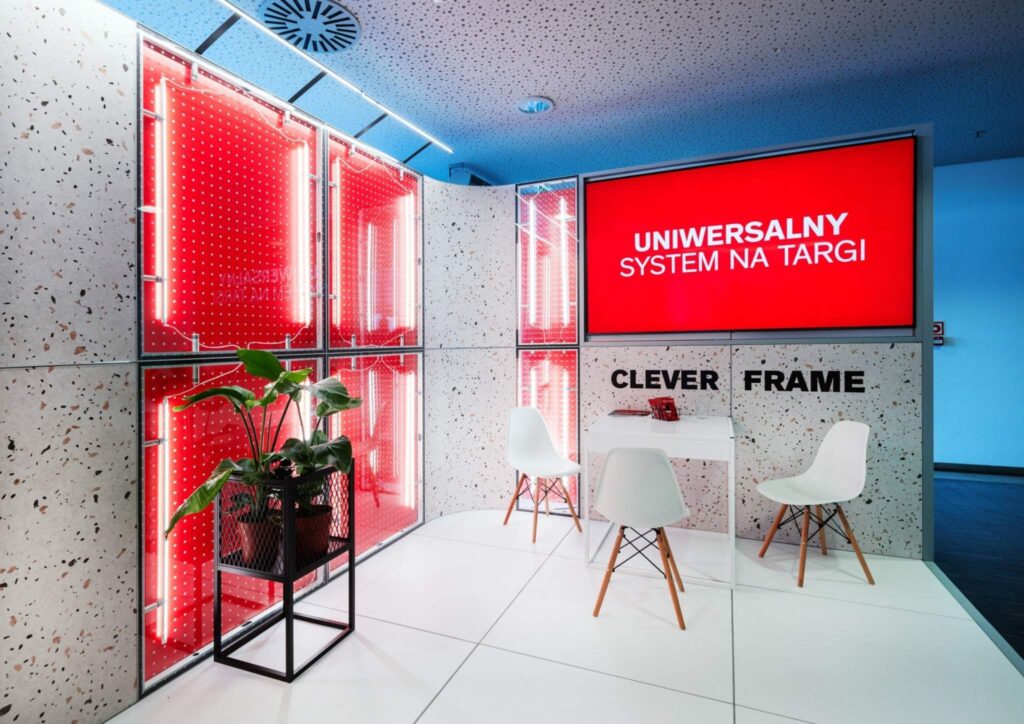
A marketing ecosystem can be understood as a set of consistent brand touchpoints – from industry events and showrooms to PR and sales activities. In this approach, trade show booth design is not decoration, but part of the communication strategy and the overall brand experience.
Consistency goes beyond a logo and colour palette. In a well-designed exhibit, what matters is whether the audience recognises the brand and understands the offer within seconds, and then moves naturally into a conversation with the team. Clever Frame modular trade show booths make it easier to maintain consistent visual and functional frameworks across multiple events, because the layout can change while the visual identity remains consistent.
When a booth is designed as part of an ecosystem rather than a one-off decoration, the brand gains an advantage in predictability: more consistency, faster preparation, and less improvisation on-site – says Artur Balcerzak, Branch Director.
Consistency includes, among other things:
Event plans often change: different floor space, a different hall layout, different goals, a new product launch. That is why modularity matters not only for logistics, but also for marketing. Clever Frame trade show booths allow you to build configurations of different sizes and layouts from the same set of elements, tailored to a specific event, without designing the booth from scratch each time.
A modular structure means frames can form different layouts. As a result, the same investment can support a major trade show, a smaller industry conference, or a recruitment event – adapted to the space and the conversation scenarios planned for the audience.
In practice, this flexibility supports actions such as:
In event marketing, time is a critical resource. Tool-free assembly and disassembly make delivery easier in tight schedules, reduce the risk of delays, and improve on-site predictability. This feature also matters to marketing teams coordinating many elements at once: logistics, materials, sales briefs, and the booth activation plan.
The biggest problem with one-off booth builds is that they can only be used once and then stop working for the brand. In an ecosystem approach, you need a layer that can be changed faster than the structure itself.
In Clever Frame trade show booths, that layer is handled by graphic panels that can be replaced quickly and easily. This allows the booth to remain functional and consistent while adapting to seasonal campaigns, new products, or changing marketing needs – without rebuilding the structure.
It is worth designing panel messaging the same way a 360 campaign is designed: for recognition, readability, and quick understanding of value. A good practice is to divide content into fixed and variable layers.
An example of planning communication layers:
A well-designed modular booth should support visitor behaviour: stopping, interacting, talking, and leaving contact details. Brand perception is built through a clear layout and a consistent narrative.
When planning an exhibit, it helps to think in terms of micro-scenarios: what the visitor sees from a distance, what is communicated at the entrance, and where conversations take place. Clever Frame trade show booths make it easier to align the layout with these scenarios, because the configuration can be modified depending on the event objective.
From a booth UX perspective, it is worth focusing on:
Sustainability in events often begins with reducing single-use production. A modular approach supports a longer lifecycle for the booth build and reduces the need to create new structures every time marketing plans change.
In the ecosystem model, the most important factors are:
Event expenses are not limited to producing the booth itself. Additional costs include new designs, adaptations, transport, storage, and team time. The ecosystem approach shifts the focus from repeated purchases to a deliberate investment in an asset that can be developed and modified over time.
Efficiency does not result from one single feature, but from the whole chain of actions. Clever Frame trade show booths make work easier when the goal is repeated use of the same elements and quick adaptation of the exhibit to the marketing plan.
The most common sources of organisational savings include:
A marketing ecosystem rarely ends with trade fairs. A modular booth can support year-round activities in different contexts, especially where consistent branding and quick adaptation to space matter.
The same structure can be used in many scenarios, provided the communication and layout are adapted to the objective. It is worth considering the booth for formats such as:
Changing the approach starts with the brief. Instead of asking only about square footage and the number of walls, it is worth gathering information that makes it possible to treat the booth as a tool for many events.
Before starting work on the configuration and design, it is worth organising the key assumptions:
An ecosystem approach to booth design helps structure marketing work and increases predictability in event planning. The most important elements of this model are:
If you want to treat your exhibit as a brand asset, start with one simple step: list your events for the next 12 months and assign goals and required booth functions to each. Then choose a modular base and plan 2-3 configuration variants plus sets of graphic panels for campaigns. You can find examples of this approach and implementation inspiration on our website.