
Brand presence at business events is no longer limited to traditional trade shows. Today, conferences, summits, industry forums, partner events and hybrid events are just as important – formats in which part of the experience happens on-site, while another part takes place simultaneously via livestream, in an event app or in digital content published later. This also means the logic behind exhibition stand design is changing. Not every brand needs a full-scale trade show booth. In some cases, a sponsor zone is the better solution; in others, a compact mini expo works best; and sometimes a traditional exhibition stand is still the right choice.
That is why, before deciding on the format of your presence, it is worth asking a few simple questions: what is the main goal of the event, how much time will attendees realistically spend with the brand, and is the priority visibility, conversations, product demonstrations, networking or perhaps a combination of offline and online engagement? Only from this perspective does it become clear that an exhibition stand is not just a backdrop. It is a tool designed to support a specific brand activation scenario.
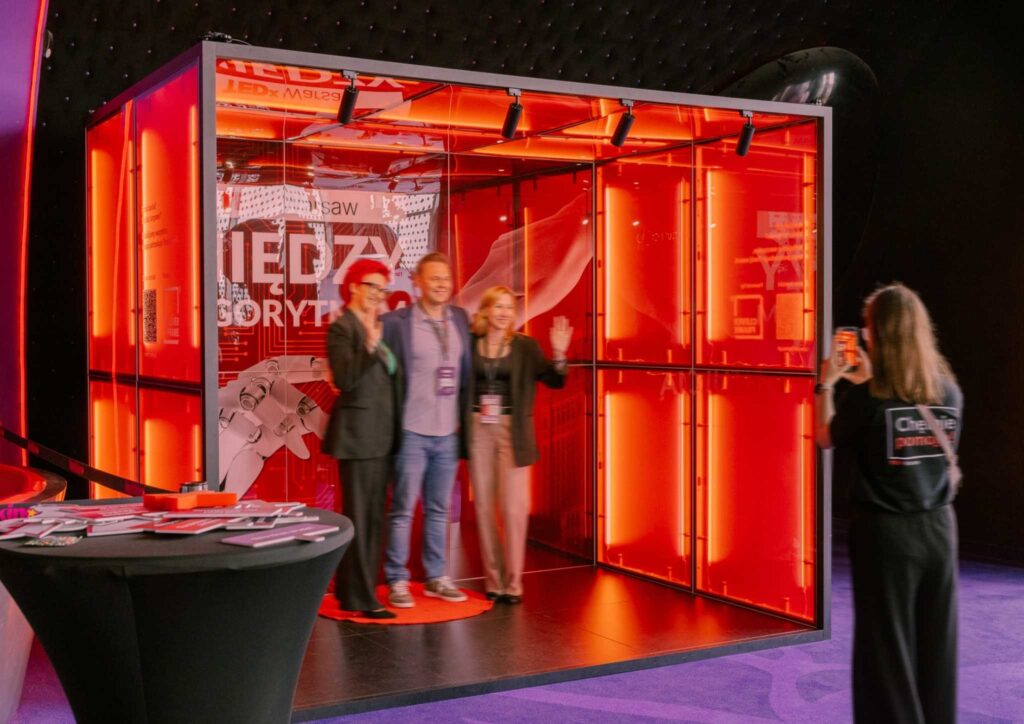
For conferences and hybrid events, exhibition needs are often different from those on a traditional trade show floor. Traffic tends to come in waves, attendees move more frequently between the stage, networking area and exhibition space, and contact with the brand is often shorter but more intense. That is why flexible configurations, quick communication updates and layouts designed for a specific event format become so important. In this context, Clever Frame trade show booths perform just as well beyond classic exhibitions, because their modular structure makes it possible to adapt the stand to different event types, levels of presence and venue layouts.
At a traditional trade show, attendees usually arrive intending to explore booths, compare offers and speak with exhibitors. At a conference, the center of gravity shifts. The event revolves around the agenda: the stage, keynote talks, panels, networking and sometimes workshops. The exhibition area plays a different role than it does at trade shows. It is often there to support brand presence, build awareness and generate contact in shorter time windows between sessions.
This changes a great deal in exhibition stand design. At a conference, you do not always need an elaborate setup with multiple walls and clearly separated areas. What often matters far more is:
A hybrid event adds another dimension. Sometimes the exhibition stand must work not only for people attending in person, but also for the camera, event photography, livestreams and content published after the event. This means the brand space should be designed not only around attendee flow, but also around how the brand will appear online.
A sponsor zone is a solution particularly well suited to conferences, summits and events where a brand wants a strong presence but does not necessarily need the classic “full booth” model. Its main purpose is usually to build visibility, strengthen the connection with the event and create a space for brief interactions with attendees.
This format works best when the brand:
In a sponsor zone, simplicity, strong visibility and a clear message hierarchy are key. Within a few seconds, attendees should understand who the brand is, what it brings to the event and whether it is worth stopping by. This is not a space that should overwhelm visitors. On the contrary, it works best when it looks light, professional and naturally aligned with the rhythm of the conference.
In practice, a well-designed sponsor zone may include:
A mini expo is a very interesting in-between format. It works well when a standard sponsor zone would be too small, but a traditional trade show booth would be too extensive or simply out of proportion to the nature of the event. It is a solution for brands that want to hold conversations, showcase a product, organise a short demo or arrange several functions within a limited footprint.
In practice, a mini expo works particularly well during:
The biggest advantage of a mini expo is that it allows several objectives to be combined at once: visibility, engagement, presentation and operational order. This matters because a brand’s conference presence rarely comes down to just one task. The team wants to talk, present the offer, collect leads and, at the same time, avoid dominating the entire space.
In this format, functional zones are especially important. Even within a limited area, it is worth planning:
This is exactly where the advantage of modular exhibition stands becomes especially visible. The same base structure can be configured as a lighter, more open expo area for a conference and, for another event, expanded into a larger, more traditional exhibition presence.
Despite the growing popularity of conferences and hybrid events, a traditional trade show booth remains an excellent solution in many situations. This is especially true when a brand needs greater control over the space, plans longer sales conversations or wants to present its offer in a more structured and comprehensive way.
A traditional exhibition stand is the right choice when:
A traditional trade show booth offers greater freedom in planning the visitor journey and more control over the brand experience. It makes it easier to separate a meeting area, demonstration space, product display and team back-of-house area. This format is particularly effective in B2B environments, where sales conversations need time, privacy and a well-organised space.
That does not mean, however, that a traditional booth has to feel heavy, closed off or inflexible. In a well-designed modular solution, it can retain a professional character while still allowing changes in layout, scale and messaging from one event to another.
One of the most common mistakes is choosing a presence format out of habit. A brand has exhibited several times at trade shows using a traditional setup, so it automatically repeats the same model at a conference. Or the opposite: it chooses a lightweight sponsor zone where it actually needs a more developed space for conversations. In reality, the starting point should always be strategic.
In practice, it is worth answering five questions:
Only then does it become clear whether a lightweight sponsor zone, a more functional mini expo or a traditional trade show booth is the better option. This is also extremely important from a cost perspective, because a well-matched exhibition stand helps you use your budget more effectively and avoid overspending on a format that does not meet the event’s actual needs.
A hybrid event requires brands to think on two tracks at once. On one hand, you need to design the experience for attendees on-site. On the other, you need to make sure the brand area looks right in online communication, photos, livestreams, recordings and post-event content.
This means the exhibition stand must support not only attendee flow, but also the brand’s media communication. In practice, elements such as the following become increasingly important:
In this context, simplicity and modularity are especially important. A brand space should not be designed for just one viewing angle. It must work across channels: for the visitor, the photographer, the camera operator and the content that will continue to live on after the event has ended.
At traditional trade shows, brands usually have more time to develop their messaging. Attendees are often prepared to explore, compare and talk. At a conference, contact with the brand is often shorter. People move between rooms, return from presentations and pause only briefly between programme blocks. This means the communication on the exhibition stand needs to work faster.
That is why, at conferences and hybrid events, a simplified message architecture works particularly well:
It is also important to remember that communication at these events often needs to be updated between one event and the next. At one time the priority may be the product, at another a partnership, a launch, a seasonal campaign or a specific audience segment. That is why solutions with interchangeable graphic panels are so practical. They allow you to keep the same exhibition stand base while changing the message without rebuilding everything from scratch.
In Clever Frame trade show booths, graphic panels mounted with magnetic tape can be replaced easily, allowing messaging to be adapted to seasonal campaigns or changing marketing needs. As a result, the brand retains a consistent exhibition stand base while updating its communication flexibly – something particularly useful for conferences, summits and hybrid events, where the same style of brand presence needs to work in many different versions.
Conferences very often mean shorter setup windows, tighter spaces and greater pressure for smooth on-site execution. Brands are usually not operating on a large, empty exhibition hall floor, but in a shared environment with other partners, networking zones, catering areas and attendee traffic. This means operational simplicity becomes critical in exhibition stand design.
The most important factors then are:
That is exactly why modular exhibition stands work so well not only at trade shows, but also in conference formats. They make the team’s job easier, reduce logistical stress and allow brand presence to be approached more systematically – as an asset used across multiple events rather than a one-off project.
Conferences, summits and hybrid events often take place in cycles. A brand may be a sponsor once, a zone partner another time, and a mini expo exhibitor on another occasion. If it builds a new exhibition stand from scratch every time, it loses not only budget, but also operational and visual consistency. A far better approach is one in which a single base can be configured for different presence formats.
This also matters from the perspective of a more responsible approach to event marketing. Using the same modular exhibition stand across many events reduces the need to produce new elements and makes it possible to update mainly the communication layer. In practice, this creates a combination of three benefits:
If a brand wants to match its exhibition stand to a conference or hybrid event, it is best to treat the format choice as a strategic decision rather than an aesthetic one. The simplest approach looks like this:
Regardless of the format, the best-performing exhibition stand is one that offers flexible configuration, allows fast communication updates and supports the brand not just at one event, but across an entire cycle of offline presence.
If you are planning your brand presence at a conference, summit or hybrid event, it is worth relying on a solution that gives you the freedom to match the format to the event objective. Clever Frame trade show booths provide a modular base that can be configured as a sponsor zone, mini expo or more traditional exhibition stand – depending on the nature of the event and the brand’s needs.