
For a marketing manager, discussing the budget for a trade show booth can be far more difficult than preparing for the event itself. The marketing team sees the potential: meeting customers, building relationships, showcasing the product, making the brand stand out, and supporting sales. The board sees it differently. From their perspective, a trade show booth is not about inspiration or aesthetics, but an investment decision that needs a solid business case, a predictable cost, and long-term value.
This is exactly where the biggest tension often appears. Marketing talks about brand image, brand experience, and the quality of the company’s presence at trade shows. The board asks about return, risk, utilization, and impact on results. If the conversation is framed only around a “great-looking booth,” it is very easy to lose. But if the booth is presented as a sales and operational tool that can be reused, scaled, and budgeted in advance, the entire perspective changes.
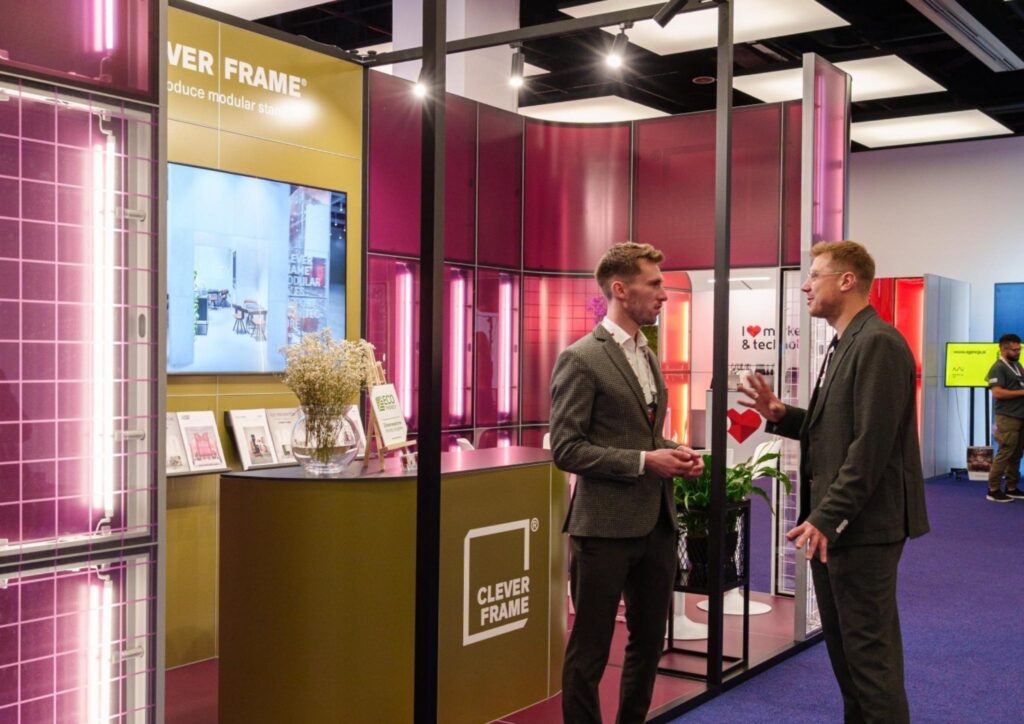
That is why, when speaking with decision-makers, it is worth shifting the focus from the cost of a single event to the logic of a long-term investment. This is especially clear in the case of modular solutions such as Clever Frame trade show booths. In this model, the exhibit is not a one-off build “for one trade show,” but a base system that can be expanded, reconfigured, and reused at future events without starting from scratch every time.
Most often, the problem is not that the board “doesn’t understand trade shows,” but that marketing and leadership use different evaluation criteria. For marketing, the booth is a brand communication tool, a way to improve the quality of customer interactions, and support for sales activity. For decision-makers, it is an expense competing with other investments: digital campaigns, product development, sales initiatives, or hiring.
If the conversation is going to be effective, you need to move beyond arguments such as “we need to look good” or “the competition will be there too.” For the board, the more important questions are:
That is why the most effective conversation with the board is not really about the “booth” itself, but about the brand’s event marketing model. If the exhibit is positioned as part of a broader event marketing strategy, it becomes much easier to defend it as an investment rather than a one-time cost.
The best starting point is not the booth design, but the business objective. The board should not see renderings first. They should first understand why the brand wants to invest in trade show presence and which processes that investment is meant to support.
In practice, it is worth starting with a short answer to three questions:
This is crucial, because only then can you change the narrative. If the company participates in one event every few years, the investment logic will be different. But if the brand operates on a model of several or even a dozen events per year, it makes much more sense to talk about the trade show booth as an asset designed to work repeatedly. This perspective is also supported by a broader view of exhibition planning, which we discuss in the article Trade Show Booth Design Across the Brand Lifecycle: How to Plan an Exhibit for More Than One Event.
This is usually the strongest argument. The board is far more likely to approve spending that can be amortized over time and used in multiple settings than the cost of a single event with no further value. So in the conversation, it is worth presenting the booth as a base system for the entire event calendar: industry trade shows, conferences, partner meetings, roadshows, or showrooms.
With modular solutions, the logic is simple: the same structure can be used many times, while the layout, scale, and messaging can change. That means the cost does not “disappear” after one event, but is distributed across future brand activities. This perspective is also reinforced in the article Exhibition Stand Layout and Marketing Goals – How to Design a Space that Drives Brand Success?
Flexibility matters enormously to the board. If the company needs a smaller booth today and a larger configuration six months from now, the best investment is one that allows growth without resetting the entire project. That is exactly the advantage of modularity: the ability to expand and modify the layout without replacing the whole exhibit.
This is particularly important for companies that are building their event calendar gradually. Instead of buying a new solution for every event, they can work from one base and adapt it to the floor space, the event objective, and the conversation scenario – from compact displays to larger, more advanced exhibit builds. From the board’s perspective, that means less risk of wasted budget and greater control over spending.
One of decision-makers’ biggest concerns is not the cost itself, but the unpredictability of that cost. The more one-off builds there are, the greater the risk of changing quotes, revisions, time pressure, and additional expenses appearing just before the event. A modular exhibit system brings order to this process because the brand works with a known structure and a familiar preparation framework.
In practice, it is worth showing that investing in a trade show booth can reduce:
This matters because the board often evaluates not only the budget itself, but also how much operational energy the organization will need to spend managing it.
Many companies avoid investing in a trade show booth because they assume that once the campaign, product, or branding changes, everything will need to be rebuilt anyway. This is one of the most important myths to challenge during the conversation. A well-designed modular booth separates the structure from the communication layer.
In Clever Frame trade show booths, graphic panels can be replaced easily, which means the booth messaging can be quickly adapted to seasonal campaigns or changing marketing needs. For the board, the message is simple: we invest once in the exhibit structure, and then manage the communication without rebuilding the entire booth, while keeping the display visually consistent. We explore this topic further in the article New Branding, Same Structure – Changing the Message Without a New Booth.
The board needs to see that the booth is not decoration, but a process tool. That means it should support specific tasks: attracting the right audience, enabling conversations, presenting the solution, qualifying leads, and helping the sales team work effectively at the event.
That is why it makes sense to talk about the booth in terms of function:
The more the booth functions as a sales tool, the easier it is to justify its value in a conversation with the board. In this context, the article When Does a Trade Show Booth Start Holding You Back – and When Does It Support Your Sales Team? may also be helpful.
Even the best argument needs numbers, or at least a logical comparison model. The point is not to promise an unrealistic ROI after a single event. It is better to prepare a set of data that shows the scale of use and the predictability of the investment.
Before the meeting, it is worth gathering:
It is also worth preparing a simple matrix showing how many times the booth base can be used per year and which types of costs will no longer repeat at every event. For the board, that is much clearer than a design visualization alone.
If you need a stronger foundation for a budget conversation, the article How much does a trade fair stand cost? is also a useful complement, as it helps organize what actually makes up the real cost of trade show participation.
The best answer is: exactly – which is why we are not treating it as the cost of one event. We are presenting a plan to use the same base across several or a dozen activities, with the flexibility to adapt the layout and messaging to different formats.
That is actually the best argument for modularity. If the brand does not have full predictability, it is better to invest in a scalable solution than a rigid one. A modular booth system allows changes without resetting the whole investment.
Not if the structure and the communication are separated. In that model, the base stays the same, and only the graphics and selected messaging elements need to be updated.
This is another advantage of modular solutions. Tool-free assembly and disassembly, space-saving transport, and predictable configurations simplify logistics instead of making them more complicated.
The best approach is to talk about Clever Frame not as a single project, but as a model for how the brand operates at events. The board does not need to buy into the idea of a “nice-looking booth.” They need to see the advantages of the model:
This way of thinking is exactly what makes the conversation with the board much easier. The question stops being “should we spend money on a booth?” and becomes “do we want to continue operating with one-off event costs, or shift to a more scalable and predictable model?”
Before meeting with decision-makers, it is worth preparing a short set of points to structure the presentation:
The most effective conversation about a trade show booth is not about the exhibit build itself. It is about the brand’s event presence model, cost predictability, and whether the company wants to build an asset that delivers value over time. For the board, the most important thing is not the emotion around the design, but the investment logic behind it.
The key arguments worth remembering are:
If you want to prepare better for a conversation with the board about investing in a trade show booth, it is worth presenting not just the booth design itself, but the full operating model: scalability, repeat usability, easy message updates, and predictable costs. Clever Frame trade show booths provide a modular base that can be adapted to different event formats and expanded along with the brand’s event calendar – so that conversations with decision-makers are grounded in concrete business logic, not aesthetics alone.