
Visitor traffic at a trade show stand is rarely stable. A single presentation, a mention in the event programme, a social media post or a sudden influx of attendees during a break can turn a calm exhibition into a very intense conversation zone within minutes. On the other hand, there are low-traffic periods when the number of visitors drops and the team has to reorganise its work flexibly.
Analyses by CEIR on visitor behaviour on exhibition floors show that traffic is concentrated in specific hours and zones, and that the most active moments have a significant impact on the number of real business conversations.[1] Reports by Bizzabo and Event Marketer emphasise that brands which plan for both high-traffic and low-traffic scenarios achieve better results in terms of both leads and participant satisfaction.[2][3] At the same time, materials from Freeman and PCMA show that well planned visitor flow management helps improve the guest experience without increasing the stand budget.[4][5]
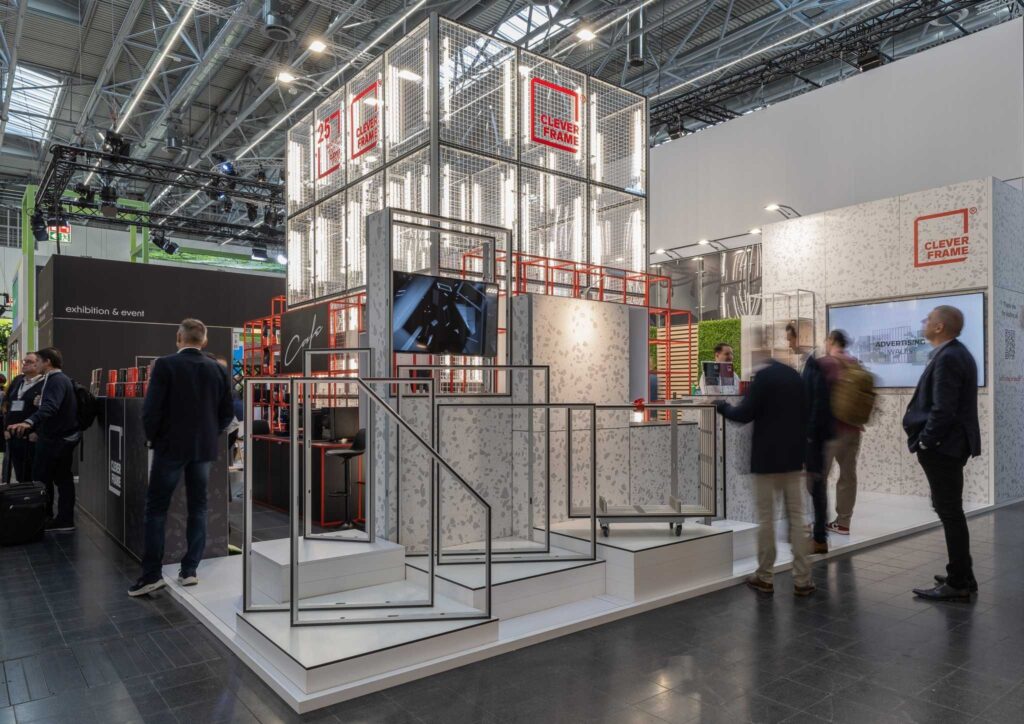
Clever Frame trade show stands, based on modular solutions, support this kind of approach. The modular structure makes it possible to quickly introduce changes to the layout of the zones, and the magnetic system makes it easier to replace graphic panels and messages between subsequent events. As a result, one stand configuration can support both high-traffic and low-traffic scenarios, without the need to design the stand from scratch.
At the stand design stage many teams assume an “average” level of traffic. In practice, a situation of perfectly even interest almost never occurs. Data from reports on participant behaviour at events show that:
High-traffic and low-traffic scenarios help teams move from a reactive mode to deliberate design. The team does not start thinking on the show floor about what to do when a queue forms at the stand or when it is quieter for an hour, but instead follows a previously prepared plan – says Artur Balcerzak, Branch Director at Clever Frame. This approach also makes it easier to analyse the data after the event, because it is clear which actions were triggered in specific situations.
A high-traffic scenario describes moments when an above-average number of visitors gather at the stand. These may be caused by a planned activity (presentation, announcement, demo) or by an independent factor, such as a break in the programme or a location next to a main aisle.
In practice, it is worth defining simple criteria that trigger “high-traffic mode”, for example:
Such thresholds can be defined before the trade show, taking into account the size of the stand, the number of team members and the nature of the event.
Clever Frame trade show stands make it easier to create a layout that works well even during peak times. It is worth planning:
The modular structure makes it possible to create different variants of entrances and exits to and from the stand. With a well planned layout, visitors who see a larger group in the presentation area can still easily reach the materials zone or a space for a short conversation.
Even the best designed stand requires good organisation of the team’s work. In a high-traffic scenario it is worth defining in advance that:
Reports on event attendee experience emphasise that clear service rules improve visitors’ perception of the stand, even if they have to wait a short time for a longer conversation.[3][5]
During periods of increased traffic some visitors will interact primarily with the visual layer rather than with team members right away. That is why it is important to make sure that the graphic panels clearly answer the following questions:
The magnetic system used in Clever Frame trade show stands makes it possible to replace graphic panels quickly. This allows the brand to prepare communication versions dedicated to events where higher traffic is expected, for example with a more prominent invitation to get in touch after the trade show or to schedule an online meeting.
Low-traffic periods are a natural part of the trade show day: during important keynote sessions, early in the morning or just after the main programme blocks have finished. Instead of treating them only as “downtime”, they can be planned as a separate activity scenario.
In quieter moments the team can focus on activities that are difficult to carry out when traffic is high, such as:
Material from such activities can later be used in social media communication or when reporting the event results.
Clever Frame modular trade show stands make it possible to introduce small layout changes between trade show days, and sometimes even during the event itself (within the organiser’s regulations). During low-traffic periods it is possible, for example, to:
Such micro tests fit well with the iterative approach described in reports on designing attendee experiences: instead of waiting for the next edition, it is worth implementing improvements already during the trade show cycle.[3][4]
In a low-traffic scenario the team can move from a reactive to a proactive mode. Examples of such activities include:
Analyses by Bizzabo and Event Marketer show that such activities increase the likelihood of engaging people who otherwise would have walked past the stand without stopping.[2][3]
The key to using high-traffic and low-traffic scenarios effectively is a stand design that ensures flexibility. Clever Frame trade show stands support this approach thanks to:
In practice this means that when planning participation in several events, a brand can prepare different layout variants: focused on intense traffic, on longer conversations or on educational presentations. The team can choose the configuration depending on the trade show profile, expected traffic levels and insights from previous editions.
High-traffic and low-traffic scenarios help make better use of the potential of a trade show stand. In practice it is worth:
Reports by CEIR, Bizzabo, Event Marketer, Freeman and PCMA show that brands which organise stand operations around specific scenarios achieve better results in terms of contact quality and visitor satisfaction.[1][2][3][4][5] Preparing for both high-traffic and low-traffic does not require complex technology, but rather a deliberate combination of spatial design, visual communication and team organisation.
Clever Frame trade show stands make it easier to implement this approach thanks to their modular structure and magnetic graphic panels. A single investment in stand construction can support different traffic scenarios and various types of events, giving the team a tool that supports iterative improvement of the stand concept.
If a brand is planning to exhibit at trade shows and wants to be better prepared for fluctuating traffic at the stand, it is worth considering cooperation with Clever Frame. The team helps translate high-traffic and low-traffic scenarios into a concrete stand design that supports business goals and makes work during the event easier.