
One brand, multiple event formats, and one consistent goal: a coherent presence that supports marketing, sales, and relationships. The challenge begins when every venue plays by different rules – one day it’s an island booth at a trade show, the next it’s a branded area at a conference, and later it’s a series of roadshow stops. In this situation, planning the booth build becomes essential, so the same set of elements can be used in different configurations – adapting the layout, messages, and booth functions to the nature of the event without starting from scratch.
Clever Frame trade show booths help brands design exhibits with repeated use in mind. Modular structures make it easier to adapt the booth build to different floor plans, while graphic panels can be replaced easily, so communication can be updated on an ongoing basis and aligned with seasonal campaigns or changing marketing needs. Tool-free assembly and disassembly also make a real difference when you’re working with an intensive event calendar.
The most common mistake in event planning is treating every event as a separate project. This leads to inconsistent branding, more operational workload, more difficult quality control, and duplicated costs – because each time, designing, producing, and preparing the booth starts from scratch. A modular approach means that, already at the concept stage, you create a set of elements that can be used to build different layouts depending on the venue and the event goal.
In practice, this means better resource utilisation and more predictable event operations, because the structural base stays the same while only the configurations and graphics change to match the message.
Before any booth layouts are sketched, it is worth organising the goals of your event presence. A booth designed for lead generation at a trade show will look different from one built for education at a conference or for reaching multiple locations quickly during a roadshow. Zone functions and communication priorities should result from those goals.
For the booth build to work across multiple formats, the brief should cover both the fixed brand elements and the variable scenarios. The following questions are especially useful:
Modularity is not only about fitting into a space, but above all about working with a set of repeatable elements that can be combined into different layouts. In practice, this makes it easier to scale the exhibit up or down depending on available floor space and the needs of the event.
In modular planning, the “core + variants” model works particularly well. The core includes the elements that always appear, while the variants are additional sets used depending on the event format. This model improves consistency and shortens preparation time before each new event.
The core usually includes the elements responsible for brand recognition and the primary brand narrative. Variants can reinforce specific goals – for example, more space for meetings, stronger product display, or a more prominent communication wrap.
The best reusable exhibits are designed like a system, not a one-off set. When the core stays consistent, the team works faster, and each new rollout becomes a simpler operational decision – says Artur Balcerzak, Branch Director.
Each format requires different design decisions. The same booth build can work across all of them if you assume from the beginning that the layout and graphics will change, rather than rebuilding from scratch.
At trade shows, you need to capture attention quickly and communicate clearly from a distance. At the same time, the booth must handle a high number of conversations and frequent staff rotation. In practice, that means a need for a clear functional division and a simple visitor journey.
It is worth taking care of elements that keep a consistent communication front in different layouts and allow fast message refreshes for the next trade show edition. In this context, it matters that the Clever Frame system makes it easy to replace graphic panels, adapting them to seasonal campaigns or changing marketing needs.
At conferences, attendees often come for knowledge rather than an offer. Booth design should therefore support credibility and make conversation easier instead of shouting a sales message. A calmer narrative, clear problem-solution communication, and space for consultation tend to work better here.
Speed of response to the agenda and current topics also matters. Interchangeable graphic panels make it possible to prepare a version focused on a specific product, service, or area of expertise without replacing the entire booth build.
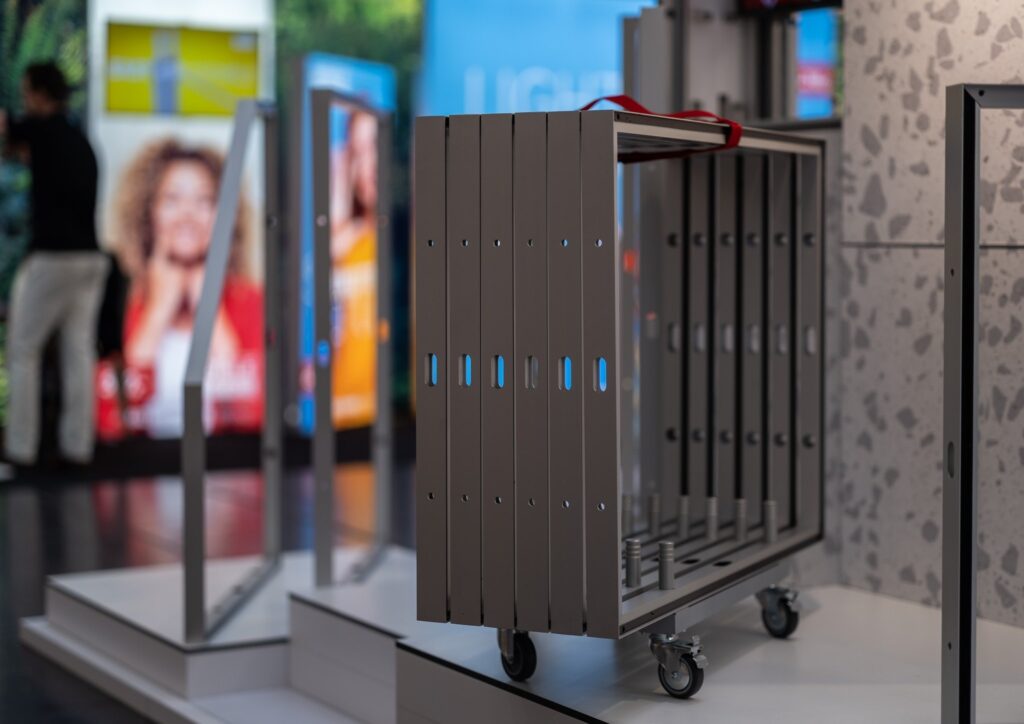
A roadshow is an operational test: time, repeatable setup, and ease of transport matter most. A modular structure made of elements that can be transported in compact form makes the event team’s work significantly easier. Tool-free assembly and disassembly are also important, because they reduce the risk of delays and simplify work across multiple locations.
A multi-purpose booth needs two levels of communication: consistent brand identification and variable messages aligned with each event’s goal. This way, the exhibit remains recognisable while avoiding the effect of looking exactly the same at every event.
It is worth planning graphics around thematic panel sets that can be rotated depending on the event. In practice, this makes marketing rollout schedules easier to manage and allows faster preparation without designing everything from scratch.
What matters is that the Clever Frame system makes graphic panel replacement easy, adapting them to seasonal campaigns or changing marketing needs. This makes it possible to keep the same structural base while changing the visual and communication layer.
A well-planned booth build should make it possible to repeat the same functions even when the footprint changes. The goal is to recreate key scenarios in every configuration: welcome and initial qualification, conversation, presentation, and closing the interaction.
Instead of designing a layout for one specific trade show, it is better to think in terms of functions that are universal for most events. That makes it easier to transfer them between formats and maintain repeatable team workflows.
In practice, Clever Frame trade show booths make it possible to adapt the layout to the venue while keeping the same functions and a consistent look. In addition, tool-free assembly and disassembly make it easier to move quickly between configurations.
Even the best design will fail if the event team loses time to unpredictable setup or lacks control over the components. Planning for multiple events should therefore cover not only the look, but also an operating standard: packing, transport, checklists, and usage rules.
When a booth build is reused multiple times, a repeatable process matters most. The checklist below helps structure preparations regardless of the event format:
In the context of roadshows and frequent location changes, repeatability of assembly and the lack of any need for tools during assembly and disassembly are especially important.
Long-term and repeated use of the same booth build is a practical step toward reducing event waste. Instead of producing one-off elements for every event, it is better to build a base that works across many cycles and change only what genuinely needs to change.
With a modular approach, it is also easier to plan upgrades in stages: expand the layout, refresh the communication, or change the function of zones without replacing the entire structure. This supports responsible resource management and makes sustainability reporting easier, without relying on unverifiable numbers.
In practice, it is worth preparing a set of three variants that match the most common event situations. Each variant should use the same base elements and differ only in layout and the set of graphic panels.
The trade show variant should highlight key messages and enable quick conversation starts. Readability and consistent branding are the priority, while the graphics can place stronger emphasis on an offer or a product launch.
The conference variant can limit the number of messages to those that support substantive conversation. Interchangeable graphic panels make it possible to prepare a version focused on solving a specific problem or addressing a selected audience segment.
The roadshow variant should be easy to recreate by different teams in different locations. The key priorities are compact transport, fast setup, and the ability to adapt graphics to local messages or campaign stages.
To make one booth build work effectively at trade shows, conferences, and roadshows, it is worth following a few principles that stabilise both design and operations.
If you are planning an event season that includes multiple formats such as trade shows, conferences, and roadshows, start by mapping the fixed core of the exhibit and 2-3 configuration variants for the most common scenarios. Examples of modular solutions and ways of working with interchangeable graphic panels are available at https://cleverframe.com/ – a strong starting point for turning marketing goals into a predictable event presence system.