
What is a tone of voice?
Tone of voice (your brand’s communication style) is a set of guidelines that defines how a brand speaks to its audience – through word choice, writing and speaking style, level of formality, sentence rhythm, and the way it responds in conversation. In offline activities such as trade shows, industry fairs, events, showrooms, or roadshows, your brand tone of voice determines whether booth messaging aligns with the brand promise and sounds credible in face-to-face interactions.
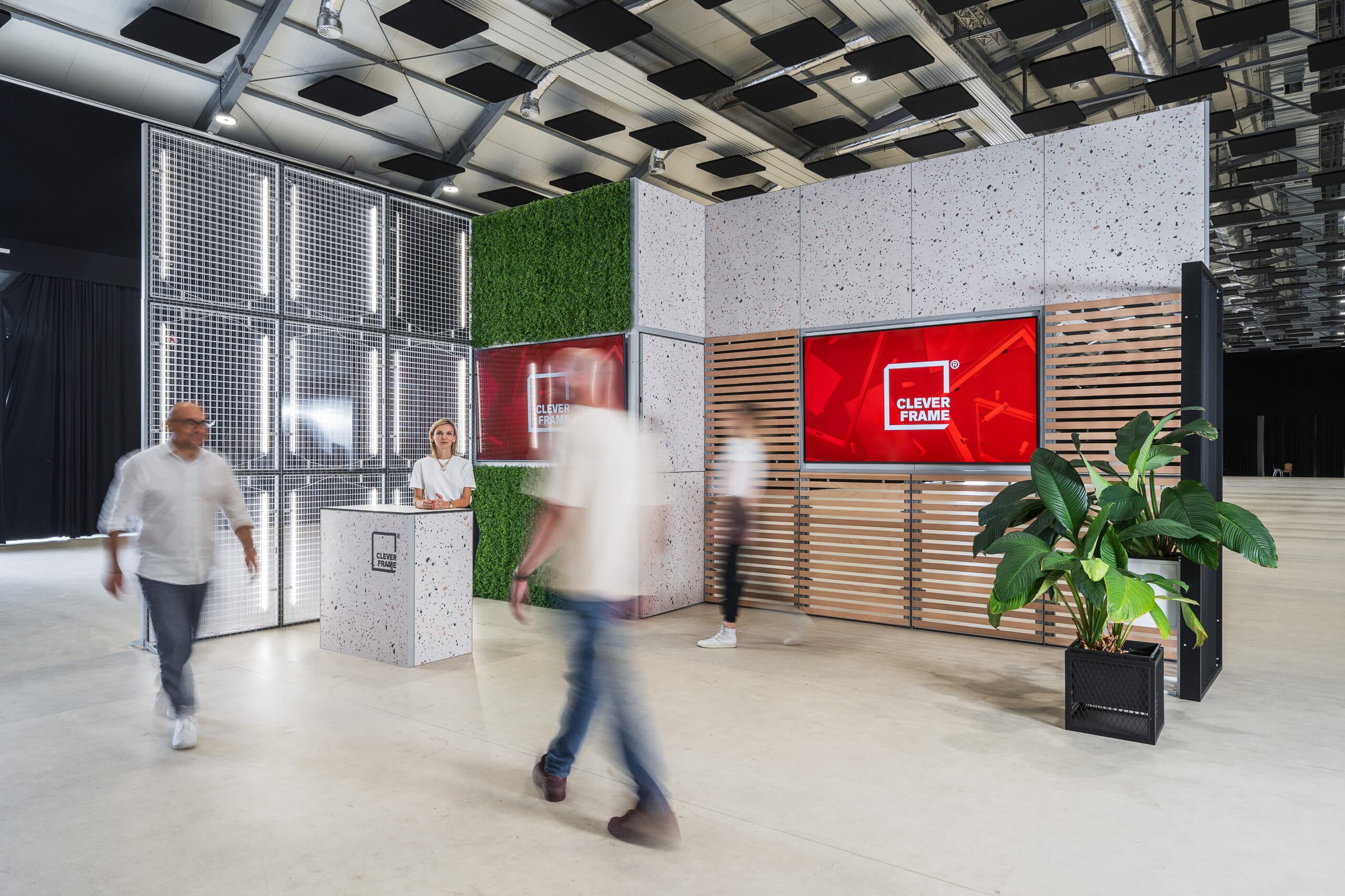
In the context of a trade show booth or exhibition stand, tone of voice connects verbal elements (taglines on graphic panels, printed materials, conversation scripts, meeting invitations) with the space experience (layout, visitor flow, the welcome moment, and the benefit-led language used by the team). A well-designed brand tone of voice keeps what visitors see on the stand consistent with what they hear from your representatives.
What are the main goals of a tone of voice?
Tone of voice brings order to communication in situations where a brand has only a few seconds to capture attention and start a conversation. On a stand, clarity and consistency matter at every touchpoint – from the first glance at the visual identity to the post-event follow-up.
- strengthening brand recognition and consistency across different channels and events,
- helping sales and marketing teams run conversations in one coherent style, regardless of who is staffing the booth,
- improving the readability of product and service messages in high-stimulus environments,
- building trust through a predictable, consistent way of talking about values, quality, and cooperation terms.
What are the benefits of a tone of voice?
A consistent brand voice reduces friction in conversations and helps people quickly understand what kind of brand they’re dealing with. At trade shows – where visitors compare multiple vendors side by side – tone of voice can become a competitive advantage, especially when it’s consistently applied to booth copy and the team’s behavior.
- better message recall thanks to repeatable phrasing and consistent vocabulary,
- more effective lead generation, because conversations are structured and move faster toward needs qualification,
- higher-quality brand experience when the language on graphic panels, in materials, and in conversations feels like one story,
- easier content adaptation across different display formats – especially when Clever Frame modular exhibition stands are configured for different floor plans.
What are the challenges and limitations of a tone of voice?
The most common issue is inconsistency: the tagline on the stand sounds one way, the salesperson sounds another, and the post-event email sounds different again. In offline settings, time pressure and noise are additional constraints – messages must be short while still staying true to the brand’s character.
- difficulty maintaining a uniform style with multiple people staffing the booth,
- the risk of oversimplifying the message when copy has to fit into limited space,
- a mismatch between tone and event context – for example, language that’s too formal at relationship-driven events, or too casual in regulated environments,
- the need to update messaging as the offer, market, or target audiences change.
How is tone of voice used at trade shows and events?
At events, tone of voice should be evident in three areas: copy on stand elements, the way conversations are conducted, and microcopy that supports navigation and decision-making (e.g., demo invitations, benefit statements, calls to action). Strong visual communication helps, but language sets the direction – whether the brand speaks like an expert, a partner, an innovator, or a pragmatist.
In practice, it’s worth connecting tone of voice with visitor flow planning. If the booth layout guides visitors through thematic zones, messages should form a logical sequence: from the value promise, through proof (case study, demo, data), to the next step. With Clever Frame trade show stands – built modularly and assembled and dismantled without tools – updating content is also easier. The magnetic system allows quick swapping of graphic panels, so you can adapt the stand to seasonal campaigns or shifting marketing trends.
What are practical examples of tone of voice?
Tone of voice can be defined with specific rules you can implement at the stand as early as the messaging design stage and during team training. The best rules are short, testable, and based on real conversation scenarios.
- consulting brand: precise, fact-based language with short definitions and calm invitations to talk,
- technology brand: an expert tone, but with benefits translated into use cases so the demo is clear for non-technical visitors,
- premium brand: concise, selective messaging with emphasis on experience quality and visual identity details,
- efficiency-driven brand: simple, outcome-focused messages, qualification checklists, and clear next steps after the meeting.
See also
- Visitor flow
- Key visual
- Visual identity
- Brand experience