
What is Marketing Attribution for Events?
Marketing attribution for events is the practice of identifying which marketing activities contributed to measurable outcomes generated through in-person touchpoints such as trade fairs, conferences, brand activations, showroom visits, and roadshows. It connects interactions that happen in a physical environment – for example, a conversation at a booth, a product demo, or a badge scan – with downstream results such as qualified leads, pipeline creation, repeat meetings, and closed revenue.
In event marketing, attribution helps teams move beyond “the booth was busy” and quantify how the event experience supported brand building and commercial performance. It typically combines onsite data (traffic, engagement, lead quality) with offsite signals (email responses, website sessions tagged with UTM parameters, CRM progression), so marketing and sales can evaluate what worked, what should be repeated, and how the exhibition presence should evolve across campaigns.
What are the main goals of Marketing Attribution for Events?
Attribution has strategic and operational goals that help marketers, event managers, and sales teams make better decisions across multiple event formats and locations.
-
linking event touchpoints to business outcomes such as meetings booked, pipeline influenced, and revenue,
-
comparing performance across events, booth formats, messaging themes, and target segments,
-
optimising budget allocation between pre-event promotion, onsite execution, and post-event follow-up,
-
improving lead quality by understanding which interactions produce the highest-intent prospects,
-
strengthening brand consistency by measuring how well the physical brand experience supports awareness and consideration.
Key benefits for event teams and exhibitors
When attribution is implemented with clear definitions and reliable data capture, it becomes a practical tool for improving event performance over time.
-
more credible ROI discussions, because results are tied to agreed metrics and time windows,
-
faster learning loops, by testing different layouts, messages, and interaction points across events,
-
better alignment between marketing and sales, through shared definitions of lead stages and handover rules,
-
more effective booth planning, as insights indicate which areas and interactions generate meaningful conversations,
-
reduced waste in production, when exhibitors reuse modular booth structures and update only the graphics to support new campaigns.
Challenges and limitations
Event attribution is valuable, but it has structural constraints that teams should address early to avoid misleading conclusions.
-
multi-touch journeys, because attendees are influenced by many exposures before and after an event,
-
offline-to-online stitching, since onsite interactions need consistent identifiers to connect with CRM and analytics,
-
selection bias, as booth visitors are not a random sample and may overrepresent high-intent audiences,
-
data quality issues, including incomplete scans, inconsistent note-taking, and mismatched company names,
-
privacy and consent requirements, because data capture methods must respect local regulations and attendee expectations.
A robust approach often uses a combination of attribution logic (first-touch, last-touch, linear, position-based, or custom weighted models) and event-specific KPIs, rather than relying on a single metric such as badge scans.
How it is used at trade fairs and live events
In physical environments, attribution depends on designing measurable touchpoints and ensuring that the booth experience supports both engagement and data capture.
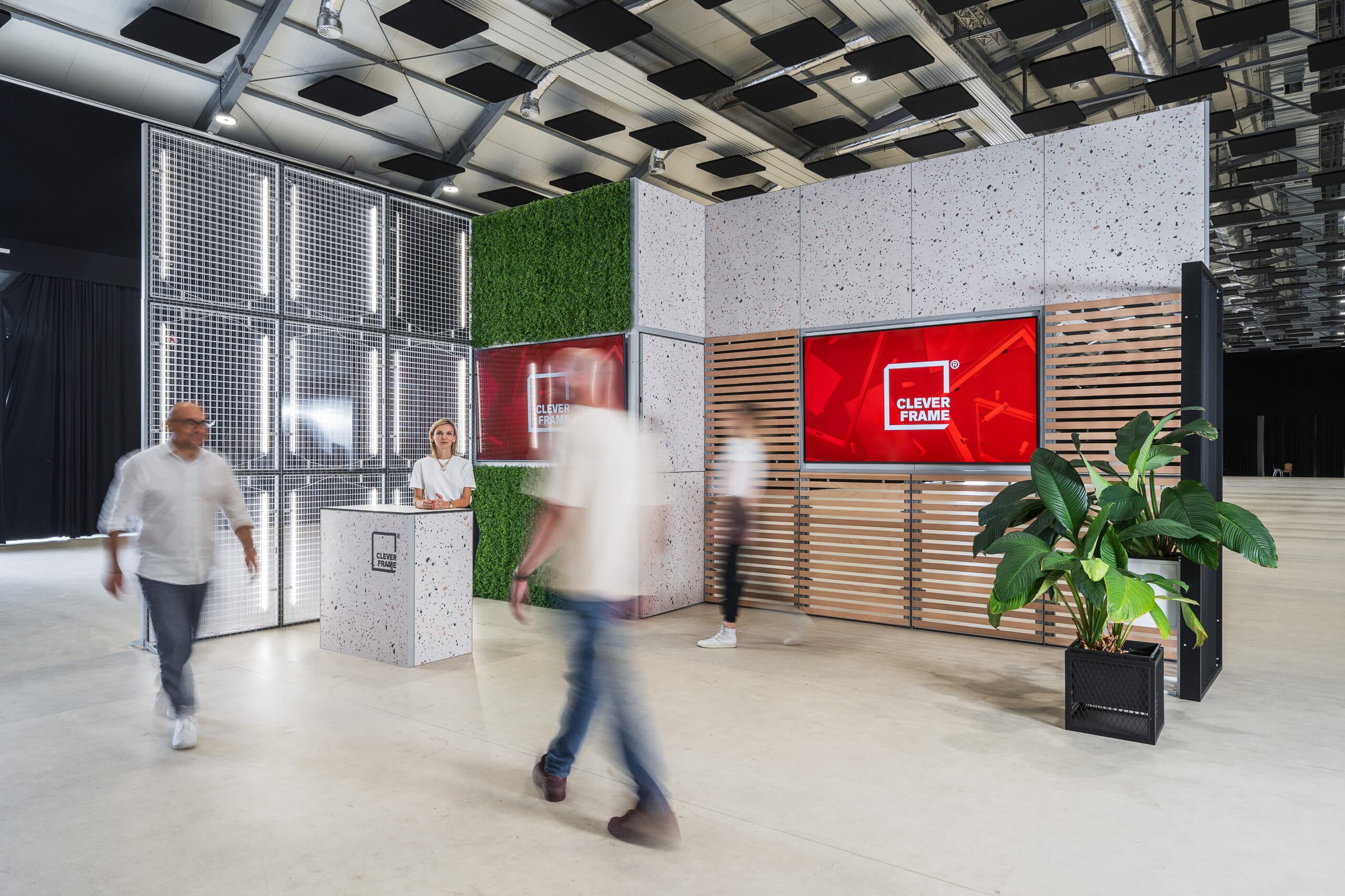
Space and visitor flow influence what can be measured. The booth layout determines whether conversations happen at the perimeter, inside the space, or at dedicated demo points. If the visitor journey is unclear, staff may miss opportunities to ask qualifying questions or capture consented contact details. Clear zoning (welcome, demo, consultation) also helps attribute outcomes to interaction types, not only to overall footfall.
Consistent visual communication supports cleaner measurement. When the same campaign message is used across invitations, onsite graphics, and follow-up emails, it is easier to interpret which proposition drove interest. Modular exhibition stands can support this consistency by enabling repeatable structures while allowing fast updates of graphic panels. This makes it practical to run seasonal or campaign-specific visuals without rebuilding the entire booth.
Interaction design matters as much as tracking technology. Product demos, scheduled micro-presentations, or guided walkthroughs create natural moments to log interests, objections, and next steps. Those qualitative signals often explain why two leads with similar profiles convert differently, which is essential for attribution models that go beyond counting contacts.
Practical examples of Marketing Attribution for Events
Below are common, realistic scenarios that show how attribution can be applied across event formats, including trade fairs, showroom meetings, and roadshows.
-
UTM-tagged pre-event invitations that drive landing page registrations, followed by onsite badge scans or lead capture forms that connect attendance to CRM opportunity stages,
-
QR codes placed near product-specific graphics, where each scan is mapped to an interest category and later compared with pipeline conversion rates,
-
NFC-enabled staff cards used to share a digital brochure, with each tap logged as an interaction tied to a specific conversation topic,
-
post-event email sequences segmented by onsite engagement level, enabling analysis of which onsite interactions predict meeting acceptance,
-
showroom attribution that links guided product walkthroughs to subsequent quote requests, using consistent lead identifiers and meeting notes.
Implementation checklist for reliable attribution
To make event attribution actionable, teams typically standardise data capture and agree on definitions before the first attendee arrives.
-
define outcomes and time windows, such as “qualified lead within 14 days” or “pipeline created within 60 days”,
-
standardise lead fields and interaction labels, so staff capture comparable data across days and locations,
-
connect onsite capture to CRM, ensuring that each lead has a consistent identifier and owner,
-
align booth messaging with pre-event and post-event communication, to reduce attribution noise,
-
review results by segment and interaction type, not only by total lead volume.
Over time, this approach supports evidence-based decisions on booth size, modular configuration, campaign messaging, and staffing, while keeping the event experience coherent for attendees.
See also
-
Event marketing
-
Visitor flow
-
Modular exhibition stand
-
Sustainable exhibition stand