
What is exhibition marketing?
Exhibition marketing (trade show marketing) is a set of activities planned and executed around a brand’s presence at trade shows, conferences, industry events, and product showcases. The goal is to generate contacts, build relationships, and strengthen brand positioning through direct, face-to-face contact with the audience. It includes both strategy (goals, key messages, audience segments) and operations (team, materials, conversation scripts, and performance measurement).
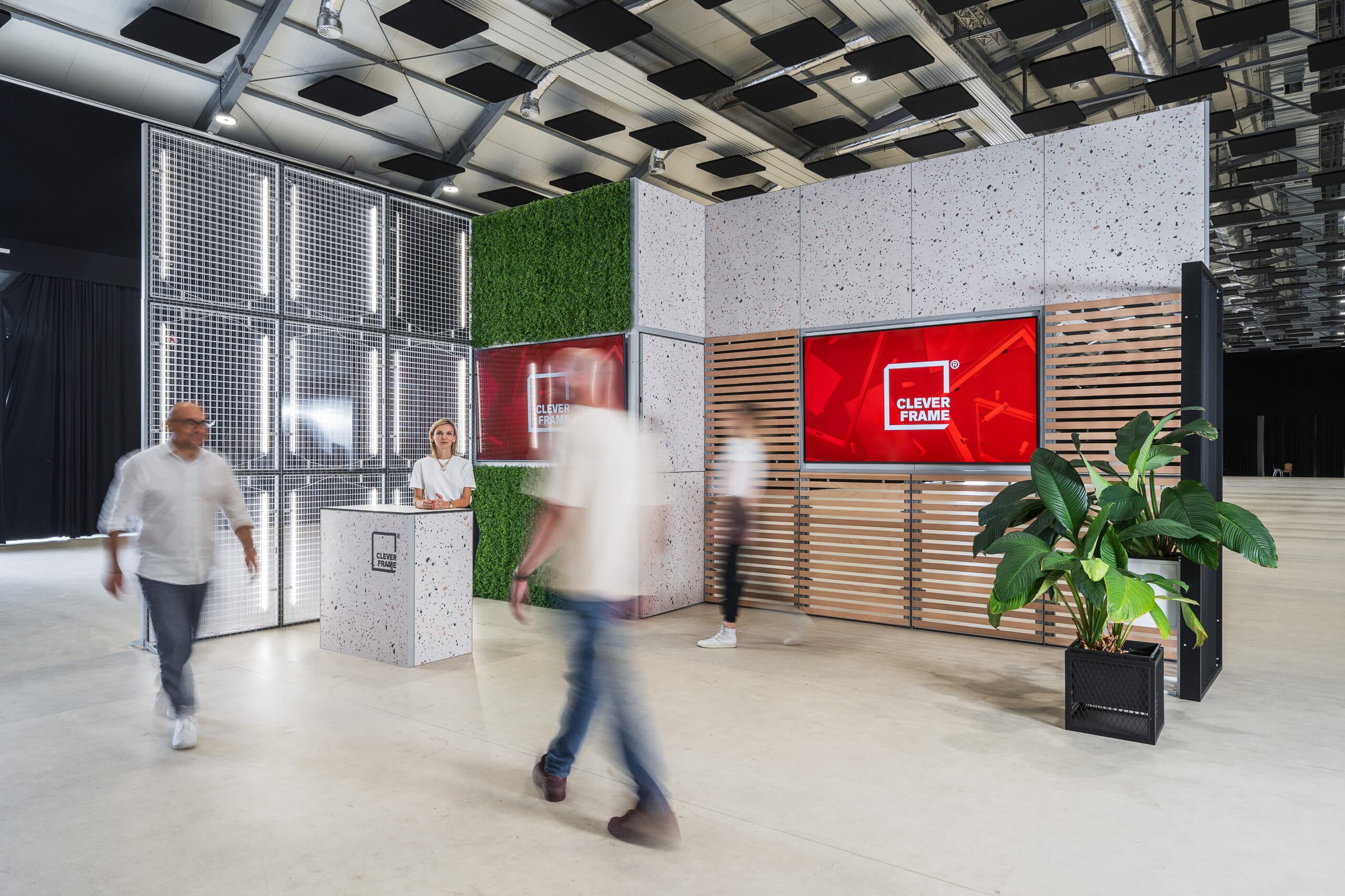
In practice, exhibition marketing combines space design (the booth and its layout), visual communication (clear, consistent graphics and signage), brand experience (interactions, demos, conversations), and B2B sales and marketing (lead qualification and follow-up). With solutions such as Clever Frame trade show booths, a key factor is that messaging carriers can be adapted quickly for different events provided the specific system and configuration actually use magnetic mounting for graphic panels (depending on the manufacturer’s specification and setup).
What are the main goals of exhibition marketing?
A strong trade show plan doesn’t end with “being present.” Goals should be defined in marketing and sales terms, with clear KPIs, for example:
- generating and qualifying leads and booking sales conversations after the event,
- strengthening brand recognition and associations through consistent spatial branding,
- presenting products and services in conditions that support comparison and use-case discussions,
- building trust through face-to-face contact and competent booth support,
- collecting market insights (questions, objections, needs) and validating key messages,
- strengthening relationships with existing customers and partners and supporting employer branding efforts.
What are the benefits of exhibition marketing?
The strength of trade show activity comes from combining communication with experience. Unlike purely digital channels, a booth lets you showcase the offer, respond to questions, and observe audience behavior at the same time.
The most commonly cited benefits include:
- more effective sales conversations thanks to the industry context and visitor intent,
- stronger brand recall through consistent identity and clear, high-impact visual messages,
- the ability to run demos and consultative conversations in a controlled environment,
- more efficient use of materials that can be updated, for example by swapping panels / graphics in systems designed for fast changes (e.g., magnetic, slide-in, or tensioned – depending on the build) for new campaigns,
- operational savings for recurring events thanks to modular structures that simplify transport and enable setup and teardown often tool-free or with minimal tool use (depending on the system).
What are the challenges and limitations of exhibition marketing?
Exhibition marketing is demanding because it combines logistics, spatial design, team execution, and message consistency. Constraints come both from organizer rules and from brand-side decisions.
Typical challenges include:
- adapting messaging to short attention spans and high communication “noise” on the show floor,
- space and formal constraints (dimensions, height limits, circulation routes, health and safety requirements),
- maintaining consistent conversation quality across team members with different experience levels,
- the risk of an ineffective layout that makes entry harder, reduces stopping power, and disrupts smooth visitor flow,
- the need to measure results and attribute outcomes to activities (lead tracking, contact quality, cost per acquisition),
- time pressure when producing materials and the need to refresh content on a seasonal cycle.
How is exhibition marketing used at trade shows and events?
At industry events, the booth acts as a face-to-face communication tool. The key is for the space to support the team’s tasks: attract attention, make it easy to start a conversation, enable a short presentation, and lead to a specific next step (e.g., a demo, a quote, or a meeting).
In practice, this means designing the booth around visitor behavior scenarios and a logical zoning plan. A modular booth is easier to fit to different footprints: from compact layouts at local events to larger configurations at international exhibitions. In Clever Frame trade show booths, frames connected with connectors and magnet-mounted graphic panels play an important role, making it easier to refresh messages and version content for different audience groups.
What are practical examples of exhibition marketing?
Exhibition marketing isn’t limited to one event type. The same strategic assumptions can be applied across different offline formats if the space design and messages remain aligned with brand positioning.
- a product launch at a trade show, where the booth layout guides visitors from the key claim and benefits to a short demo and an implementation conversation,
- a multi-city roadshow, where a modular build supports a repeatable display standard and quick reconfiguration across venues,
- a temporary showroom at a client’s site or in a rented space, where graphics are swapped to match seasonal campaigns,
- an industry conference, where the booth functions as a meeting point and appointment hub, with shortened messages focused on qualification,
- a partner event, where the booth reinforces brand consistency among many co-exhibitors, making the brand easier to recognize in photos and event coverage.