
What Is Event ROI?
Event ROI (Return on Investment) is a metric that shows the return generated by investing in an event – such as attending a trade show, hosting a conference, running a roadshow, or organizing a customer event – relative to the costs incurred. In practice, it connects marketing and sales perspectives by measuring outcomes like leads generated, sales pipeline value, closed deals, as well as brand impact and the quality of the in-person brand experience.
In the context of trade show booths, Event ROI includes more than the cost of floor space rental, staffing, or logistics. It also reflects the quality of the booth design, the consistency of visual branding, and how effectively the booth supports sales conversations and product presentation. Most often, ROI is calculated as: (benefits – costs) / costs, where “benefits” can be financial (revenue) or indirect (e.g., increased brand awareness).
What Are the Main Goals of Event ROI?
Event ROI helps structure event participation decisions and makes it easier to choose formats that genuinely support business objectives. The most common goal is to combine measurable performance with better resource planning.
- assessing whether attending a specific event translates into pipeline and sales,
- calculating cost per lead and the cost per sales meeting in offline settings,
- comparing the effectiveness of different formats – trade shows, showrooms, roadshows, or invite-only events,
- optimizing the booth, graphics, and logistics budget for future editions,
- verifying how the space and visitor flow support conversations, product demos, and contact data capture.
What Are the Benefits of Event ROI?
A well-defined Event ROI helps translate event marketing efforts into numbers without losing sight of the brand experience quality. Both marketing and sales teams benefit.
- more predictable results thanks to KPIs set before the event,
- stronger marketing–sales alignment on lead definitions and CRM statuses,
- the ability to test messaging, booth layout, and conversation scripts in subsequent iterations,
- a stronger case for investing in reusable solutions when one-off costs reduce ROI,
- clear insights into which booth elements genuinely increase the volume and quality of interactions.
Event ROI Challenges and Limitations
Measuring event ROI for offline events can be harder than in digital channels because some outcomes appear with a delay and customer journeys are multi-touch. That’s why it’s worth defining your methodology and measurement window upfront (e.g., 30/90/180 days).
- attributing event impact on sales when the customer also engages with the brand through other channels,
- underestimating total costs if you overlook team time, transport, and storage,
- difficulty assigning value to brand outcomes such as trust, brand preference, or purchase intent,
- inconsistent lead quality when qualification criteria and data capture processes are not standardized,
- a short contact window at trade shows, which requires strong visitor flow and a clear message hierarchy.
How Is Event ROI Used at Trade Shows and Events?
In practice, Event ROI combines quantitative data (numbers) with qualitative insights (experience). The key is to design the booth as a working tool: with a clear visual story, space for conversations and demos, and a logical flow of visitors.
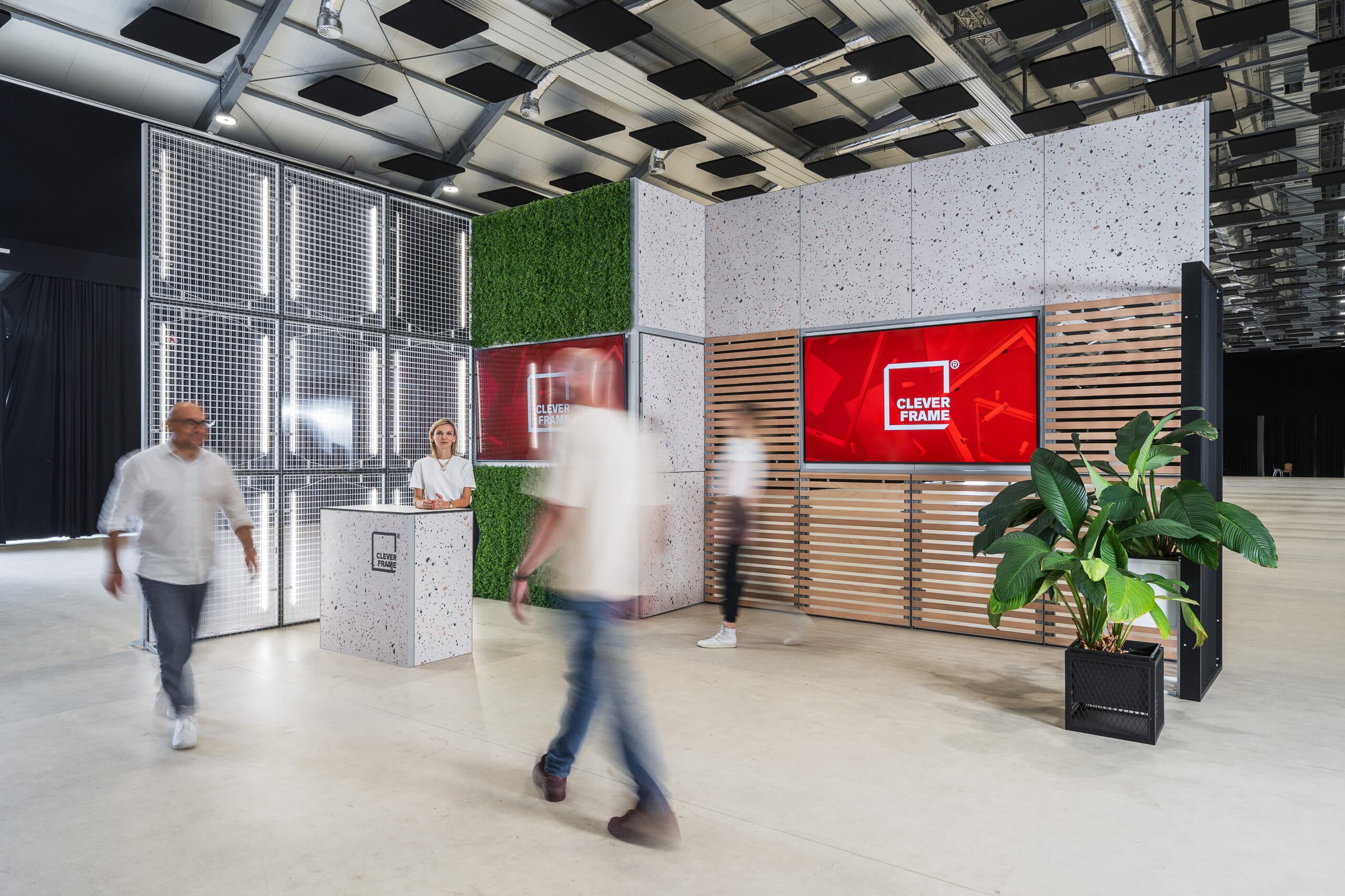
Clever Frame trade show booths make it easier to standardize and compare results across events because the same set of elements can be reconfigured for different booth sizes and goals. In addition, magnetic installation of graphic panels enables fast message and visual identity swaps, so the display can be aligned with seasonal campaigns or changing sales priorities. Setup and dismantling are tool-free, reducing operational time and minimizing on-site errors.
Practical Examples of Event ROI
Event ROI can be calculated for different scenarios, as long as you define in advance what counts as the “return” and how it will be measured. The examples below show common approaches in offline activities.
- B2B trade shows: trade show ROI based on pipeline value from leads captured at the booth and the conversion rate over 90 days,
- Roadshows: comparing the cost to reach one company (meetings scheduled vs. meetings held) and the impact on the number of product demos,
- Showrooms: ROI calculated from incremental sales among visiting customers within a defined period and from reducing the cost of frequent, one-off fit-outs,
- Partner events: evaluating ROI through the number of high-quality conversations, follow-up rate, and survey results on offer clarity and messaging consistency.
See Also
- visitor flow
- event lead
- modular trade show booth
- booth visual communication