What are Event Micro Personas?
Event Micro Personas are highly specific audience profiles used to plan and optimise in-person touchpoints at trade shows, conferences, brand activations, roadshows, and showroom visits. Compared with classic personas (often built for broader segments, including digital ones), micro personas focus on the real-world context of the event – what a visitor needs in that moment, how they move through a space, which cues they notice first, and which interactions help them progress from curiosity to a meaningful conversation.
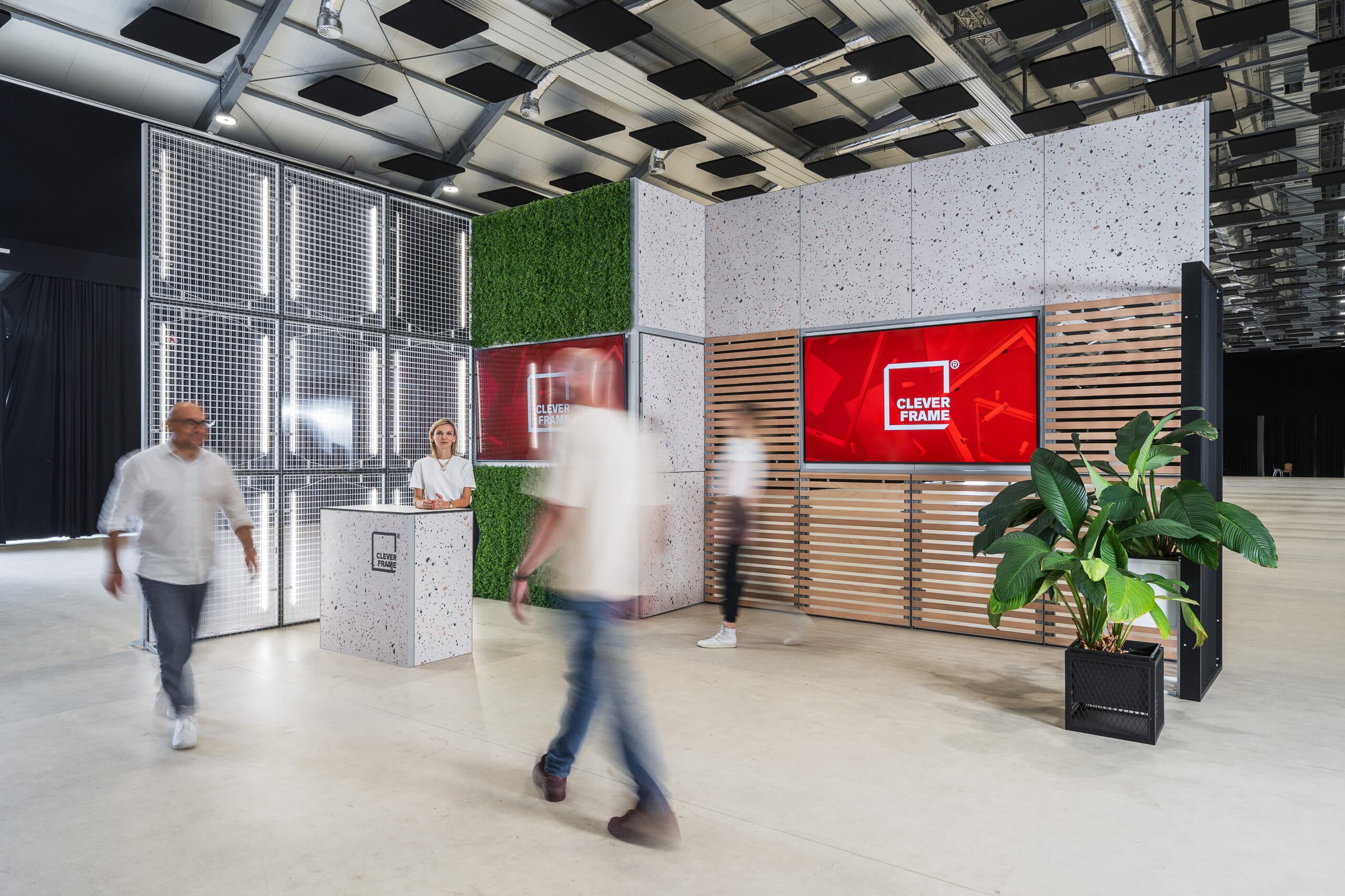
In practice, Event Micro Personas connect marketing strategy with the physical design of a booth or event zone. They translate brand objectives into tangible choices such as messaging hierarchy, modular layout, interaction points, and staff roles. This makes them especially useful for teams that want a consistent brand experience across changing footprints and formats, including modular trade show stands where the same core elements can be reconfigured for different venues and audiences.
What are the main goals of Event Micro Personas?
Micro personas help teams design the experience around distinct visitor intents, constraints, and decision-making roles. They are used to align planning across marketing, sales, product, and event operations so that the booth communicates clearly and supports the right conversations.
-
clarifying which visitor types the brand should prioritise at a specific event,
-
mapping likely questions, objections, and information needs to on-stand messaging and demos,
-
defining success metrics per persona, such as qualified meetings booked, product trials completed, or partner introductions,
-
matching booth zones to behaviours, for example quick scanning versus deeper consultation,
-
supporting staff briefing so that conversations are consistent and role-appropriate.
Benefits of Event Micro Personas
When micro personas are integrated into planning, the stand becomes easier to navigate and more effective as a communication tool. The biggest gains typically appear in visitor flow, message clarity, and lead quality – not just in raw footfall.
-
more relevant first impressions, because key messages are tailored to what specific visitors look for within seconds,
-
stronger brand recognition through consistent visual language across panels, zones, and printed touchpoints,
-
better visitor flow, because layout decisions reflect different engagement depths and can reduce bottlenecks,
-
higher-quality conversations, because staff can quickly route visitors to the right content, demo, or expert,
-
greater reuse of assets in modular trade show stands, because micro persona needs can be addressed by swapping graphic panels and adjusting the configuration rather than rebuilding from scratch.
Challenges and limitations
Event Micro Personas are only as useful as the inputs behind them and the discipline in applying them. They can also fail when they are treated as fictional characters rather than behaviour-driven tools grounded in event reality.
-
insufficient data, especially when persona assumptions are not validated with sales feedback, event observations, or previous lead outcomes,
-
over-segmentation, where too many micro personas dilute the messaging and make the booth harder to understand,
-
conflicting objectives between teams, such as lead volume targets versus long-form product education,
-
space and venue constraints, including limited frontage, restricted build heights, or fixed entry points that shape visitor flow,
-
execution gaps, where the stand design reflects the personas but staff scripts, demos, or follow-up processes do not.
How are Event Micro Personas used at trade shows and events?
Event Micro Personas influence both content and spatial decisions. Teams typically start with a shortlist of 3–5 priority micro personas for a given show, then translate them into a stand plan that supports scanning, stopping, and engaging in a predictable sequence.
Space planning and visitor flow
Because physical environments create friction and cues, micro personas should be mapped to the stand’s zones and pathways. A modular layout can create clear entry points, short interaction loops for high-traffic periods, and quieter areas for consultations without forcing all visitors into the same journey.
-
designing a “fast lane” for time-poor visitors who need a one-minute value proposition and a next-step CTA,
-
creating a “deep dive” area for evaluators who need technical detail, comparisons, and stakeholder-ready materials,
-
placing proof points where scanning behaviour is highest, such as near the open edge or main approach line,
-
reducing decision fatigue by limiting competing messages within a single sightline,
-
allocating staff positions based on predicted questions, not convenience.
Visual communication and modular assets
Micro personas improve how visual hierarchy is set across a booth. Instead of trying to communicate everything everywhere, each zone can carry a message layer relevant to the visitor intent. In Clever Frame trade show stands, graphic panels make it easier to refresh or swap campaign visuals across events, aligning content with seasonal priorities, new product releases, or market-specific propositions without changing the underlying structure.
-
building a consistent brand “spine” that stays unchanged across events, while persona-specific panels rotate,
-
separating top-level promise from supporting evidence, so scanning visitors do not miss the core message,
-
using modular configurations to adapt the same assets to different footprints and traffic patterns,
-
planning interaction points where the visual story naturally prompts a question,
-
ensuring accessibility, readability, and contrast so information remains usable in busy halls.
Practical examples of Event Micro Personas
Micro personas should describe event-relevant roles, motivations, and constraints. Each example below can be operationalised into messaging, layout, staff scripts, and follow-up paths.
-
the “time-poor decision-maker”, who needs a clear outcome, social proof, and a scheduled next step rather than a full demo,
-
the “technical evaluator”, who asks about specifications, integration, implementation effort, and risk,
-
the “solution scout”, who compares multiple vendors quickly and collects differentiators for internal shortlists,
-
the “partner prospect”, who looks for co-marketing or distribution fit and values credibility signals and shared pipeline potential,
-
the “existing customer”, who expects continuity, product roadmap context, and a relationship-focused conversation.
How to create Event Micro Personas for offline experiences
Creation is most effective when it combines quantitative signals with on-site observation and post-event learning loops. The goal is not a perfect document, but a usable planning tool that can be tested and refined event by event.
-
reviewing CRM and pipeline data to identify roles that historically convert after events,
-
analysing past event notes, meeting outcomes, and recurring questions asked at the booth,
-
observing real visitor behaviour, such as approach angles, dwell time, and drop-off points,
-
defining for each micro persona a primary message, proof points, and a single preferred next step,
-
translating the persona map into a layout and signage plan that supports intuitive visitor flow.
See also
-
modular trade show stands
-
visitor flow
-
brand experience
-
sustainable exhibition stands