
What is an Event Lead Attribution Model?
An Event Lead Attribution Model is a structured method for assigning credit for a lead, opportunity, or revenue outcome to specific event-related touchpoints. In practice, it helps marketing and sales teams understand which interactions at a trade show, conference, showroom visit, or roadshow contributed to a contact becoming a qualified lead and moving through the pipeline.
Unlike purely digital attribution, event attribution combines offline signals (for example, conversations, demos, badge scans, meeting notes) with measurable identifiers (for example, QR codes, event app interactions, post-event landing pages, CRM timestamps). The model is used to improve decision-making around booth strategy, messaging, staffing, and follow-up, while keeping the brand experience consistent across physical environments.
What are the main goals of an Event Lead Attribution Model?
The purpose of event attribution is not only to “prove” that an event worked, but to explain how it worked and which parts of the experience created measurable progress in the funnel. Typical goals include:
-
connecting specific event touchpoints to lead creation and qualification outcomes,
-
improving budget allocation across events, formats, and audience segments,
-
optimizing booth layout and visitor flow based on where meaningful interactions happen,
-
aligning marketing and sales on what counts as an event-sourced or event-influenced lead,
-
creating a repeatable measurement framework for trade shows, showroom programs, and roadshows.
Key benefits for trade shows, events, and physical brand experiences
A well-defined model supports operational improvements before, during, and after an event. It also reduces reliance on anecdotal reporting by translating booth activity into comparable performance signals. Key benefits include:
-
clearer visibility into which booth interactions correlate with qualified pipeline,
-
better prioritization of follow-up based on interaction type and intent signals,
-
more disciplined experimentation with messaging and visual communication,
-
stronger feedback loops between stand design, staff behavior, and lead outcomes,
-
more credible event ROI discussions, based on defined rules rather than assumptions.
In environments where the physical space shapes behavior, attribution can also reveal how practical design choices affect lead quality. For example, a booth that supports multiple interaction depths (quick intro, guided demo, scheduled meeting) often generates more differentiated data than a single-purpose setup.
Challenges and limitations
Event attribution is sensitive to data quality and operational consistency. Even a strong model can mislead if touchpoints are not captured in a reliable way or if sales stages are applied inconsistently in the CRM. Common challenges include:
-
incomplete touchpoint capture when interactions are not logged or scanned,
-
time-lag effects, where the event influence appears weeks or months later in the pipeline (depending on the buying cycle),
-
multiple stakeholders and long buying cycles that dilute single-event credit,
-
selection bias, where only certain visitor types agree to be scanned or interviewed,
-
privacy and consent requirements for tracking and follow-up communications (for example, GDPR and other applicable regulations).
Attribution models also require agreed definitions. Teams should align on what counts as event-sourced (lead created due to the event) versus event-influenced (event contributed but was not the first touch). Without that alignment, comparisons across events can become unreliable.
How it is used at trade shows and events
In event marketing, an attribution model is applied by mapping the visitor journey into measurable moments and then deciding how credit is assigned. The same event can be evaluated through different models, depending on the goal and the sales cycle. Common attribution approaches include:
-
first-touch attribution, where the event gets credit if it is the earliest recorded touchpoint,
-
last-touch attribution, where the event gets credit if it is the most recent touchpoint before conversion,
-
multi-touch attribution, where credit is shared across several interactions such as booth visit, demo, and meeting,
-
time-decay attribution, where interactions closer to conversion receive more credit,
-
position-based attribution, where first and last touches receive most credit and the rest share the remainder.
On-site, the physical environment strongly affects which touchpoints happen and how trackable they are. Visitor flow, sightlines, and the placement of demos and conversation areas determine whether staff can start meaningful conversations and whether visitors encounter measurable triggers (for example, a QR code at a demo station or a short form at a product display).
Booth design and data capture
Attribution improves when the stand is designed to support both experience and measurement. A modular structure can help teams standardize where key interactions occur and how they are tracked across multiple events.
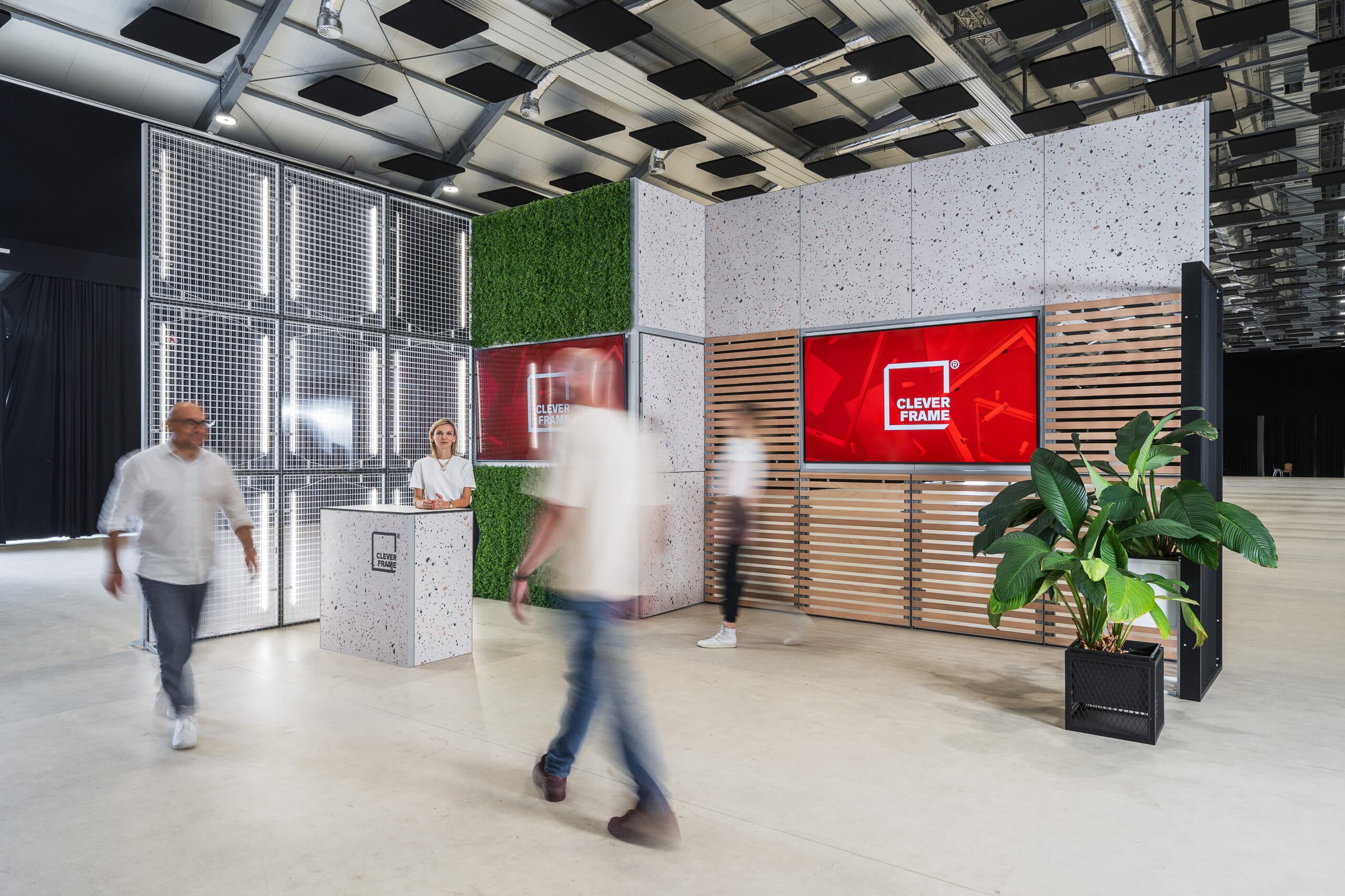
For example, Clever Frame trade show stands are described as being based on modular frames connected with dedicated connectors, enabling tool-free assembly and disassembly. In measurement terms, repeatable geometry makes it easier to keep consistent “interaction zones” across events, which supports comparable data collection. If the system supports quick replacement of graphic panels, teams can update visual communication for seasonal campaigns or changing marketing priorities without changing the entire build.
Practical examples of Event Lead Attribution Model usage
Attribution becomes actionable when it is tied to specific touchpoints and operational rules. Practical applications include:
-
assigning weighted credit when a visitor completes a demo, requests a quote, and attends a scheduled meeting at the booth,
-
using unique QR codes per product area to connect stand interaction topics with post-event page visits and form fills,
-
comparing lead quality between different booth layouts by tracking dwell time proxies and staff-logged conversation outcomes,
-
linking badge scans to CRM opportunities and analyzing which on-site interaction types most often progress to next-stage meetings,
-
testing alternative visual messaging across events by swapping graphic panels and measuring changes in scan-to-meeting conversion rate.
For showroom programs and roadshows, the same principles apply. The model typically emphasizes meeting outcomes, product walkthrough completion, stakeholder attendance, and follow-up acceptance, while accounting for longer decision cycles and account-based dynamics.
See also
-
Event ROI
-
Visitor Flow
-
Brand Experience
-
Modular Trade Show Stand