What is Event analytics?
Event analytics is the practice of collecting, integrating, and interpreting data about how people discover, enter, move through, and interact with a live experience such as a trade fair booth, brand activation, showroom event, or roadshow stop. It combines behavioural signals (for example visitor flow and dwell time) with commercial outcomes (for example qualified leads and pipeline influence) to evaluate what worked, what did not, and what should be improved next time.
In event marketing, event analytics helps connect the physical space to measurable brand and business objectives. It supports better decisions about booth layout, communication hierarchy, staff allocation, and content sequencing, while also improving consistency across touchpoints such as graphics, product demos, and direct conversations with attendees.
Main goals of Event analytics
Event analytics is typically designed to answer specific questions about performance, experience quality, and efficiency of onsite execution. Common goals include:
-
quantifying booth reach by measuring traffic, unique visitors, and peak hours,
-
understanding engagement by tracking dwell time, interaction rates, and demo participation,
-
assessing lead quality by connecting onsite conversations with CRM status changes and follow-up outcomes,
-
verifying communication effectiveness by testing which messages, visuals, or product stories are recalled,
-
optimising operational performance by comparing staffing, queue times, and conversation length against results.
For trade fairs, these goals translate into more reliable post-event reporting and clearer inputs for the next build of the booth concept, including the selection of modules, the placement of key messages, and the location of meeting points.
Benefits of Event analytics for trade fairs and offline brand experiences
Well-designed analytics reduces guesswork in offline marketing. It helps teams treat a booth not only as a presence, but as a measurable environment where spatial design and communication choices can be evaluated.
Key benefits include improved budget allocation and more consistent learning across events. Instead of evaluating success based on subjective impressions, teams can compare results across different booth footprints, different product focuses, or different audience segments. For modular exhibition stands, analytics also supports iterative optimisation: when the same core set of frames is reconfigured for multiple events, results can be tracked per layout and reused as benchmarks.
Event analytics can also strengthen brand experience management. By measuring where people stop, which content attracts attention, and where conversations start and end, teams can align visitor flow with the intended narrative – from initial awareness to product understanding and finally to a sales discussion or meeting request.
Challenges and limitations of Event analytics
Event analytics is useful only when the measurement approach fits the reality of a physical environment and respects legal and ethical constraints. Typical limitations to plan for include:
-
data fragmentation across tools such as badge scanners, CRM, meeting calendars, and onsite surveys,
-
attribution uncertainty, because many contacts influence a deal and the event is rarely the only touchpoint,
-
sampling bias, since not every visitor is willing to scan a badge, complete a survey, or join a demo,
-
privacy and compliance requirements, including consent management and secure handling of personal data (for example GDPR/UK GDPR where applicable),
-
environmental noise such as hall traffic patterns, neighbouring booths, and schedule clashes with conference sessions.
Another practical constraint is that not everything should be measured. High-quality event analytics starts with a small set of decisions the team is ready to make based on the data, and only then selects metrics and tools.
How Event analytics is used at trade fairs, events, showrooms, and roadshows
In practice, analytics is implemented as a measurement layer added to the event plan and the physical setup. This includes defining the audience segments, mapping the desired journey, and choosing observation points where data can be captured without disrupting the experience.
At trade fairs, teams often combine quantitative and qualitative inputs. Quantitative inputs may include counts of visitors (often estimated), the number of meaningful conversations, demo attendance, and meeting bookings. Qualitative inputs typically come from structured staff debriefs, short intercept interviews, and open-ended notes about objections, competitor comparisons, and recurring questions.
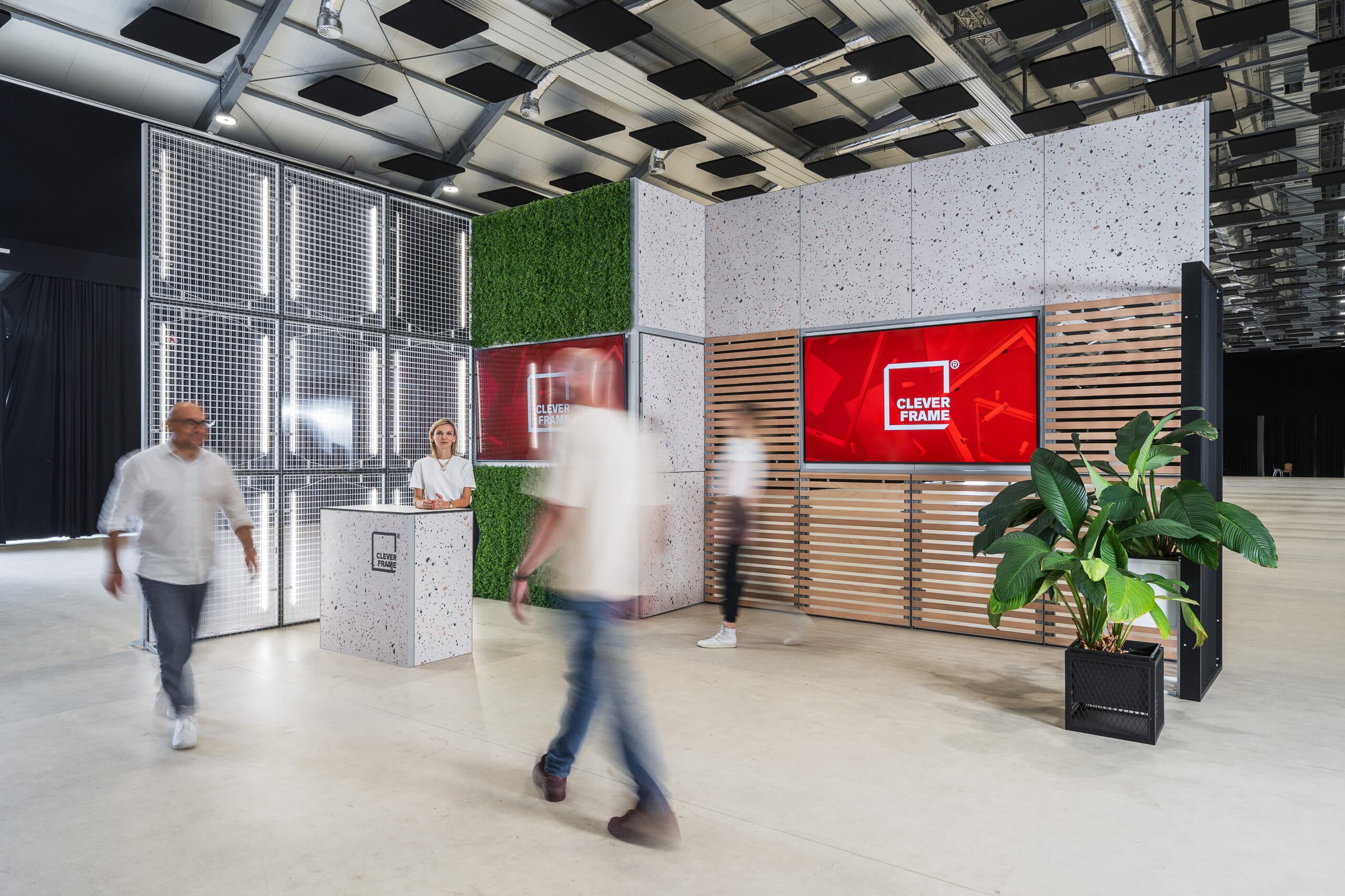
Space plays a central role. Booth layout influences visibility, accessibility, and conversation comfort. Analytics can reveal whether visitor flow supports the intended priorities or whether, for example, a product demo area draws attention but blocks access to meeting zones. Consistent visual communication also matters: when a booth uses interchangeable graphic panels, teams can test different messaging sets across events and replace panels quickly to align with seasonal campaigns, new product launches, or regional positioning.
For modular solutions such as Clever Frame trade fair booths, analytics can be tied to operational execution as well. If the specific system supports it, assembly and disassembly without tools can reduce setup time variability, which can be tracked against labour planning and onsite readiness (for example whether the booth is fully prepared before peak traffic begins).
Examples of Event analytics in practice
Event analytics becomes most actionable when it is linked to specific hypotheses about layout, messaging, and interaction design. Examples include:
-
comparing two booth configurations to see which produces a higher ratio of qualified conversations per hour,
-
testing alternative message hierarchies on graphic panels and measuring recall in short exit surveys,
-
analysing visitor flow to identify dead zones and then adjusting the placement of demos or consultation points,
-
tracking lead handover speed by measuring time from conversation end to CRM entry and first follow-up,
-
evaluating roadshow consistency by benchmarking engagement and conversion rates across multiple locations.
A practical workflow is to define a small KPI set (for example qualified leads, meeting requests, and dwell time), decide how each KPI will be captured, and set a post-event review cadence. Over time, the organisation builds a library of learnings that connects space, content, and staff behaviours with measurable outcomes.
See also
-
Modular exhibition stand
-
Visitor flow
-
Brand experience
-
Trade show ROI