What are brand guidelines?
Brand guidelines are a documented set of rules that define how a brand should look, sound, and behave across touchpoints. In event marketing and trade fairs, they translate the brand strategy into practical instructions for physical communication – including the booth layout, graphics, messaging hierarchy, and the way teams interact with visitors – so that the brand is recognized and trusted in a busy, competitive environment.
In offline settings such as exhibitions, roadshows, and showrooms, brand guidelines help teams make consistent decisions under time pressure: what to display, what to say, which visual elements are non-negotiable, and where there is room for adaptation. They also support coherent brand experience design by aligning space, visual identity, and visitor flow with the goals of the event.
What are the main goals of brand guidelines?
Brand guidelines exist to protect consistency while enabling efficient execution across multiple formats and locations. In the context of trade show booths and event spaces, their goals typically include:
-
ensuring consistent brand recognition across different events, countries, and teams,
-
defining a clear visual hierarchy so key messages and product benefits are readable from relevant distances,
-
aligning spatial design decisions with brand positioning, for example whether the brand feels technical, premium, approachable, or innovative,
-
reducing decision fatigue and production errors by standardizing assets, file specifications, and approval workflows,
-
supporting a coherent visitor experience, including how people enter, navigate, stop, and engage with staff and content.
What are the benefits of brand guidelines?
Well-built guidelines improve both brand performance and operational efficiency. For teams responsible for exhibitions and experiential marketing, the benefits commonly include:
-
faster preparation for events by reusing approved assets, layouts, and messaging blocks,
-
more consistent lead quality because visitors understand the offer sooner and can self-qualify through clearer communication,
-
stronger trust signals, as coherent visuals and tone reduce perceived risk in B2B purchasing decisions,
-
better collaboration between marketing, sales, and external partners such as booth designers and print suppliers,
-
lower reprint and last-minute correction risk, because artwork standards and brand do’s and don’ts are explicit.
What challenges and limitations do brand guidelines have?
Brand guidelines can fail when they are treated as a static PDF rather than a working tool for real spaces. The most common challenges in event and trade fair settings are:
-
over-standardization that ignores constraints such as venue rules, line-of-sight limitations, or local language requirements,
-
too much focus on visual identity, with insufficient guidance on behavior, conversation starters, and lead-handling processes,
-
unclear ownership and approvals, causing delays when fast decisions are needed during event build-up,
-
asset libraries that are outdated or incomplete, leading teams to improvise with off-brand visuals,
-
insufficient adaptation rules, for example what can change between product launches, seasonal campaigns, and market segments.
A practical approach is to separate “fixed” elements (core logo rules, typography, key brand messages, legal disclaimers) from “flexible” elements (campaign headlines, case studies, product focus, localized proof points). This helps protect identity while keeping the brand relevant at different events.
How are brand guidelines used at trade fairs and events?
At exhibitions, brand guidelines should inform the full journey: the first impression from the aisle, the way the booth communicates from a distance, and the interaction quality once a visitor enters the space. Spatial decisions are part of brand communication, not just logistics.
Guidelines can directly influence booth performance through layout and visitor flow. For example, they may specify where high-priority messages are placed, how product demonstrations are framed, and which areas are designed for quick conversations versus deeper consultations. They also help ensure that staff behavior matches the brand personality, whether the brand is positioned as consultative, innovative, or efficiency-driven.
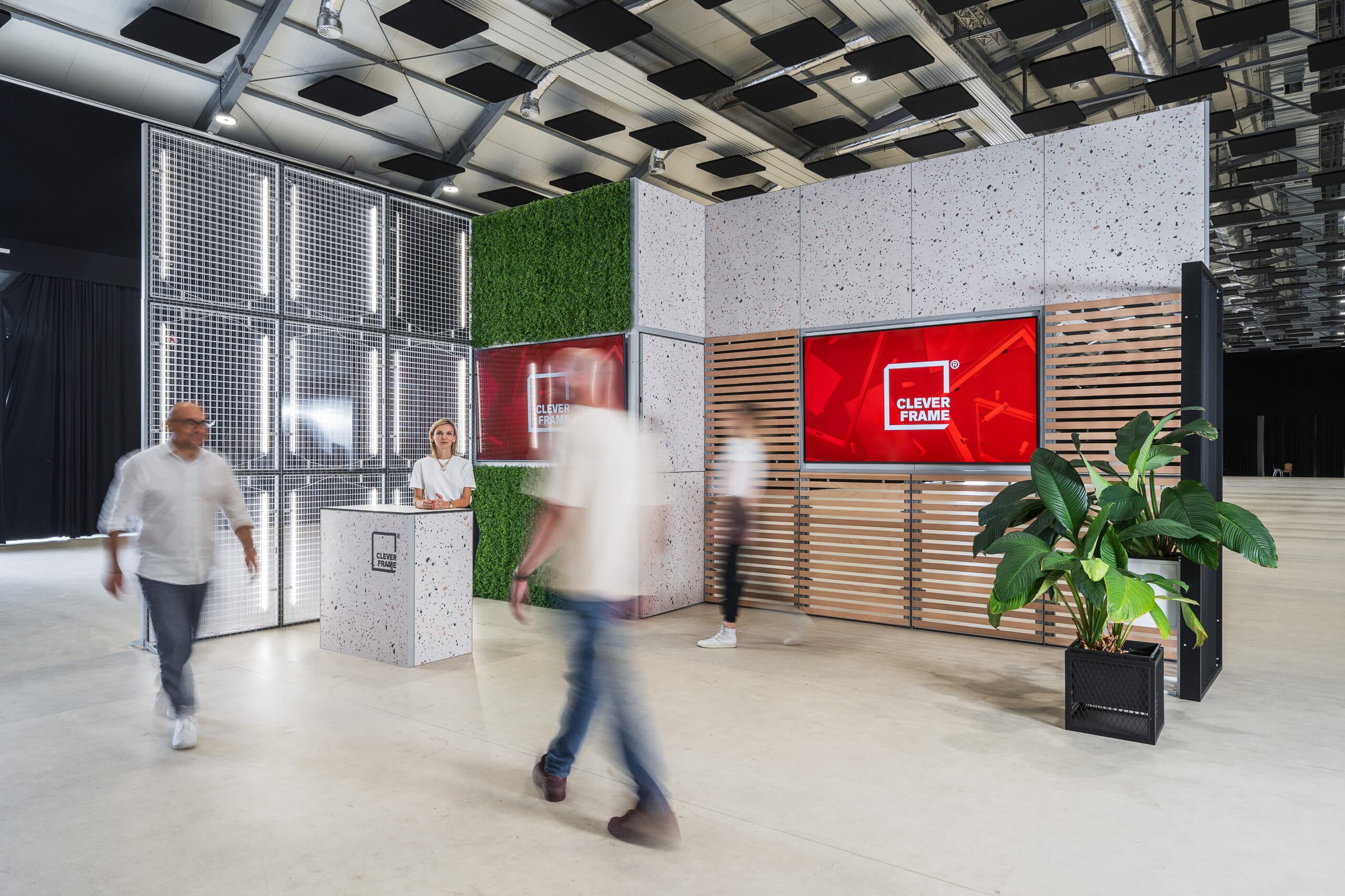
In modular exhibition stands, brand guidelines are especially valuable because the same set of components can be reconfigured across events. Clear rules for content hierarchy and graphic use make it easier to scale a concept from a small footprint to a larger one without losing clarity. With Clever Frame modular exhibition stands, magnetic graphic panels enable quick exchange of visuals, making it practical to keep messaging aligned with seasonal campaigns or changing marketing priorities while maintaining consistent brand fundamentals.
Operationally, guidelines should include technical and production standards that matter offline, such as minimum font sizes for readability, contrast requirements, preferred image style, and file preparation rules for print. They should also cover on-site execution realities, including tool-free assembly and disassembly where applicable, and how to keep brand-critical elements correctly positioned after multiple builds.
Examples of brand guidelines in practice
Brand guidelines become most effective when they are applied to recurring event scenarios with clear rules and templates. Typical practical applications include:
-
a trade show messaging framework that defines one main promise, three supporting benefits, and a proof layer (numbers, certifications, case studies),
-
a booth zoning model that assigns specific content types to specific areas, such as product discovery near the front and detailed consultations deeper in the space,
-
a modular graphic set that distinguishes evergreen brand panels from campaign panels, allowing updates without rebuilding the entire concept,
-
a staff interaction playbook that aligns greeting style, qualification questions, and demo scripts with the brand tone of voice,
-
a measurement checklist that links the brand experience to KPIs, such as dwell time, qualified leads, meeting bookings, and post-event follow-up rates.
In roadshows and showrooms, the same principles apply but often with more control over the environment and longer interaction time. Guidelines can define how product storytelling unfolds step by step, how visitors are guided through a sequence of touchpoints, and how physical assets support consistent brand memory.
See also
-
Modular exhibition stand
-
Visitor flow
-
Event marketing
-
Brand experience