
What is account-based marketing (ABM)?
Account-based marketing (ABM) is a joint marketing-and-sales approach in which activities are planned around specific, pre-selected companies (accounts) with the highest business potential. Instead of casting a wide net, ABM focuses resources on personalized messaging and a tailored brand experience for decision-makers and buying committees within selected organizations.
In the context of trade shows, industry events, showrooms, and roadshows, ABM translates into deliberately designing every face-to-face touchpoint: from the invitation and conversation playbooks, through the layout of the space, to a consistent visual message across the booth. The goal is not only lead generation, but also strengthening relationships with key accounts and accelerating purchasing decisions through precisely designed offline interactions.
What are the main goals of account-based marketing (ABM)?
ABM helps set priorities and align marketing with sales – especially when the buying cycle is complex and multiple stakeholders are involved. Most often, an ABM strategy is used to:
- improve reach and relevance for target accounts through messaging tailored to the industry, role, and funnel stage,
- increase the quality of trade show and event meetings by pre-booking conversations with the right decision-makers,
- create a consistent offline brand experience across touchpoints that supports recall and recognition,
- accelerate opportunity growth by better qualifying needs and planning clear next steps after the event.
What are the benefits of account-based marketing (ABM)?
ABM can be particularly effective in B2B, where relationship quality and trust matter most. In practice, the benefits are also visible in how the booth experience and on-site communication are planned.
- more relevant messaging, because content and narratives address the real challenges of selected accounts,
- stronger marketing and sales alignment through shared goals, success criteria, and conversation frameworks,
- a more predictable ROI from trade show participation, because priority is given to meetings with high-potential companies,
- greater visual and informational consistency when booth messaging is designed for specific segments and use cases.
In event environments, the ergonomics of interaction also matter. A well-designed visitor flow makes it easier to move from initial interest to a meaningful conversation – and then to booking the next step.
What are the challenges and limitations of account-based marketing (ABM)?
ABM requires operational discipline and high-quality data. Without them, personalization can become superficial, and the booth team may lack a clear, consistent plan for engaging selected accounts.
- the need for rigorous account selection and up-to-date insight into decision-making structures within target companies,
- high demands for content, messaging, and materials tailored to multiple personas at once,
- the risk of a mismatch between the marketing promise and the on-site experience if the space and staff do not support real conversations,
- difficulty measuring offline impact on the sales pipeline without shared attribution rules and consistent follow-up.
How is account-based marketing (ABM) used at trade shows and events?
At events, ABM starts before anyone steps onto the show floor: with a target account list, invitations, a meeting agenda, and pre-planned topics. Inside the booth, two elements matter most: clear messaging and the ability to run conversations in different modes – from quick qualification to a longer presentation.
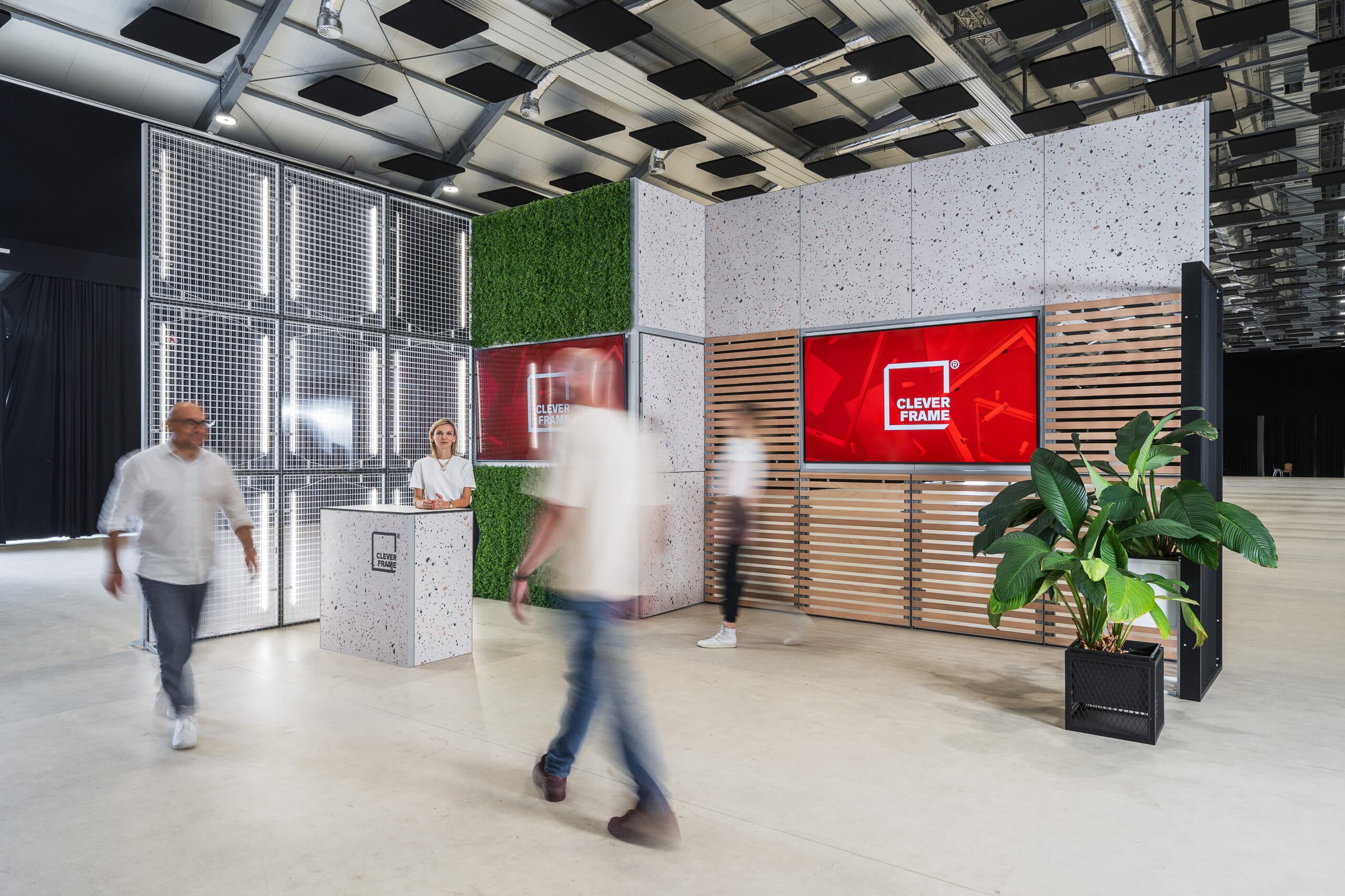
Clever Frame trade show booths can support ABM thanks to their modular design and the magnetic system that allows graphic panels to be swapped easily – adapting to seasonal campaigns or shifting marketing trends. Panels can be replaced quickly and without tools, making it easier to prepare different messaging variants for different accounts, industries, or product lines without rebuilding the entire structure. Modular frames connected with connectors also make it possible to plan the booth layout around visitor flow: one configuration for 1:1 conversations, another for quick demos, and another for pre-scheduled meetings.
What are practical examples of account-based marketing (ABM)?
ABM at trade shows and events works best when the experience design is driven by goals for selected accounts. In practice, that may include:
- preparing two versions of the booth narrative: one for technical teams and one for stakeholders responsible for purchasing and risk,
- designing conversation zones so that the first minutes of contact don’t block the entry path, while deeper conversations have the right conditions for focus,
- using interchangeable graphic panels to support specific case studies, industries, or product applications,
- planning a post-event sequence: meeting recap, role-based follow-up materials, and scheduling a demo or workshop.
In each of these scenarios, the key is ensuring that the visual communication, the content of conversations, and the space design reinforce one another rather than running in parallel.
See also
- Event marketing
- Brand experience
- Visitor flow
- Trade show booth personalization