
Modern trade show booths are increasingly designed as multi-layered experience environments – not only places to meet clients, but spaces where sales conversations, product presentations, educational activities, video recordings and a constant flow of visitors intersect. CEIR studies emphasise that it is the way the space is organised – not the size of the booth – that determines how long visitors stay at the stand and how many interactions the team is able to conduct during the day.[1] As a result, designing functional zones – clear, coherent and planned in a way that supports brand goals – is becoming increasingly important.
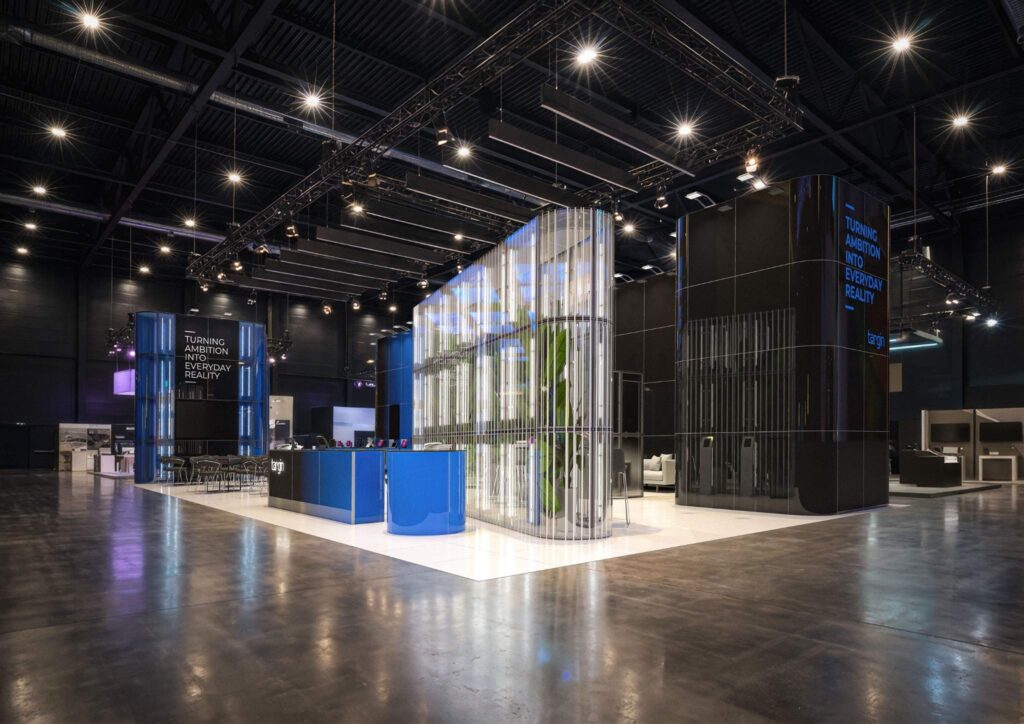
The modular booth structures from Clever Frame support this approach. Thanks to a construction based on repeatable elements and the ability to quickly change graphic panels, zones can be created, rearranged and developed from one event to another. A single investment in the booth can therefore support different trade show scenarios: those focused on product demos, those oriented towards business conversations, as well as those where the main value is content creation.
Well-planned zones make it possible to think of the booth not as decoration, but as a tool that can be scaled and optimised based on data. In practice, this means more valuable conversations and a better understanding of how visitors use the booth – notes Maciej Czarnecki, Design Director at Clever Frame. He also emphasises that modularity is key if a brand wants to learn from subsequent trade show editions and develop the layout iteratively.
In research on the design of event environments (PCMA, Freeman) a common conclusion appears: visitors navigate more easily in spaces where specific activities have their own dedicated areas.[2][3] If the booth is a uniform surface without any logic of flow, guests struggle to understand “what can actually be done here”. As a result, the average time spent at the booth gets shorter, conversations become more chaotic, and it is harder for the team to decide where to direct individual visitors.
When the space is divided into zones with distinct “roles”, visitors intuitively decide: here I can get basic information, there I can see the product, and over there I can sit down for a more in-depth conversation. In practice, this approach leads to more predictable interactions, higher quality sales conversations and a smoother flow of traffic. Clever Frame modules make it possible to create layouts in a predictable way while remaining flexible enough to react to the specifics of different events.
In practice, booth design most often revolves around six recurring functional zones. Each plays a different role and together they form a logical path for the visitor – from entry to conversation or demo, all the way to the moment when the booth becomes a place where content is created.
The entrance is the most strategic fragment of the booth, because this is where the visitor decides whether to engage or walk on. Studies on trade show visitor behaviour show that a clear and transparent entrance structure can increase the number of spontaneous stops by several dozen percent.[1][4] The entrance zone should therefore be open, legible and free of barriers – both visual and physical. Modular frames from Clever Frame make it possible to adjust the width and angle of the entrance so that it matches the profile of the event and the expected traffic.
The discovery zone is where the visitor starts to understand what the brand actually does. It is a kind of “orientation layer”, whose purpose is not to fully explain the offer, but to enable quick initial understanding. According to Event Marketer reports, this is the zone that most strongly influences how well the brand is remembered after the event.[5] In the discovery zone, clear visual identity, concise messages and display elements that can be seen and understood without involving a team member work best.
The demo zone is the heart of most B2B booths. This is where visitors can evaluate the product, compare solutions and move from general interest to concrete questions. Analyses by Wistia and Vidyard indicate that demo experiences generate the highest engagement and the longest interactions in the trade show environment.[6][7] Clever Frame modules make it easier to design this zone in a way that is sufficiently visible from the main aisles, but at the same time allows several demos to run in parallel without chaos.
A well-prepared demo zone should be designed not only in the context of the booth itself, but also in relation to traffic flows across the entire hall. CEIR data shows that visitors are more likely to stop at presentations located on the “entrance” side of the aisle rather than deeper inside the booth.[1] The modular nature of Clever Frame allows this orientation to be adjusted without having to create a completely new design from scratch.
When the initial interaction turns into a discussion of real needs, visitors usually look for a calmer and more organised place. The meeting zone does not have to be fully enclosed, but it should provide a sense of intimacy. Quite often, a small separation – using frames and graphic panels – is enough for participants to feel comfortable. Bizzabo reports show that dedicated meeting zones improve the quality of conversations and increase the number of leads, even if they are very compact.[8]
Although the storage area is invisible to visitors, it has a huge impact on order and workflow. A lack of space for extra materials, bags, cables or documents often leads to visual clutter, which negatively affects the perception of the entire booth. The modular Clever Frame structure makes it possible to integrate storage in such a way that it is completely invisible from the outside and does not disrupt the aesthetics of the stand.
The growing importance of video content means that more and more brands dedicate a small part of the booth to a content corner that functions as a filming area. This can be a section of wall without traffic in the background, a semi-open niche with a neutral backdrop or a small corner separated from the main booth with modules. Research by Wyzowl and HubSpot confirms that videos recorded “live” during events deliver higher engagement when they have a clean, consistent background and a neat setup.[9][10]
The content corner makes it possible to record short expert statements, updates, teasers and commentary that are later used in social media or recruitment campaigns. Thanks to the modularity of Clever Frame, the graphic identity in the background can be adapted to the topic of the recording or the current campaign.
The most challenging part of designing functional zones is not separating them, but creating a smooth flow that does not force visitors to think about where they should go next. Logical transitions from the entrance to the discovery zone, then to the demo zone and further on to the meeting zone ensure that the booth guides the user instead of confusing them.
In practice, this means analysing not only the booth itself, but also the movement around it. Freeman reports emphasise that booth design should take into account the direction of visitor traffic in the aisle and natural points where people tend to pause.[3] Clever Frame modular solutions make it possible to quickly adjust the layout – even after the first day of the show – if team observations indicate that traffic flows differently than expected.
A booth design based on functional zones helps structure the visitor experience and create an environment that simultaneously serves demos, sales conversations and content activities. The entrance captures attention, the discovery zone supports orientation, the demo zone engages, the meeting zone enables strategic discussions, storage keeps the team’s work organised, and the content corner generates communication value that extends beyond the event itself.
Research from CEIR, PCMA, Event Marketer and video platforms clearly shows that booths designed around logical zones generate more valuable interactions than those that function as a single undifferentiated space.[1][2][3][5][6][7][8][9][10] The modular Clever Frame construction makes it possible not only to create such zones, but also to continuously optimise and adapt them to changing event scenarios.
Brands that treat the booth as a dynamic marketing tool gain the ability to consciously shape visitor experiences. With flexible frame layouts and interchangeable graphic panels, they can build spaces that are cohesive, functional and ready for many different activities – from quick chats to full-scale demos and video recordings.