
Eco-friendly trade show booths are not only a way to reduce waste and the consumption of new materials. They are also a strategic investment in brand image and the long-term effectiveness of marketing activities. A modular structure allows the same components to be reused, adapted to different floor spaces and refreshed with new messaging without having to manufacture an entirely new booth. Discover the environmental, branding and business benefits this approach can bring to your company.
Sustainability in the exhibition industry is no longer limited to choosing recycled materials. Today, the way the entire exhibition space is designed matters far more: its durability, reusability, the amount of waste it generates, and the logistics involved in transport and assembly.
In this context, modular trade show booths offer an alternative to structures created for a single event. They can be reused, reconfigured and adapted to different spaces. As a result, an environmentally responsible decision can also deliver measurable business benefits — from reducing the cost of future projects to strengthening the consistency of brand communication.
Participating in trade shows requires a wide range of materials, including structural boards, decorative components and flooring. When a booth is designed exclusively for a single event, many of these elements lose their purpose after dismantling.
This is not always because they are worn out. Often, the structure has been tailored to a specific floor space, exhibition hall layout or campaign and cannot easily be reused.
At the next trade show, the entire process therefore begins again: a new design, new materials, another production cycle and another delivery.
The modular model changes this approach. Instead of treating a trade show booth as a one-off project, the company invests in a system that can become the foundation for many future exhibition spaces.
A modular structure consists of repeatable, compatible components that can be combined in various configurations. The same modules can be used to create a compact corner booth, a larger peninsula booth, an exhibition island, a promotional zone or a showroom arrangement.
The environmental value of this solution comes primarily from extending the product’s life cycle.
The more often a single structure is reused, the less need there is to manufacture new components from scratch.
The key environmental benefits include:
However, simply describing a booth as modular does not automatically make it sustainable. The durability of its components and the number of times it is actually reused are equally important. The greatest environmental benefit is achieved when the system is consistently used across several trade show seasons.
One of the most important advantages of modular trade show booths is the separation of the durable structure from the communication layer.
A company does not have to replace the entire booth simply because its product range, campaign message, visual identity or presentation language has changed.
In practice, the same frames and equipment can be retained while only selected graphic panels are replaced. This allows the booth’s appearance to be refreshed regularly without generating the volume of waste associated with producing an entirely new structure.
For marketing teams, this means greater flexibility. One system can support different campaigns, product brands, markets and target audiences while maintaining a consistent visual standard.
Customers increasingly assess whether a company’s declarations are reflected in its actual activities. A brand that communicates environmental responsibility while using a single-use booth that is difficult to repurpose may appear inconsistent.
A reusable trade show booth allows brand values to be translated into a tangible solution. It demonstrates that a responsible approach extends beyond the product itself to include marketing, sales and event organisation.
This is particularly important for companies that:
The most credible communication is based on facts. Instead of making general claims that a booth is “eco-friendly”, it is better to highlight specific actions: repeated use of the structure, the number of configurations created, replacement of graphic panels only, or a reduction in the production of new components.
Environmental benefits are directly linked to financial efficiency. A component that does not need to be manufactured again usually does not need to be financed again either.
When assessing a modular solution, it is therefore worth considering not only the cost of the first booth but also its total cost of ownership over several years.
The more frequently a brand participates in trade shows, conferences and industry events, the greater the financial potential of this model becomes.
Modularity makes it possible to adapt a booth to different floor spaces without commissioning an entirely new structure each time.
The same components can be used to create:
This means the investment is not limited to a single exhibition hall, booth size or campaign. The system can support the brand throughout the year, including outside the trade show calendar.
Owning a modular system makes it easier to plan future events. The company is already familiar with the structure, the available equipment and the possible configurations.
There is no need to begin every project by searching for a contractor and manufacturing all the components from scratch.
This results in:
For the marketing team, this means less operational work with each project. For the sales team, it provides greater flexibility when deciding whether to participate in new events.
A modular system helps preserve the booth’s distinctive features regardless of its size. Colours, spatial divisions, lighting, product presentation and key brand identity elements can be repeated across different configurations.
This consistency strengthens brand recognition. Visitors can identify the company more easily, while all its exhibition spaces — from a compact promotional zone to a large trade show booth — form a coherent communication system.
At the same time, modularity does not mean that the booth must look identical at every event. The structure can be reconfigured, expanded with new accessories, adapted to a different functional layout and updated with new graphics.
The brand therefore maintains visual continuity without creating the impression that the same arrangement is being repeated again and again.
Designing for reuse requires greater discipline, but it often leads to more functional solutions. Every component should have a clearly defined purpose, work in different layouts and remain compatible with the other modules.
As a result, a modular booth is:
From a business perspective, sustainable design does not have to limit possibilities. On the contrary, a well-designed modular system can increase the number of available configurations and extend the useful life of the purchased components.
Before selecting a system, consider not only the materials but also its entire usage model. The following questions can help you make an informed decision.
Its components should retain their properties after multiple cycles of assembly, transport and storage.
The system should allow the layout to be changed without requiring the entire structure to be manufactured again.
This makes it possible to update brand communication while retaining most of the existing components.
Access to compatible parts and accessories extends the system’s useful life.
Using the structure in a showroom, reception area, sales zone or at corporate events increases how frequently it is used.
Consider the packed volume, the type of packaging and whether the components can be transported and stored efficiently.
The environmental benefits of a trade show booth should be communicated precisely and in a way that can be verified.
The use of green colours, plants or expressions such as “environmentally friendly” does not in itself prove that the solution has a genuinely positive impact.
A more credible message might explain that:
This type of information demonstrates a tangible mechanism for reducing resource consumption. It also helps audiences understand that the brand’s declarations are supported by a genuine change in its operating model.
The greatest advantage of modular exhibition systems is their ability to combine environmental, marketing and financial objectives.
A single decision can reduce waste, increase flexibility in event planning, strengthen brand consistency and lower the cost of future projects.
The key is to think long term. Instead of designing a booth solely for the next trade show, consider the company’s entire event schedule, potential floor spaces, different display configurations and opportunities to use the system in other environments.
A well-designed modular trade show booth does not reach the end of its life when the exhibition hall closes. It can change its form, perform new functions and support future campaigns.
It is this repeated and carefully planned use — rather than a one-off eco-friendly addition — that creates genuine value for both the environment and the business.
Yes. A modular booth is more sustainable than a traditional single-use structure because it can be reused and adapted to different floor spaces and events.
Instead of manufacturing an entirely new booth, the company replaces only selected graphics or components. This reduces raw material consumption, waste and the environmental impact of future exhibition projects.
Yes. A modular system allows different configurations to be created from the same components. The extent of these changes depends on the number of modules available and the way the system has been designed.
The greatest savings are achieved when a company participates in trade shows regularly. Instead of ordering an entirely new structure for every event, it reuses the existing system and updates only selected components.
Communication should be based on specific actions and data, such as the number of times the structure has been reused, the proportion of previously used components, or the replacement of graphics instead of the entire booth.
General environmental claims that cannot be supported with evidence should be avoided.
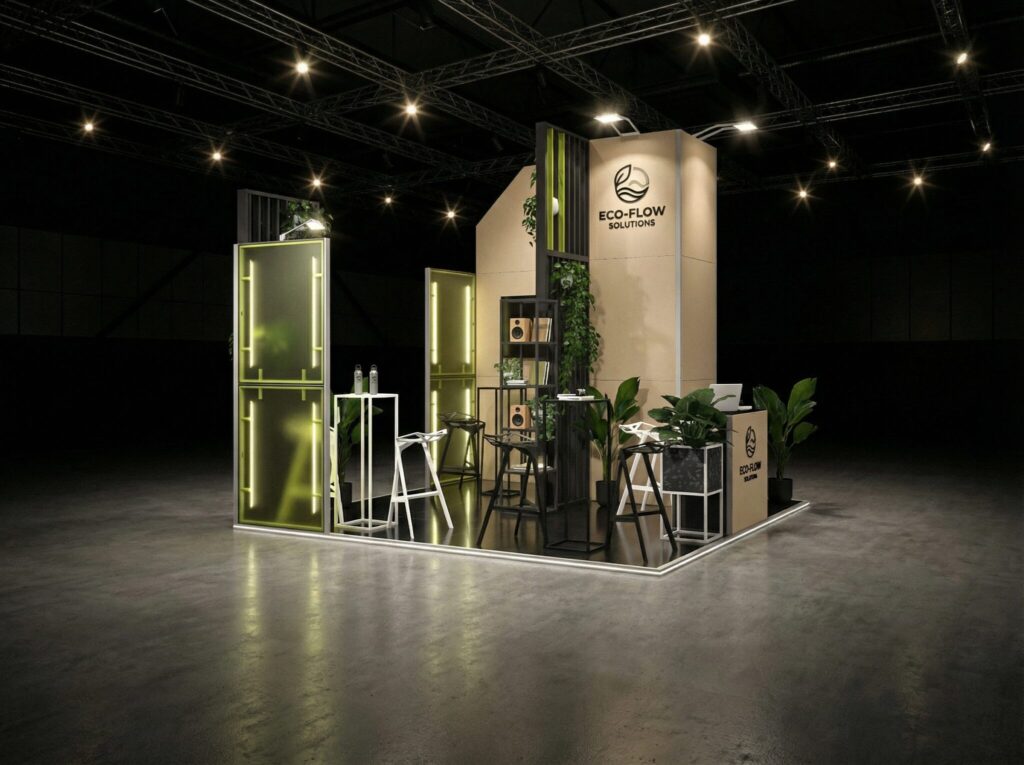
If this approach to exhibition design reflects your company’s values, contact us. We will design a modular trade show booth that is functional, visually impactful and tailored to your brand’s needs.
We will create a solution designed for repeated use and easy reconfiguration, delivering long-term benefits for both your business and the environment.