
E-commerce brands have spent years learning how to design the customer experience with precision in the online environment. They know how to guide users from their first contact with an ad, through the product page and social proof, all the way to purchase. The problem starts when the same brand wants to make an impact offline at a trade show, industry event, or temporary brand activation space. Suddenly, it becomes clear that a high-performing online store, efficient digital communication, and a well-optimized funnel do not automatically translate into a physical exhibition stand.
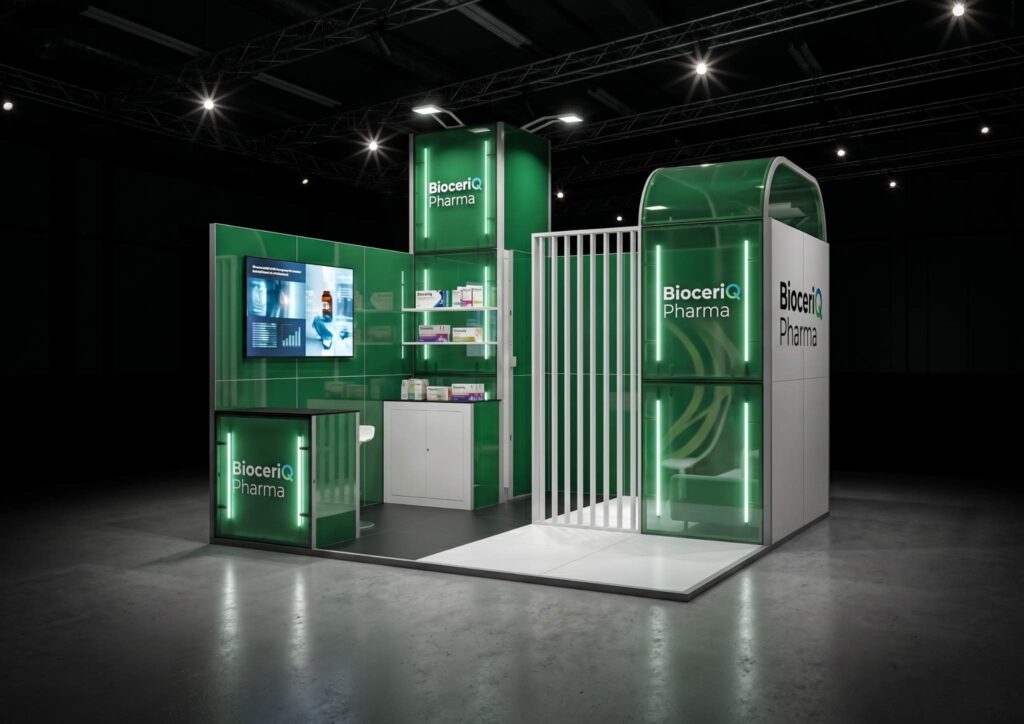
At trade shows, an e-commerce brand is no longer competing only on offer, price, and delivery speed. It is also competing on the quality of the first impression, the clarity of its message, the way it leads conversations, and whether it can turn offline contact into a specific action: a conversation, a sign-up, a lead, a product trial, or a sale. This is exactly where the question arises: how do you design an offline experience that is not just a “nice display,” but one that actually converts?
In this context, Clever Frame trade show booths are a strong fit for brands that sell online every day but want to operate offline in a professional, consistent, and operationally efficient way. The modular structure makes it easier to translate the logic of brand experience from digital into physical space, while the ability to quickly change messaging allows the booth to be adapted to different campaigns, launches, and event formats.
An online brand very often builds its strength on controlling the user experience. In an online store, everything is planned: the order of stimuli, the hierarchy of information, images, CTAs, recommendations, and paths to the cart. At a trade show, that control disappears. Visitors move freely, the environment distracts them, they compare multiple booths at once, and they decide whether to stop within just a few seconds.
This means that a trade show booth for an e-commerce brand should not be designed like a classic catalog display. It should work more like a physical sales funnel that:
In practice, this means that an e-commerce brand at a trade show cannot simply “show products.” It needs to translate the logic of its online world into a space that also works intuitively offline.
One of the most common mistakes online brands make at trade shows is designing the booth around aesthetics before defining the purpose of being there. A good offline experience should not result from appearance alone, but from what the brand wants to achieve at the event.
Depending on that goal, the booth may need to be designed in completely different ways. For one brand, the priority may be on-site sales and showcasing bestsellers. For another, it may be building brand awareness and collecting contacts for future remarketing. Yet another may treat the event as a moment to test a new category or enter traditional retail.
That is why, before designing a trade show booth, it is worth answering a few basic questions:
If you want a broader view of how marketing goals shape exhibition space, it is also worth reading Exhibition Stand Layout and Marketing Goals – How to Design a Space that Drives Brand Success?
The best e-commerce brands do not sell just a product. They sell an experience: ease of choice, benefit-driven messaging, convenience, a sense of fit, and a consistent visual narrative. At trade shows, you need to create the physical equivalent of that experience.
In practice, it helps to think of the booth as a physical version of a product page or landing page. That means:
This is exactly where simplicity matters most. Online brands are often tempted to show their whole world at the booth: all categories, all benefits, all campaigns, and all communication formats at once. But offline, selection works best. A few strong stimuli convert better than an overload of content.
An online brand that wants to operate effectively offline should design its booth as a structured customer journey. The goal is not to have “a bit of everything,” but to make visitors intuitively understand where to look, where to walk up, and what to do.
In practice, the following zones work especially well:
A well-designed zoning plan helps an e-commerce brand avoid one of the biggest trade show problems: a booth that looks attractive but does not lead to any clear action. Clever Frame’s modular exhibition booths make this kind of planning easier because they allow you to build functional layouts tailored to the event objective and available floor space.
One of the biggest advantages trade shows have over digital channels is the ability to create a product experience beyond the screen. This is especially important for e-commerce brands that usually sell through photos, descriptions, videos, and reviews. At an event, the customer can finally see the real scale of the product, touch the material, check the quality, compare variants, or ask the team questions directly.
This means the booth should support the product experience, not just product display. Depending on the category, this may include:
This is where the offline experience starts to truly convert. Not because the booth “looks nice,” but because the visitor understands the product faster and feels more confident about taking the next step.
Many e-commerce brands have a very strong visual language online. The challenge is that it is not always obvious how to translate that language into a trade show booth. What works well on social media or in an online store does not always work in an exhibition hall, where visitors do not read for long or focus on details the way they do on a screen.
That is why offline branding should preserve the spirit of the brand, while also being adapted to spatial conditions. In practice, it is worth focusing on:
If you are interested in how space and arrangement influence visitor decisions, also see The Psychology of Trade Show Booth – How Layout Influences Visitor Decisions.
Online brands understand the power of a CTA very well. At trade shows, the same logic still applies, but it needs to be translated into physical actions. The booth should not end with browsing. It should lead to a specific next step that is realistic and suited to the event context.
Depending on the strategy, the CTA may mean:
The most important thing is not to design several equally important actions at the same time. If everything is a CTA, in practice nothing works. An e-commerce brand’s trade show booth should have one main call to action and, at most, one supporting CTA depending on the audience type.
E-commerce brands usually operate faster than traditional offline sales businesses. They change campaigns more often, test new products more often, update communication more often, and frequently participate in different event formats: from trade shows and conferences to showrooms, roadshows, and pop-ups. That means they need an exhibition booth system that can keep up with this pace.
In this area, Clever Frame modular trade show booths offer very practical benefits:
This is especially important when a brand wants to treat its offline presence as part of a long-term strategy rather than a one-off activity. This logic is also complemented by the articles Modular Trade Show Stand up to 50 m² – When Is a Medium-Sized Booth the Best Choice? and Trade Show Booth as Part of a Cohesive Marketing Ecosystem – Not a One-Off Project.
For e-commerce brands, seasonality and changing communication are completely natural. Collections change, performance campaigns change, hero products change, promotions change, and communication directions shift. That is why a booth cannot be too visually rigid. If every campaign change requires a new booth build, offline quickly becomes expensive and hard to scale.
In Clever Frame trade show booths, one important feature is that graphic panels mounted with magnetic tape allow for quick and convenient message changes, adapted to seasonal campaigns and evolving marketing needs. As a result, the brand keeps a consistent booth structure while flexibly updating the message in line with each new campaign. This allows the same booth base to appear in different versions – at a launch, during an industry trade show, in a showroom, or at a sales event.
For an online brand, this means one thing: offline does not have to be disconnected from the pace of digital activity. It can move to the same rhythm, just in a physical space.
An offline experience that converts does not depend only on the front of the booth. A lot also happens behind the scenes, in the team’s workflow and organization. If materials are poorly placed, the back area does not function well, and the configuration makes movement difficult, even the best branding will not translate into interaction quality.
That is why it is worth remembering that an effective trade show booth for an e-commerce brand should also support:
Modular construction and tool-free assembly support this operationally, because they make booth setup more predictable and allow repeated use without organizational chaos.
For brands that operate online, moving offline rarely ends with trade shows alone. If the booth is meant to be part of a broader brand experience strategy, it is worth making sure the same base can also work in other formats.
The same structure can also support the brand during:
Thanks to this, the investment in a trade show booth starts to function more like a marketing asset than a one-time cost.
An e-commerce brand should not copy everything it does online into an exhibition hall. It should translate the logic of its digital experience into a physical space that works quickly, intuitively, and leads to a specific action. That is when the offline experience starts to convert.
The key conclusions are simple:
If you want to design a trade show booth for an e-commerce brand so that it truly supports branding, product experience, and specific conversion goals, it is worth relying on a solution that combines consistency with flexibility. Clever Frame trade show booths are a modular exhibition system that can be adapted to different event formats and updated in line with campaign cycles – so the logic of an online brand translates into an effective offline presence.