
At trade fairs, decisions are made faster than in any other marketing channel. A participant passes dozens of brands, and their attention operates in “scanning” mode: is this for me, is it worth approaching, do I understand the message? In practice, stand graphics must work immediately – not as decoration, but as a tool that in the first seconds organises the message and leads to conversation.
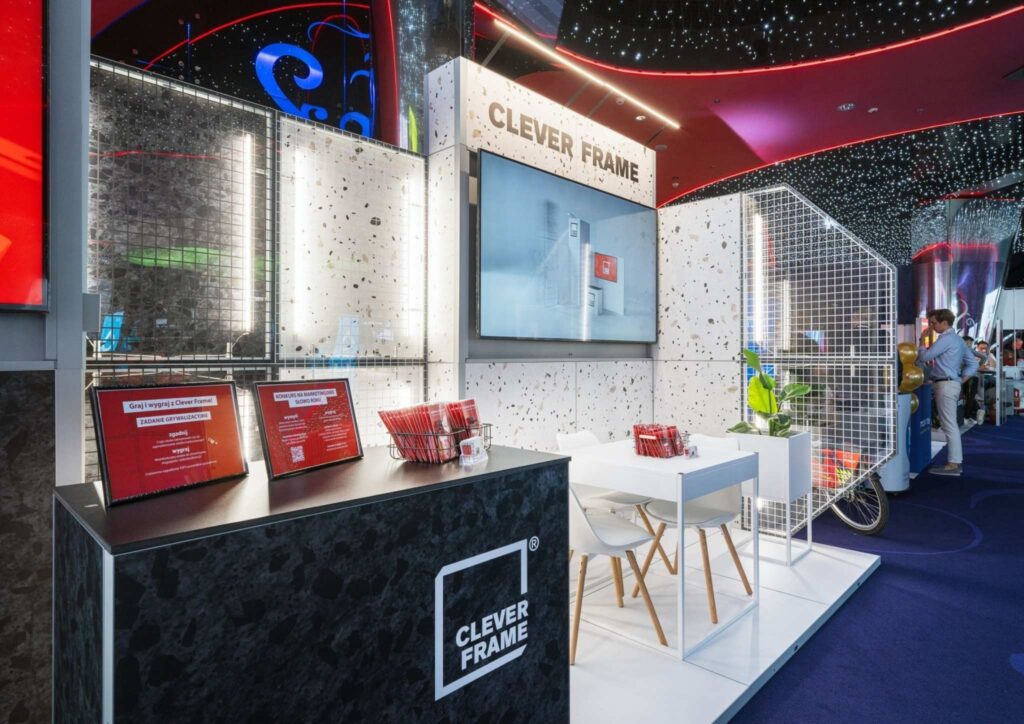
Stand graphics should be designed for rapid comprehension: one main message, a clear information hierarchy, and a visual element that stops the eye from a greater distance. In practice this means less content, but better structure – one that allows a visitor to understand in a few seconds what the brand does and why it is worth coming closer.
Within Clever Frame solutions, graphics function as an element that can be easily updated between events, because the panels are mounted using magnetic tape. This allows the messaging to be adapted to specific trade fairs, campaigns, or products without the need to change the entire stand structure.
“3 seconds” is a mental shorthand: the time a visitor needs to register what the stand is communicating and whether it relates to their needs. The goal is not to convey the entire offer in 3 seconds. The aim is to produce one clear effect: stopping, coming closer, and beginning an interaction.
In this sense, stand graphics serve three functions: they attract the eye and differentiate the brand in the “noise” of the exhibition; they instantly communicate the category and the value; and they direct movement towards the conversation area, the demo zone, or the lead-capture point.
Effective trade fair graphics follow from what the brand wants to achieve at a given event. A stand aimed at lead generation is designed differently from one focused on a product launch, and differently again from one intended to reinforce recognisability. Clever Frame modular exhibition stands make it easier to maintain consistency while allowing communication accents to be changed without rebuilding the entire display.
Before designing the graphics, it is worth establishing a simple set of priorities. This helps to shorten the message and avoid “information wallpaper”. The three questions to answer are: who the offer is for, and how that person will recognise that the stand is “for them”; what the one most important benefit or differentiator is to be remembered; and what the next step is after stopping – a conversation, a demo, a sign-up, or downloading materials.
In practice, three levels of communication work well – legible from different distances. At a trade fair, several brands are often visible simultaneously, which is why hierarchy is more important than the volume of information.
This is the element that needs to work while the visitor is moving, passing the stand. It should be brief, unambiguous, and anchored in the category context. What matters most in this layer is a short headline that states what the brand does or what value it delivers; strong contrast and large typography, legible from a distance; and minimal detail, which disappears in the crowd and the lighting of the hall.
When the visitor approaches, they need a reason to stay longer. Short benefit lists, icons, and elements that structure the offer work well here. In practice, three to five value points described in benefit language perform well, alongside a simple distinction between offer segments without elaborate tables, and clear indication of what can be seen or tested on-site.
The third level consists of supporting content: information that aids the conversation with the stand team but does not need to “shout” at passers-by. It is worth placing this in zones where guests naturally pause. Short case studies or application examples in condensed form are particularly useful here, as are QR codes linking to details, and elements that help qualify conversations – for example, indicating relevant industries or implementation scenarios.
In exhibition stand design, what matters is not only aesthetics but also directing movement. Graphics should signal where to approach and where interaction begins. In a modular structure, the layout can be planned so that the key message is visible from the main traffic flow, and the deepening elements are positioned closer to the conversation zones.
It is worth thinking of graphics as a map: the most important message in the sightline of someone walking along the aisle; clear visual “anchors” that can be remembered after a single glance; and legible separation of zones – informational, presentation, and conversation.
At trade fairs, it is often not the brand with the weaker offer that loses, but the one that cannot be “read” on the move. That is why simplification is so valuable. Consistency does not mean the entire surface needs to be in the brand colour. It means that elements are predictable: headlines, icons, photographs, and calls to action all look like a single story.
Before sending files to production, it is worth running a short check. This reduces the risk of the finished structure looking good only “on screen”. In practice, check: whether headlines are legible from a distance and do not disappear against photographic backgrounds; whether a single main font and consistent styles have been used, with no random mixing; whether photographs support the message rather than acting purely as decoration; whether a clear hierarchy is visible – what is first, second, and third to be read; and whether the number of elements does not compete for attention in the same area.
In the traditional view, trade fair graphics are often “attached” to a single event. With a modular approach, it is worth planning them as a set of messages that can change depending on the objective, the market, and the season. Clever Frame exhibition stands allow layouts to be expanded and modified, and assembly and disassembly take place without tools. As a result, the same structure can work across many events, and only what should change does change: the message.
In a trade fair marketing calendar, needs change dynamically: a launch, a seasonal campaign, a new product feature, different personas at a different event. That is precisely why graphics need to be interchangeable and planned in cycles.
In Clever Frame exhibition stands, graphic panels mounted using magnetic tape allow easy replacement of visual communications, adapting them to seasonal campaigns or changing marketing needs. This solution supports brand consistency while allowing the message to be quickly updated without rebuilding the entire structure.
In the context of sustainable development, the greatest impact comes from reducing one-off builds. Modular stands that can be used repeatedly support an approach based on a longer display lifecycle and on managing changes in a controlled way.
In practice, this helps achieve several organisational and environmental goals: fewer single-use elements produced for a single event; easier communication refreshing through the replacement of graphic panels rather than building from scratch; and transport space savings thanks to the thoughtfully designed modular structure.
In event marketing, repeatability and the ability to scale matter. A modular structure makes it possible to plan participation in successive events in a way that uses the same base and adapts it to the current objective. This shifts the cost perspective: the greatest value lies in the ability to modify and expand, rather than in a one-off build. Particularly worth bearing in mind are the ability to use the same structure at different events; the ability to expand and modify layouts depending on floor area and location; and the shorter preparation time thanks to assembly and disassembly that often requires no tools.
When designing panels and the layout of messages, it is worth thinking more broadly than a single event. The same elements can support activities in other formats when the layout and content are planned modularly. Clever Frame exhibition stands can also be used as structures for industry events and partner meetings; temporary display in a showroom or company headquarters; and roadshows where mobility and a repeatable presentation standard matter.
The best exhibition graphic designs combine message discipline with execution flexibility. Here is a set of principles that help translate this into practice: start from the event objective and one key brand promise; design three layers of information – from a distance, close up, and in conversation; build a clear typography and contrast hierarchy without overload; plan the graphics as a set of elements for updating rather than a one-off composition; and make use of the ability to replace graphic panels quickly, enabling messaging to be easily adapted to seasonal campaigns or changing marketing needs.
If you want to plan your trade fair graphics in the logic of “3 seconds” and prepare a set of panels for rotation between events, Clever Frame will help you choose the stand configuration and the scope of interchangeable graphic panels suited to your objectives.