
A shared booth for two brands can work like a well-designed partner campaign: it strengthens the message, shares costs, and expands reach, but only when it is strategically aligned and clear to visitors. At trade shows, there is no time to guess who is who and what each company actually offers. That is why, in co-branding, the key factors are a clear division of roles, a shared objective, and an exhibition design that organizes the visitor experience.
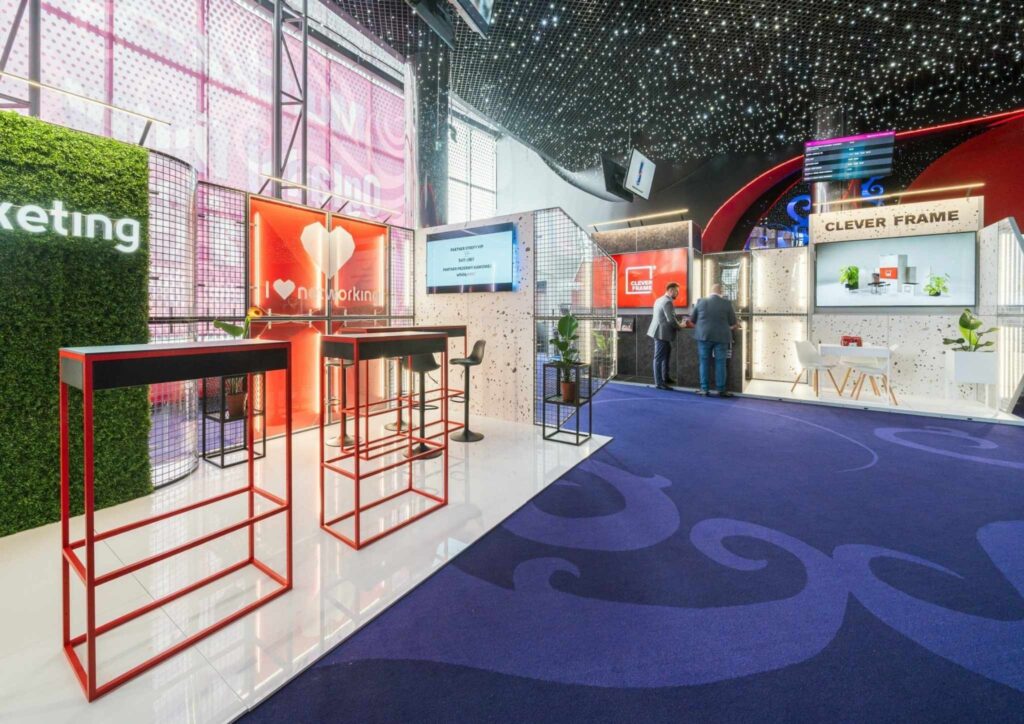
Clever Frame trade show booths, based on modular solutions, make it easier to create a shared space for two brands in a flexible way that can be quickly modified between events. Below is a practical guide, from strategy and layout to graphics, logistics, and long-term efficiency.
Trade show co-branding is the shared presence of two brands within one exhibition space, planned so that visitors quickly understand the relationship between the partners and the benefit of their cooperation. This type of presence should not be treated as simply “sharing square meters,” but as an event marketing tool. It can increase credibility, make lead generation easier, and help tell an end-to-end story.
The best results are achieved when the cooperation is natural and clearly visible in the offer. In practice, co-branding works especially well when:
A shared exhibition can strengthen the message, but it can also blur the identity of both brands. The most common problem is the lack of a clear communication scenario: the visitor sees two visual identities, but does not know how to connect them. The second type of risk concerns logistics: who is responsible for which part of the booth and its operation.
It is worth defining rules already at the planning stage to organize both the design and the operations. In practice, a simple checklist of agreements works well:
In co-branding, the most important thing is to design the booth as a path: the visitor enters, understands the subject, reaches the right zone, and leaves with a clear conclusion about who is responsible for what. Modular construction makes it possible to build a layout that maintains communication order and at the same time is easy to adapt to different floor areas and organizer requirements.
The choice of layout depends on whether the brands are equal or whether one acts as the “main solution” and the other is a supporting partner. The three most common models are:
Well-planned zones are the best antidote to chaos. Instead of multiplying attractions, it is better to rely on clear spatial roles and intuitive navigation. In practice, it is worth considering:
The biggest challenge of co-branding is balance: two visual identities cannot compete with each other. The graphic design should support the shared message and at the same time make it possible to quickly recognize which brand is responsible for a given area.
An effective pattern is one headline promise shared by both brands, followed by two “proofs” in the form of benefits or functions assigned to each brand. In practice, it is worth following these rules:
In a trade show calendar, the communication objective is rarely identical every time. Sometimes the priority is a new product, sometimes a seasonal campaign, and sometimes a different target group. A well-designed exhibition makes it possible to update communication easily between events, without creating everything from scratch.
In Clever Frame trade show booths, panels mounted with magnetic tape can be replaced easily, allowing communication to be adapted to seasonal campaigns or changing marketing needs. In co-branding, this means it is possible to shift the balance of communication quickly, for example when Brand A dominates at one trade show and Brand B at the next.
A shared booth often has to “perform” at different events: sometimes on a larger floor area, sometimes with a different traffic layout, and sometimes in a different themed zone. A modular structure makes it possible to plan the exhibition as a set of frames and connectors that can be configured as needed without losing visual consistency.
In practice, this gives marketing and event teams several important operational benefits:
A shared exhibition can be more sustainable if it is designed from the start as a reusable solution. From both an environmental and organizational perspective, the biggest difference comes from reducing one-off elements and building resources that return to use in future seasons.
In co-branding, design decisions that reduce the need for frequent “new builds” and make it easier to update the communication itself work especially well. It is worth taking into account:
A shared booth naturally makes it possible to spread the cost of trade show presence across partners, but real budget efficiency depends on whether the exhibition will work beyond one event. In a modular approach, the key factor is the ability to reconfigure and reuse the setup. That is what limits the need to build new solutions from scratch whenever the plan changes.
It is worth viewing the investment as an asset that supports a cycle of events. From the perspective of marketing managers and event managers, the biggest benefits come from:
Co-branding often goes beyond classic trade shows, especially when partners develop joint sales or educational activities. A modular structure makes it easier to transfer the same narrative into other event formats without having to build a new setup every time.
Clever Frame trade show booths can also be used in contexts such as:
The list below organizes the most important steps that help move from concept to effective execution. In practice, it is worth:
If you are planning a shared booth for two brands, Clever Frame can help select the right modular configuration and define the rules for zone division and graphic panels so that the message remains clear and the exhibition is easy to update between events.