
Participation in trade fairs and industry events is increasingly starting to resemble the management of a project portfolio: one time a compact setup is needed for a local event, another time a larger display for the biggest trade fair of the year. For many companies, the challenge is finding a balance between marketing ambitions and limitations in budget, time, and operational resources. In this context, the Booth-as-a-Service (BaaS) model and so-called hybrid rental are beginning to sound like a sensible alternative to one-off executions.
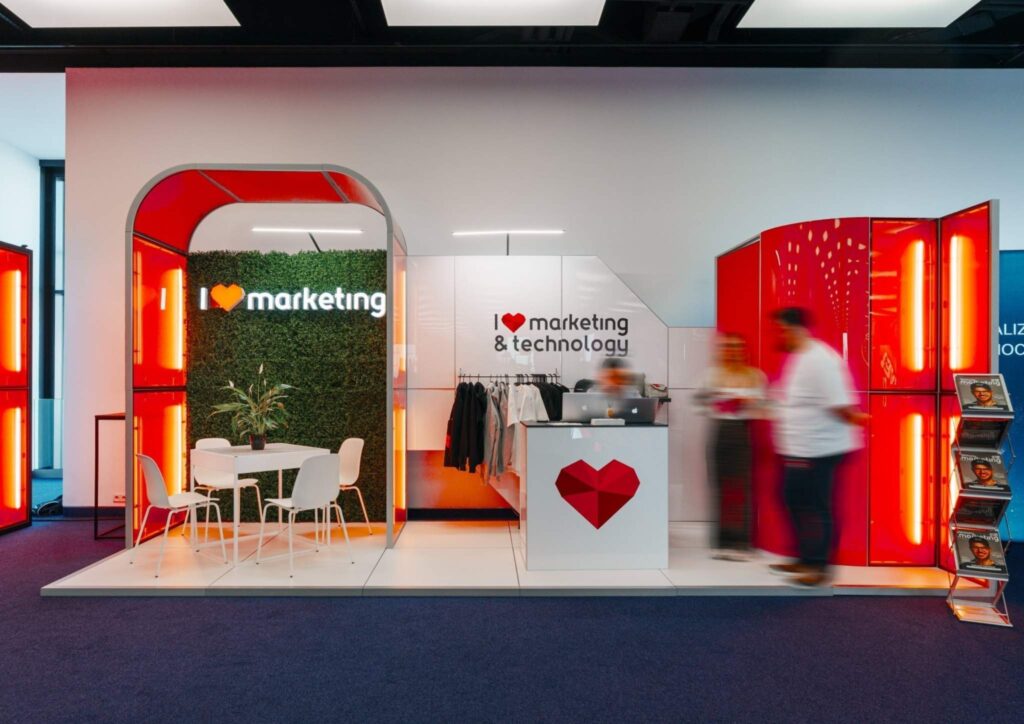
In practice, BaaS shifts the way of thinking about a stand from a “one-off project” to a “service” that supports event marketing goals, while hybrid rental makes it possible to combine flexibility with predictability and repeated use of modular elements. Below is a practical look at how to approach this in a business context and what role Clever Frame trade fair stands can play.
Booth-as-a-Service (BaaS) is an approach in which a trade fair stand is treated not as a one-time execution, but as a repeatable marketing tool used at subsequent events. Instead of designing and building a display from scratch every time, the brand works with a modular base that can be configured and adapted to different events, campaigns, or product launches.
In a service-based model, the organizational burden shifts from months of “building from scratch” to managing configuration and communication. As a result, event activities can better support sales and branding goals. In practice, this means:
Hybrid rental can be understood as a mix of solutions in which a brand benefits from rental flexibility while at the same time building a stable base of repeatable display elements. In practice, this means a “fit and scale” approach instead of “design and discard.” In this model, Clever Frame trade fair stands work particularly well because their modular structure makes reconfiguration easier, while assembly and disassembly take place without the use of tools.
In many companies, sales and marketing activities run in parallel with many other projects. For that reason, organizing a presence at trade fairs is not only about the look of the stand, but also about process predictability, efficient logistics, and the ability to reuse proven solutions across different events.
Instead of increasing the number of activities, many companies are looking for ways to execute the same activities more efficiently and in a more consistent way. The most common bottlenecks include:
The BaaS model and hybrid rental support standardization and repeatability. As a result, the team can focus on the quality of conversations and the achievement of objectives, rather than putting out production and logistics fires. In the case of modular stands, the key benefit is that configurations can be modified, expanded, and adapted to further events without starting from zero every time.
Hybrid rental makes sense when the structure itself allows a flexible shift between formats and event goals. Clever Frame trade fair stands are designed with modularity, mobility, and repeatable use of elements across multiple executions in mind.
In practice, modularity means the ability to build different layouts from repeatable elements. The same base can work as a compact stand at a local event or be expanded into a larger display when needs and the scale of activity grow.
In hybrid planning, it is especially useful to think of the stand as a set of building blocks that make it possible to arrange different display scenarios. This makes it easier to adapt to:
In event marketing, communication can change quickly: seasonal campaigns, new products, new customer segments, and new slogans. That is exactly why it matters that booth graphics can be updated without complicating the whole preparation process.
In Clever Frame trade fair stands, graphic panels can be easily replaced, adapting the visual communication to seasonal campaigns or changing marketing needs. This approach supports brand consistency because the structure of the stand remains the same, while the message can be updated in step with marketing activities.
For SMEs, what matters is not only the visual effect, but also whether the stand can be handled efficiently. In this context, the following are especially important:
A stand is a medium of brand communication, not just a backdrop for meetings. In the BaaS and hybrid rental model, the priority is to create a repeatable, recognizable space that supports marketing goals at different events.
In practice, the most effective displays are those that are clear, consistent, and adapted to visitor behavior. Instead of random elements, it is worth taking care of a logical communication layout that includes:
Booth design does not have to mean creating complex one-off structures. In a hybrid model, the best solutions are those that create a custom feel while remaining modular and practical. A good direction is to plan a base configuration that can change depending on the event, without losing consistency.
It is worth considering an approach in which:
From the perspective of responsible marketing, reducing one-off materials and activities that generate waste is increasingly important. A modular approach to stands supports a longer lifecycle of the structure and reuse of the same elements across multiple events.
In practice, a more sustainable direction is supported by:
When it comes to costs, it is worth avoiding oversimplification. Hybrid rental will not always be the best choice for every company, but in many cases it makes it possible to match spending more effectively to the real frequency of events and the variability of needs.
The decision should come from the event calendar, marketing goals, and how often communication changes. Hybrid rental is often particularly well suited when:
Effective planning begins with creating a “use-case map” for one booth base. The more events that can be supported by the same structure, the more sense the hybrid model makes. In practice, it is worth planning:
One of the biggest advantages of the BaaS approach is the possibility of using the same structure in different contexts. For SMEs, this means that a single prepared base can support marketing across many customer touchpoints.
Clever Frame trade fair stands can also be used as:
Hybrid rental within a Booth-as-a-Service approach can be a practical direction for SMEs that want to scale event activities without losing consistency and control over communication. The value of this model grows when the stand is modular, easy to handle, and suitable for repeated use.
The most important conclusions in one place:
If you want to assess whether a hybrid approach makes sense in your event calendar, including configurations, graphic panels, logistics, and repeatability, Clever Frame can help choose a modular booth base and expansion scenarios for different events.