
Events rarely take place under fixed conditions. Venues change, floor plans shift, organizers’ goals evolve, attendee profiles vary, and the industry context changes from one event to the next. At the same time, your brand should remain recognizable and consistent, with the same style, communication language, and value promise. In practice, the challenge is not just “being visible,” but maintaining one message across multiple formats without visual chaos and without rebuilding your exhibit from scratch every time.
The modular construction of Clever Frame trade show booths makes it possible to adapt the layout flexibly to different events and scenarios. Halls change, booth sizes vary, and visitor traffic behaves differently, yet the core of the brand identity remains consistent because the same elements can be reused and combined into different builds. As a result, the booth stays functional while allowing the message to be adjusted to different event contexts.
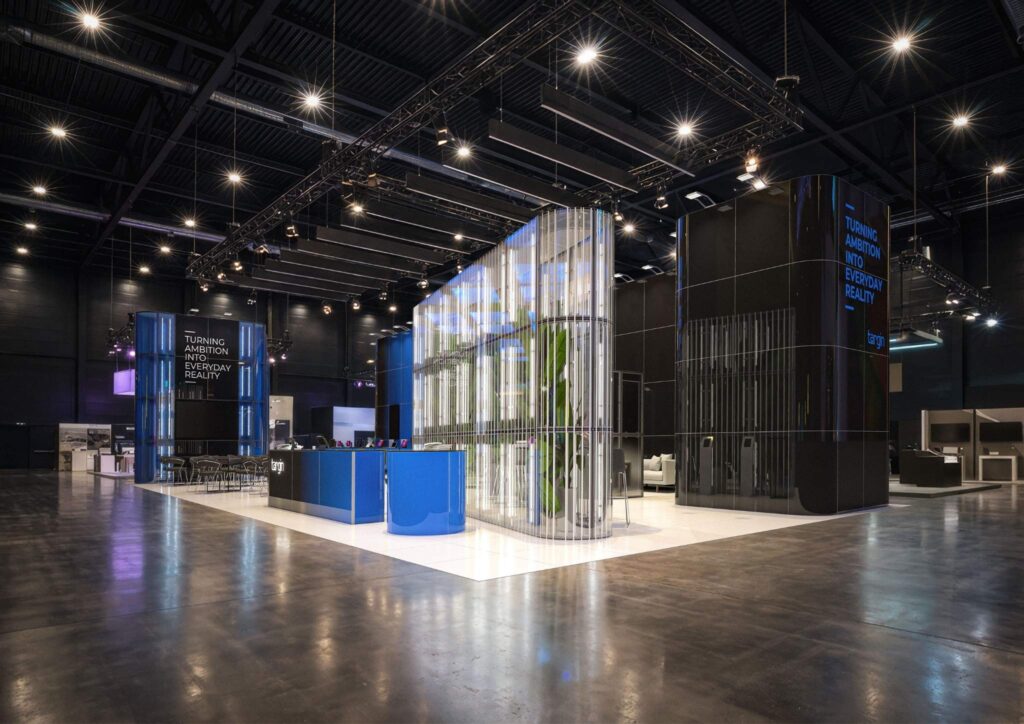
Brand consistency at events is the ability to maintain recognizable identity elements and a unified message regardless of location, format, and audience. It is not just a logo on a panel, but consistency in the way the product is presented, in the selection of key messages, and in the design of the visitor experience.
Even a well-defined brand can become fragmented at events when each project is created ad hoc and successive executions follow different standards. Typical causes include:
A brand may appear differently at a technology event, a medical trade show, or a meeting for business partners. Consistency means that these differences are intentional and controlled. The booth may look different every time because the same set of modular elements can be configured freely, with zone layouts adjusted to the needs of a given event. In practice, it helps to think of the booth as a combination of fixed foundations and flexible layers: the identity remains unchanged, while the messages adapt to the context.
Clever Frame trade show booths are designed so that one investment can work in many configurations. This means the brand does not have to start from an empty space every time. Modularity supports consistency because it helps maintain the same proportions, structural rhythm, and key communication points while still allowing the layout to change for a specific event.
In practice, flexibility means the ability to build different layouts from the same frames and structural components. The same base can be used at events with different floor space and different visitor flow. The key is to preserve the brand “anchors” in every version, meaning the repeatable elements that visitors recognize immediately.
These anchors most often include:
These “anchors” make it possible for the booth to change its layout and appearance depending on the event, while the brand remains recognizable and consistent – notes Maciej Czarnecki, Design Director at Clever Frame.
Brand consistency at events also depends on repeatable execution. If installation is complicated, the risk of mistakes grows, affecting both appearance and perceived quality. In the case of Clever Frame trade show booths, assembly and disassembly are tool-free, making it easier to maintain a consistent execution standard and reducing the need for improvisation on-site.
The same solution may appeal to different industries with different needs and different benefit language. Consistency does not require saying everything to everyone, but maintaining the same communication logic: who the brand is, what problem it solves, and why it can be trusted.
When planning event content, it helps to divide communication into two layers. The fixed layer builds recognition, while the flexible one responds to the context and goal of the event.
A practical structure may look like this:
In many industries, messages change more often than the brand strategy itself. Seasonal campaigns, new features, an offer refresh, or new audience segments all require updates to the visual layer without replacing the entire booth build.
In Clever Frame trade show booths, graphic panels can be easily removed and attached using magnetic tape mounting. This makes it possible to keep the same layout and proportions of the exhibit while quickly updating industry-specific and marketing content to match the needs of a given event.
Adapting to an industry does not have to mean building a new identity. Very often, it is enough to change the set of arguments and use cases while keeping the same brand pillars. Below are sample directions for differentiating communication without losing consistency.
The booth is a medium that translates brand strategy into participant experience. A well-designed exhibit not only looks consistent, but above all supports specific actions, from conversations and presentations to lead qualification and stronger brand recognition after the event.
It is easier to maintain a consistent message when the booth has a clear functional layout. Instead of adding more messages, it is better to plan the visitor journey: from catching attention, through understanding the offer, to making contact with the team.
In practice, it helps when each zone has a clear role:
Consistency in identity and exhibit quality is part of credibility. If a brand looks like an organized, confident player at one trade show and like a random composition at another, audiences notice the disconnect. A modular booth supports repeatable standards, while the ability to expand and modify layouts makes it easier to adapt to organizer requirements without losing the brand’s DNA.
Brand consistency increasingly relates not only to communication, but also to practices. In event marketing, this matters because events generate waste and require transport. A modular approach helps reduce one-off executions, since the same booth can be reused multiple times.
From a sustainability perspective, the most important elements are:
Maintaining one exhibit standard across different industries often means fewer exceptions, fewer last-minute decisions, and better control over resources. Clever Frame modular trade show booths support this approach because they allow expansion and modifications without redesigning the entire booth from scratch for each event. The same set of elements can create hundreds of different exhibit versions.
In practice, efficiency increases when:
Brand consistency is built across many touchpoints, not only in exhibition halls. A modular approach makes it easier to use exhibit elements in other formats where control over communication and aesthetics matters.
Clever Frame trade show booths can also be useful as:
Consistent branding at events is the result of a process, not a one-off project. To keep one message while adapting it to different contexts, it helps to rely on a repeatable booth system, a clear communication structure, and easy updates to the graphic layer.
If you want to organize brand consistency across events while preparing communication variants for different industries, talk to the Clever Frame team. We can help you design a “core + layers” model for your messaging and choose booth configurations that can scale from one event to the next without losing recognizability.