
Events offer something that is hard to overvalue in brand communication: authentic context, people in action, and natural opportunities for conversations and solution demos. The problem begins when the booth works great on site, but after the event all that remains is a handful of random photos and a few short stories with no coherent narrative. For a booth to become a true “content machine,” you need a plan rather than improvisation – and a booth structure that supports content production in a predictable way.
This guide shows how to design photo, video and short-form content from a single event so you can make the most of your team’s time and the full potential of your trade show booth. The tips in this article work especially well with Clever Frame trade show booths – modular, easy to assemble and dismantle without tools, mobile, and ready for frequent communication updates thanks to replaceable graphic panels. The Clever Frame system makes it easy to adapt the booth to the character of the event and the needs of your team, creating a functional and consistent work environment no matter how often you change the layout.
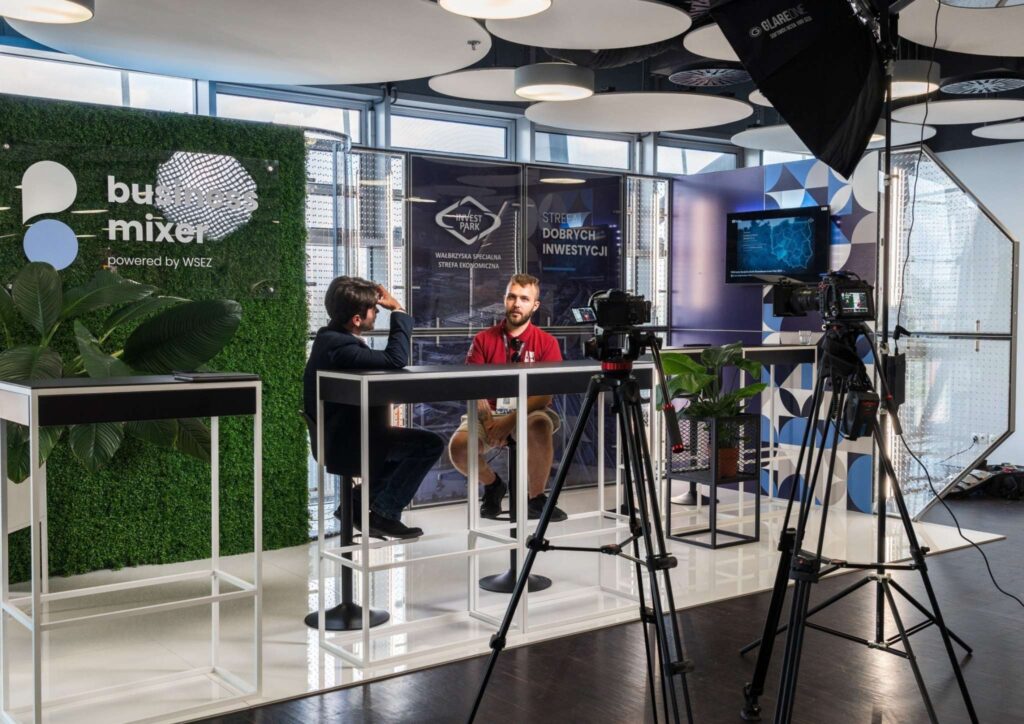
A booth is not just a meeting point. For marketing, it is a production set, a message distribution point, and a tool for building brand credibility through experience. In practice, event content should meet three needs: extend reach, strengthen brand perception, and provide assets for longer-term use such as ads, newsletters, sales presentations, and landing pages.
Clever Frame trade show booths can make content production easier because their modular structure allows you to plan recurring camera angles in advance and then repeat them across future events. This is especially important when a brand wants to build a recognizable visual language and publish content regularly in a similar format.
If a booth is meant to be a source of strong content, it has to provide predictable shots: fixed recording points, a clear background, and a layout that can be repeated at future events. Then content is no longer a matter of chance, but the result of a process – Maciej Czarnecki, Design Director.
The biggest time-saver comes from one simple rule: first the publishing plan, then the shot list, and only then the filming schedule. This way, the team does not collect random materials, but instead “recreates” formats designed in advance.
At a strategic level, it makes sense to assign content to specific marketing outcomes upfront. A practical way to do this is to divide it into three categories:
It is worth planning a content set that can be repurposed across multiple channels without additional filming. A sample structure of assets from one event might look like this:
Your shot list should result from what the booth communicates and how it directs traffic. With a modular booth structure, it is easier to predict recurring shots and fixed backgrounds in advance. This is the right moment to define:
Event content looks professional when the shots are consistent, the background is clear, and the messages are easy to understand. That is why the booth should be treated like a set design that can be deliberately arranged for specific formats.
Consistency in communication grows when a brand has recognizable shots: a similar layout, a similar background, and a similar speaking position. Clever Frame trade show booths allow you to expand and modify configurations, which makes it possible to:
In marketing practice, campaigns change faster than logistics. That is why it matters that booth communication can be updated without complicated replacement of structural elements.
In Clever Frame trade show booths, the system of interchangeable graphic panels allows messages to be changed quickly. Thanks to this, one booth layout can be used to create content for different product lines, segments, or markets while maintaining consistency in the visuals.
Event content often runs into logistical limits: restricted setup time, long travel, and poor working conditions. If you plan to produce content regularly, it makes sense to choose solutions that reduce operational friction. In this context, the following are key:
Shorts work best when planned as a series: each clip should have one idea and one leading shot, and the whole set should form a coherent package. A good practice is to work in 30-45 minute blocks rather than filming continuously throughout the day.
To standardize production, it helps to stick to a repeatable structure:
The most effective shorts are the ones that come from real event conversations. To avoid improvisation, you can prepare a topic list in advance and then match it during the event to the questions attendees actually ask:
Event marketing works when the brand experience is clear and repeatable. Event assets should show not only presence, but also the quality of conversations, the expertise of the team, and consistency in communication.
It is worth planning event photography so that you end up with a package suitable for multiple uses: PR, social media, website, and sales presentations. A minimum package that usually covers marketing needs includes:
One or two short horizontal videos can become central assets from which additional formats are created. To make that possible, it is worth ensuring:
Event content is increasingly judged through the lens of brand responsibility. In the context of trade show booths, what matters is whether the structure is disposable or whether it can be reused multiple times while only updating the communication where needed.
Clever Frame trade show booths can support a more sustainable approach through the possibility of reusing the same booth structure at different events and modifying the layout depending on the need. In addition, the system of interchangeable graphic panels makes it easier to update messages, helping reduce the need to produce completely new exhibition elements every time the communication changes.
The effectiveness of an event rarely depends only on the number of on-site conversations. What matters is how long the event keeps working after it ends, and whether the resulting assets can be used across multiple channels. Well-planned content turns a one-time event expense into a longer stream of value.
In practice, the biggest savings come from standardization enabled by modular booth structures: the same shot layout, a similar shot plan, and a similar preparation process. This shortens the team’s workload before each next event and makes it easier to scale your presence at trade shows, events, and roadshows.
To increase the return on investment in the booth structure, it is worth thinking beyond the trade show calendar. Clever Frame trade show booths can also support other marketing activities where a consistent setup and predictable shots are needed.
Examples of how the booth can work as a “content set” include:
For a booth to work like a “content machine,” three elements are needed: a designed set of formats, predictable set design, and a simple production process. In practice, it is worth remembering these rules:
If you want, we can prepare a ready-made “event content pack” for your brand: a shot list, short-form scripts, a recording-zone plan for the booth, and a set of campaign graphic panels. This way, at your next event, you will gather enough material for weeks of publishing, not just one day. Contact Clever Frame and describe your event format and communication goals.